Steve Jobs: Leader or Boss? The Myth That Destroys the "Good Leader" Hype“
Have you ever seen that tired meme that constantly goes around LinkedIn? The poorly drawn one, where the figures of the "Boss" and the "Leader" are compared. In drawing, The Boss is a tyrant sitting at his desk, whipping his employees as they pull a sled; the Leader, on the other hand, is in the front row, smiling, pulling the rope with his team.
It's the classic comfort food A cognitive tool for frustrated managers. A reassuring tale that reduces complex corporate culture to a nursery school framework: if you're good and kind, you're a leader; if you demand things, you're a bad boss.
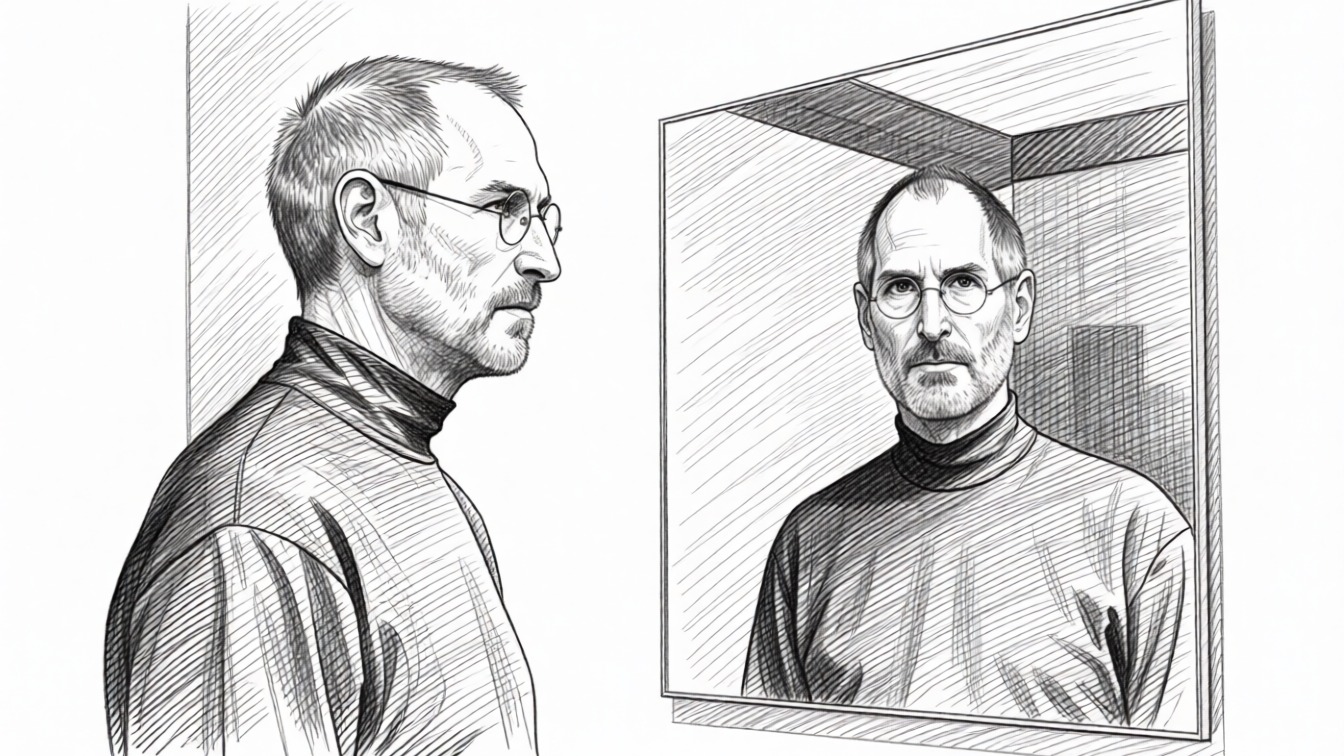
But then reality knocks on the door. And reality often takes the form of a thin man, wearing a black turtleneck and a hellish character.
The never-ending debate on Steve Jobs is a classic of management literature for this very reason: because his figure shatters that reassuring binomial of self-satisfied HR. To understand whether Jobs was a bastard boss or a saintly leader, you have to stop looking at memes and start distinguishing between two different things: his relational method and his inspirational impact.
The ruthless autocrat
If we look at traditional definitions in HR manuals, Jobs embodied the worst of hierarchical despotism on a daily basis. There's no point in beating around the bush or sugarcoating the pill with the usual rhetoric of the misunderstood genius: the man used authority in a brutal way. Testimonies about Jobs, in fact, describe a tough, controlling, and often aggressive management style, capable of combining high-minded vision with extremely unpleasant behavior.
Anyone who has frequented his creative workshop has encountered three frightening traits:
- The feedback sharp: Jobs didn't use the "sandwich" technique so popular in corporate leadership courses. He could demolish an engineer's months of work with a cold: “This is rubbish”. End.
- Obsessive micromanagement: So much for delegation and team autonomy. Jobs delved into the most insignificant details, like the precise shade of gray on a computer's internal keys or the invisible curvature of an aluminum case.
- The climate of psychological pressure: His irritability created an environment of constant tension. In the corridors of Cupertino, the fear of failure was not an abstract stimulus, it was a physical presence.
If any manager behaved like this today, he or she would be charged with mobbing within twenty minutes. And yet, thousands of people worked beyond their biological limits for him. Why?
The distortion field
The answer lies in the fact that Jobs, at the same time, put the best of the transformative leadership. People didn't work their backs off for twelve hours a day just because they were afraid of being fired; they did it because they had been sucked into a vision bigger than themselves. Management literature often describes it as a transformational leader: creative, passionate, visionary, capable of inspiring a strong sense of purpose.
First of all, Jobs didn't sell circuit boards or silicon: he was selling the “why”. He didn't hire you to optimize a process, but he offered you the opportunity to scratch the universe. This higher purpose is the ultimate magnet for true talent.
Secondly, there was the infamous Reality Distortion Field. Jobs was a magician who could convince you that the impossible could be achieved in three weeks. A banal boss orders you to work overtime on Saturday mornings; A true leader convinces you that by staying in the lab on weekends you are literally building the future..
Finally, his was not simply arrogance for its own sake. It was an almost religious devotion to beauty and perfection. A search for beauty as a form of resistance to mediocrity.
Consistency versus sympathy
Today many sociologists and observers classify it as a transformational leader. But forget the “Servant Leader” who worries whether you breathed deeply enough during your lunch break to preserve your work-life balance. Jobs cared less than zero about the team's physical and mental well-being. At the center of his world were not people: there were the product and the vision.
His secret has never been kindness, but the absolute coherence between what he asked for and the final objective. People did not follow him because he was good; they followed him because, by being with him, they felt part of an epic. And this is a fundamental distinction, because it explains why leadership does not automatically coincide with sympathy.
Jobs has demonstrated, cynically and irrefutably, that one can be a leader even if one is rough, unpleasant and tiring, provided one has a vision so powerful that it justifies the sacrifice required. He was a man who sought harmony in the final result, even at the cost of creating a profound dissonance in the human process.
The inconvenient truth
Labelling him only as a “bad boss” would be reductive given the cultural impact he has left on the planet; but elevating him to a “good leader” according to the canons of modern corporate bullshit would be a philological error. Jobs wasn't the motivational saint popular at provincial workshops, nor was he just the caricatured tyrant who simplifies everything.
It was, much more simply, a brutal catalyst of beauty. A man who took silicon and forced us to search within ourselves for an emotion.
Q&A on Steve Jobs
Was Steve Jobs a good boss?
No, not in the reassuring sense that HR manuals like. It was often tough, controlling and confrontational.
Was Steve Jobs a leader?
Yes, if by leadership we mean vision, ability to inspire and obsession with a goal bigger than immediate consensus.
So can you be a leader without being kind?
Yes. Jobs shows just that: leadership can be powerful even when it's rough, as long as it is coherent, visionary and capable of drawing people into a higher meaning.
The agenda remains open, coffee is on the table. And we continue to create, strictly outside the box.
“I seek beauty everywhere. And if I don't find it, I create it.”

Digital creative, musician, and storyteller. I explore the intersection of humanity and technology, telling stories of AI, music, and real life. Welcome to my organized mess.”