Richard, why do you keep looking in the wrong direction?
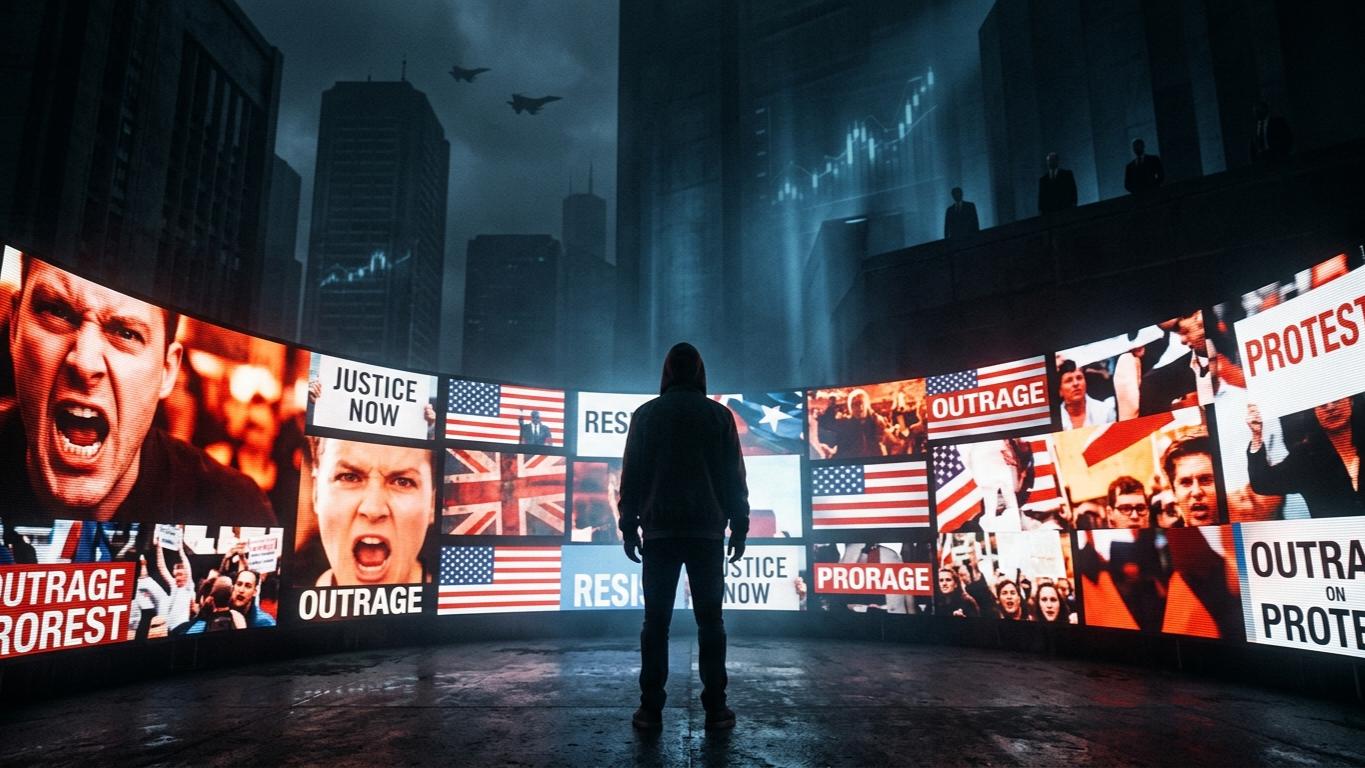
There's a man—let's call him Riccardo—who turns on the phone every evening and gets angry. There's not enough work, prices are rising, a distant war seems to have nothing to do with him. Yet he votes, comments, gets heated. Always in the wrong direction.
A legitimate anger. Real. Absolutely right.
It's a shame that it is always, systematically, directed to the wrong place.
And no, I'm not just talking about some random Riccardo. I'm also talking about myself. And you, reading this. I'm talking about us.
The right anger, the wrong direction
Riccardo works. He struggles. He makes ends meet. He knows full well that the world is going wrong—he feels it every time he goes grocery shopping, every time he opens his paycheck, every time he thinks about his children's future.
But when you ask him who's responsible, he doesn't look up.
He looks sideways. At those who have even less than him.
It's one of history's oldest and most tried-and-true mechanisms: anger from below is diverted downward, while those above remain safe. They call it the scapegoat mechanism—a target is identified on which to unload social resentment, carefully avoiding facing real responsibilities. No conspiracy is needed, no direction is needed. All it takes is stoking the right fear, at the right time, through the right channels. Riccardo will do the rest on his own, for free, with conviction.
Who tells you where to look?
And this is where the real question comes in. Not "who's right"—everyone says that. The question is: Who has an interest in keeping you busy?
Who benefits from your not looking up?
The populist politician does his part. He doesn't govern: he orchestrates attention. He shows you the small, visible, everyday enemy. He talks about invasion, degradation, substitution, betrayal. But always without naming the core of the problem. His job is to transform economic frustration into wounded identity. Anger becomes belonging. Belonging becomes a vote. The vote becomes power—for those who were already at the top.
The system doesn't censor you. It just offers you more convenient targets.
The anger factory
Three gears, working together for decades.
The first is the populist politician. His art isn't governing—it's pointing out the enemy. Trump, Le Pen, Wilders, Salvini, the new Radev: different stories, same playbook. The enemy is always small, visible, easily hated. Never powerful, never dangerous to those above. Nuances don't win elections—polarization does. Divide and conquer, the Romans said. It worked then. It works today. It will work tomorrow.
The second is the algorithm. Social media they are not designed to inform you. They're designed to keep you glued to the screen for as long as possible. And anger holds more sway than any other emotion. Polarizing content is rewarded because it generates interactions, shares, and dwell time. Those who sow resentment are pushed to the top. Those who seek dialogue, to the bottom. It's not an accident: it's the business model.
The third is the paradox of voting. We vote, freely, against our own interests. Because we've been convinced—through slogans, fears, and fabricated enemies—that the danger lies beside us, not above us. Not because we're stupid. Because we're human. And humans are afraid. And fear, as we know, is blind.
Who is better not to see?
Who has any interest in Riccardo continuing to get angry with his foreign neighbor instead of looking up?
Let's name names. With numbers.
In 2025, according to the Oxfam report presented in Davos, the billionaires in the world will have exceeded the quota 3.000, with an aggregate wealth of 18.3 trillion dollars. In 2024 alone, their fortunes grew by 2,000 billion — three times faster than the previous year. The richest 1% on the planet owns almost 45% of global net wealth. It's not an anomaly. It's the very structure of the system.
And wealth, as always, needs protection. Not from the poor—they're not scary. It needs the poor to continue hating each other.
The second level comes into play: the large investment funds. The so-called “Big Three” — BlackRock, Vanguard and State Street —are consistently among the major shareholders of the world's largest defense industries. In the shareholder records of Lockheed Martin, Raytheon, and Boeing, the same three names recur with almost touching monotony. These aren't details. They're the geometry of power.
Who finances the wars. Who sells the weapons. Who manages the funds. Who owns the media that reports all this?.
Often, they are the same people.
679 billion reasons not to make peace
In 2024, the world's top 100 arms manufacturers had revenues of 679 billion dollars, with a growth of 5,9% compared to 2023 — the highest level ever recorded by SIPRI. The United States leads the sector with 39 companies in the top 100, for total revenues of 334 billion. The top five companies — Lockheed Martin, RTX, Northrop Grumman, BAE Systems and General Dynamics — alone totaled 213 billion dollars.
It's not a coincidence. It's a business model.
War isn't a failure of the system. For some, it's the system working perfectly.
20,000 children
In Gaza, since October 2023, over 1,000 people have been killed. 20,000 children. More than one every hour, Save the Children certifies. Over 50,000 dead and injured. Thousands still buried under the rubble—uncounted, unmourned, unreported.
“"Collateral victims," the official press releases say. With that bureaucratic coldness that turns a child into a budget item.
Collateral to what, exactly? To what supreme goal is the life of a three-year-old worth it, a child who has never made a choice—not where to be born, nor what war to grow up in?
Here's the question that splits everything:
Would you be happy if a bomb fell on your house tonight, while your children were sleeping?
No? Strange. Because no one asks a child in Gaza that question. The answer comes straight from heaven.
The small sacrifice that no one proposes
There are, in the world, approximately 1,043 companies registered They produce weapons, ammunition, and war components. A microscopic portion of humanity. A mere fraction of 8 billion people.
And yet they would be enough. They would be the knot to untie—if we really wanted to untie something.
But no. We continue to argue among the poor. We continue to build walls between those who have little and those who have nothing. We continue to elect those who promise to defend us from those weaker than us, while those who are stronger than all count their billions in silence, far from the slogans, far from the spotlight, far from the bombs they order dropped.
Mr. Everyone gets indignant every night.
In the wrong place.
War and Power: The Question We Never Ask
The world is spiraling into violence unlike anything we've seen in a century. Prices are rising. Jobs are crumbling. Children are dying—in Gaza, Sudan, Ukraine, wherever someone has decided that that land is worth more than that life.
But those who order bombs are not workers. Those who deregulate labor are not farmers. Those who speculate on the markets are not people trying to feed their children.
These are people we—yes, we—continue to elect, follow, applaud, and defend online with a ferocity we never, ever reserve for those who are truly hurting us.
So, Riccardo — and this time the question is really for me, for you, for whoever is reading:
Why do we keep looking in the wrong direction?
I seek beauty everywhere. And if I don't find it, I create it.
But this time the ugliness is so evident that there is no need to even look for it.
Just look up.

Digital creative, musician, and storyteller. I explore the intersection of humanity and technology, telling stories of AI, music, and real life. Welcome to my organized mess.”