
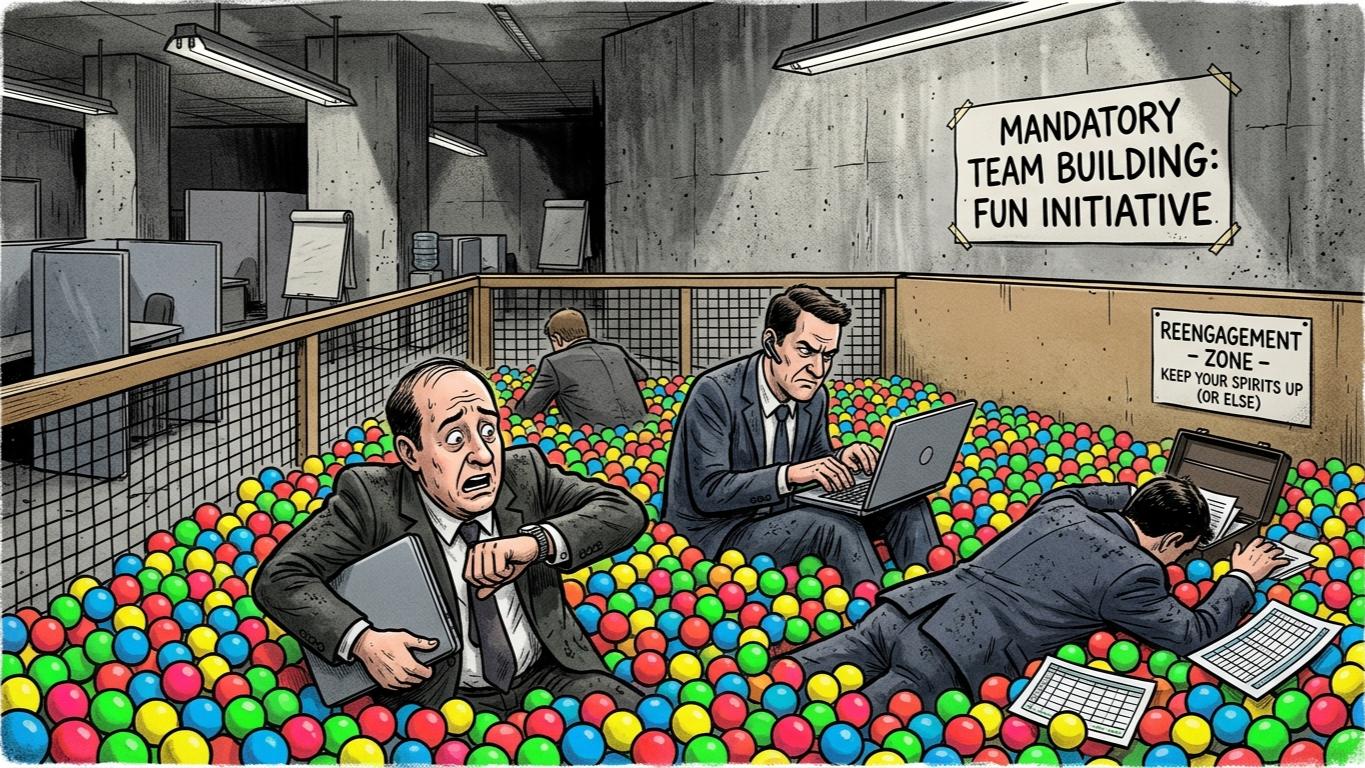
🏗️ Team Building: The Corporate Art of Spending Money to Solve Nothing
Imagine this scene. It's 5:45 PM. You have three deadlines staring you in the face, a colleague who gave you a rude response this morning, a meeting that could have been an email, and a four-day-old technical issue that no one knows how to fix. You're already daydreaming on the couch at home, drinking a beer, your daughter telling you about school, the silence. Then you get an email from the HR manager.
“Remember: we have horse whispering class on Friday afternoon! 🎭 Mandatory for everyone. It will be a great learning experience for the team!” (It actually exists, read below!)
Welcome to corporate team building. Where the solution to everything is: force people to have fun together.
The 40,000 Euro Guru Business
First of all, let's pay tribute to those who really benefit from all this: team building facilitators. Charismatic figures who, armed with colorful post-its, circles of trust, and role-playing games, manage to convince companies to spend considerable sums for a few hours of experiential activity. The corporate training and team building market is worth billions globally, and it's growing.
Not that it's necessarily a crime. But when the company can't manage deadlines, processes are a disaster, and interpersonal relationships are icy, the answer isn't a clown show. It's solving structural problems. Team building isn't therapy. It's, at best, a painkiller.
What Science Says (Yes, It Exists)
In 2021, a research by the University of Sydney analyzed the reactions of employees to the so-called “forced fun” —forced fun in the workplace. The results? When activities are forced, especially in already high-stress environments, the benefits are nullified. Worse, they breed resentment.
The same study highlighted that forcing workers to socialize outside of work, without addressing internal issues, amplifies the feeling of disrespect for their private time and space.
A search for Leadership IQ He found that about half of employees consider team-building activities useless or annoying. Not a minority. Half.
And then there is the concept of boundary violationEveryone draws a line between work and private life. Family day, the mandatory company happy hour, the Friday afternoon theater class—all these things blur that line. For many people, especially introverts or those with family responsibilities, this breach is genuinely stressful, not pleasant.
The Logic of the Enthusiastic Owner
There is a recurring archetype in the Italian corporate world: the owner or manager who has read three American management books, has returned from a leadership course in Barcelona, and is now convinced that the secret to success lies in sense of belonging to the group.
He's not a bad person. Often, he's someone who truly believes it. But he makes a fundamental conceptual error: confuses the symptom with the cure.
If the team isn't working well together, the problem isn't that they haven't done enough clapping circles. The problem probably lies in:
- Poorly defined or absent internal processes
- Toxic vertical communication
- Poorly distributed workloads
- Misaligned expectations between management and employees
- Unresolved interpersonal relationships that no one has the courage to really address
Putting these people doing acrobatics in the woods doesn't solve any of these problems. At most, they'll give you leg cramps.
True Team Building Is Not Organized: It Is Lived
Here comes the serious part, the one that doesn't earn consultants tens of thousands of euros.
Authentic team building is the daily one. It's a manager who defends his team to the CEO instead of passing the blame. It's a company process redesigned so everyone can work better, not just the fastest ones. It's a meeting that ends on time because someone had the courage to say: “this wasn't necessary”.
A company is a small social community. As in any community, not everyone can agree, not everyone can love each other, and that's not even necessary. What's needed is to be able to row in the same direction, even when you look at it askance.
And that shared ability to row isn't built with an afternoon of theater. You build it every day, with mutual respect, clear goals, and a leadership style that knows how to listen as well as lead.
When It Works (Because There Is a When)
It would be dishonest to say that team building is always useless. There are contexts where it really works, and the difference lies in three words: voluntariness, timing, context.
A creative workshop for a team about to tackle a new project, where there's already a positive underlying climate, can really accelerate cohesion. An informal, non-mandatory outing, proposed—not imposed—can strengthen existing relationships. An effective communication course, tailored to the real-world problems of that specific team, can change the dynamics.
The difference with the toxic version? It's not organized. in the place of solve problems. It is organized After having faced them, as a multiplier of something that already exists.
Conclusion (Which Is Not a Conclusion)
If you work in a company where team building is forced upon you while real problems pile up on your desk, know that you're not the problem. Your resistance is rational, not sabotage.
If you're a manager or owner considering investing in team building, before calling the guru with the briefcase of Post-it notes, sit down with your team and ask them what's really holding them back. The answer might surprise you—and cost you a lot less.
And to the gurus of the €40,000 team building event: respect for the business. But every now and then, a little intellectual honesty wouldn't hurt.
“"The true glue of a team can't be bought. It's earned, one day at a time."”
*Whispering to horses: incredible but true, this is also among the team building exercises actually proposed to companies as a technique for learning the effective communication. As the participants of such an event recall, one day one of the horses in the stable got wild and started running toward the group. This event certainly helped strengthen the team's bond: everyone felt united by a single, true, and powerful feeling: that of imminent death.

Digital creative, musician, and storyteller. I explore the intersection of humanity and technology, telling stories of AI, music, and real life. Welcome to my organized mess.”