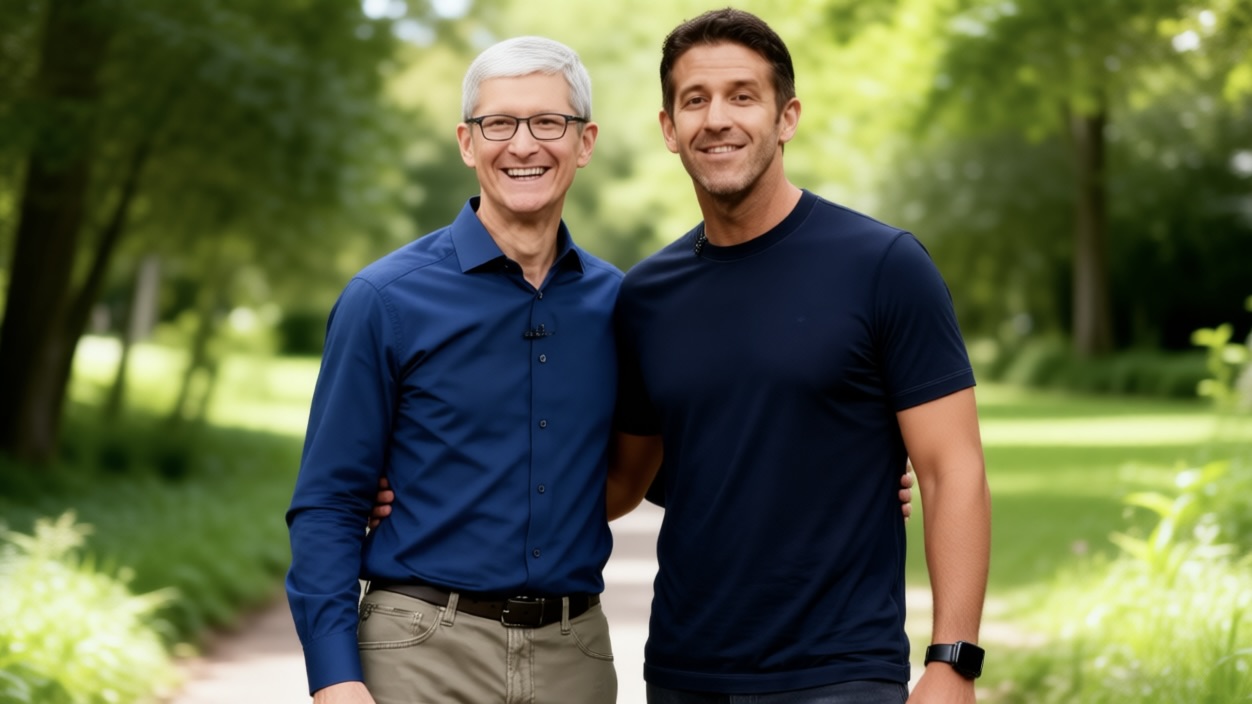
John Ternus.
Say it out loud. John Ternus.
It sounds like the name of a mutant in a movie Marvel Studios, the one with the power to bend metal with his mind or project force fields at enemies. But no: he's Apple's new CEO, effective September 1, 2026. He's guided the company's hardware—iPhone, iPad, Mac, AirPods, the transition to Apple Silicon chips—with the same obsessive discretion that Steve Jobs would have kept a product secret until the morning of its launch. But now he's the face. The name on the official press release.
Would you like to stop with me for a moment before rushing into the future? Because this is the closing of a chapter that deserves to be read in its entirety, not just the last page.
Tim Cook: Fifteen Years of an XXL Apple
Tim Cook became CEO of Apple on August 24, 2011. Steve Jobs had just resigned for health reasons. The tech world was already in early mourning. Many thought Cook was "just" the good operations manager—the one who knew where every screw in every iPhone made in China was—but Surely not the visionary capable of keeping the Cupertino flame alive.
What a wrong. A terrible wrong!
When Cook took the reins, Apple was worth about $350 billion. Today, on the eve of his operational departure, that figure has surpassed 3.7 trillion. Assets have grown from $108 billion in 2011 to over $391 billion in 2024. Under his leadership, Apple Watch, AirPods, Apple Pay, Apple TV+, Apple Music, Apple Vision Pro, and the historic transition to Apple Silicon chips were born. Not bad for someone who “he didn't have the vision“.
But there's one part of this story that I like to tell more than the financial charts.
The Apple and Rights: When the CEO is Worth More than the Company
In 2014, Tim Cook did something rare in the corporate world: he came out. Publicly. In a major publication like Bloomberg Businessweek. He wrote that he was proud to be gay, and that his homosexuality had been "a great gift." It wasn't just a personal statement. It was a signal. In an industry—and a world—still too busy pretending nothing is happening, the CEO of the world's most valuable company stood up and said: I am like this, I exist, I count, and I don't apologize for this.
Since then, Cook has held the line. Apple has maintained its diversity, equity, and inclusion programs even when political pressure—especially from the Trump administration—pushed them in the opposite direction. In 2025, while other tech giants were embarrassingly backtracking on their DEI commitments, Cook declared that “Diversity is one of Apple's strengths”, reiterating that the company's policies would only change if an unjust law forced it — and not simply because change of political wind.
He defended privacy as human right fundamental, clashing with the FBI when the US government asked to create a backdoor in the products to spy on user data. Cook's response was more or less that first they should have taken him away in a coffin. She has advocated for the protection of minors online without sacrificing privacy. She received the Visibility Award from the Human Rights Campaign.
He wasn't perfect. No multinational is. But in a landscape where many billionaire CEOs have chosen to bow before political power—whatever that may be—Cook has often chosen to to remain standing.
John Ternus, or: the superhero who didn't know he was one
And so here we are, with this cinematic name finding itself inheriting one of the most powerful and symbolic companies in recent history.
John Ternus: 51 years old, with a background in mechanical engineering from Berkeley, joined Apple in 2001. He led the entire hardware sector in a crucial period: the transition to the M1, M2, M3, M4 chips. The iPhone 16. Mac who finally leave nothing to be desired, and now at a more "democratic" price. He's not a stage personality—he doesn't have Jobs's theatrical wolf cub or Cook's composed loafers—but he has the substance of someone who knows how to get things done. Apple describes him as someone capable of inspiring teams with "contagious enthusiasm, technical excellence, and a profound respect for people.".
In Marvel mythology, characters with names like "Ternus" usually have the power to transform matter. In the Cupertino universe, the power granted to them is more complex: transform a transitional phase into a new era, without losing what made Apple more than an electronics company.
What we hope it brings with it
Tim Cook will remain as Executive Chairman—a formal presence, but one that counts. It's not retirement: it's more of a maestro sitting in the back row watching the performance, ready to intervene if anything goes wrong. He will also manage "political" relations with various world governments.
To John Ternus, in this passage of apple, we would like to say just one thing (assuming he could ever read this article…):
You manage the numbers. You know the chips. But Apple is also that thing that's a little hard to measure: the moment when a multinational decides whether to be just a company or also a statement.
That part, John, don't forget.
Even if your name sounds like an Avenger.

Digital creative, musician, and storyteller. I explore the intersection of humanity and technology, telling stories of AI, music, and real life. Welcome to my organized mess.”





2 Comments