
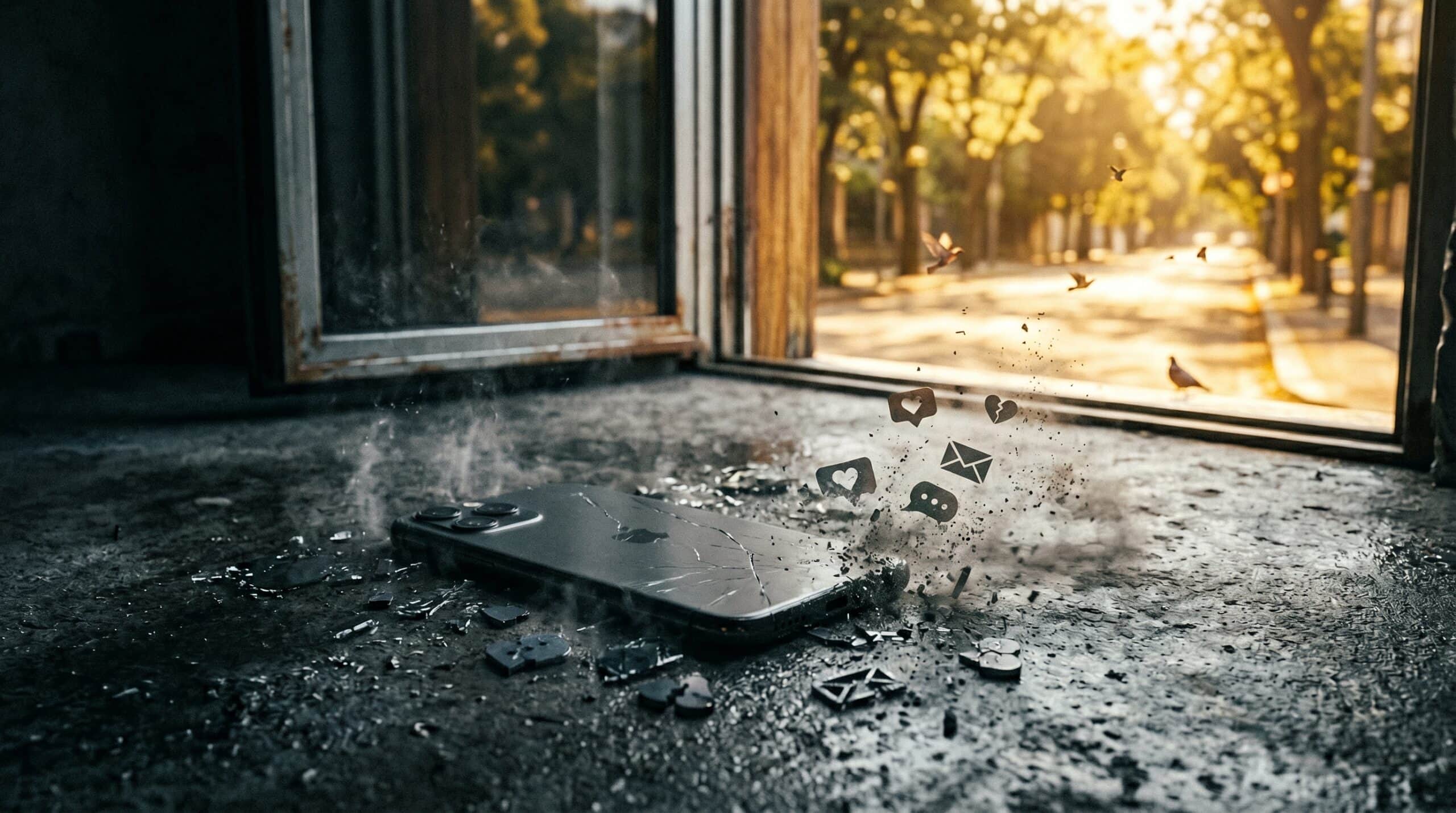
Six months without social media. And how wonderful it is not to know what you're doing!
Let's get one thing straight: I didn't slam the door of Facebook, Instagram, and TikTok. I walked toward it slowly, brick by brick, accumulating years of disillusionment, annoyance, and finally, a clear and definitive disgust. My relationship with social media has always been conflicted: from the naive enthusiasm of the early years— look at how many opportunities, how many connections, what democratization! —to the bitter realization of what they really were.
The fake democracy where "everyone can express themselves freely" is a commercial for the naive. In reality, it's a surgical mechanism designed to make billions of dollars by allowing hatred, ignorance, arrogance, and gratuitous insults to thrive. And the best part—so to speak—is that you can't avoid them. They overwhelm you. They enter your home.
Finally, six months ago, I removed those apps from my personal phone. I did what many dream of but few actually do: a true, radical, personal digital detox. The only concession: the Monday morning marketing protocol for company pages. On a personal level, that's it. The end. Silence.
And I feel incredibly better.
Digital Phantom Limb Syndrome
The first few days were exactly like those of a chain smoker who decides to leave his pack at home. He knows full well he doesn't have it, yet every now and then his hand reaches for his pocket. In my case, my thumb searched for the unlocked screen, ready to open my feeds in idle moments, in the animal terror of missing something vital. It couldn't find them. A moment of confusion, followed by a strange sensation: silence.
It took me a few days to understand that that silence wasn't empty. It was space.
The Sewer and the Shepherd Algorithm
Let's be clear: social media has become the cesspool of human misery. Not because human nature has changed, but because these platforms understood very early on that negative emotions—anger, envy, disgust, indignation—generate engagement, and engagement generates revenue. So they've built their architectures to amplify them. The problem is, they drag you down with them.
And in the meantime they delude you with the lights and glitter of visibility. Come on, show off. You're special. You could be someone. Too bad you have to become a sheep to do that. You have to follow the algorithm's unwritten rules, and woe betide anyone who breaks them: don't write too much, or better yet, don't write at all. Post a photo with your mouth hanging out like a chicken's ass, turn your back to the sunset, or make a video complaining about everything and everyone in the voice of a scared little girl. This is the content that rewards the algorithm. This is the price of visibility.
I chose the blog. I chose The RickyVerse. Because I write the rules here.
What Has Changed: The Human Profile of Detachment
Removing the background noise triggered a series of reactions that I hadn't entirely anticipated:
- The end of social illusion: I've realized that ultimately, I don't give a damn about the lives of people outside my immediate circle. Enduring daily complaints, whining, and expressions of feigned super-happiness is an invisible stress. You only notice it when you stop breathing in that emotional smog.
- The Return to Intentional Relationships: I thought I knew how other people were doing just because I saw their posts. It's a terrible idea, and I'm a little ashamed of it. Without that illusion, I started to really seek out the people I care about again. A message, a phone call, a coffee. Relationships chosen, not imposed by the algorithm. And I discovered I'd neglected important people because "I already saw them on social media." This hurts.
- Professional detachment: On Monday mornings, I open my company platforms, do my job, and close them again. Looking at them as a professional who uses them as a tool—and not as a consumer who is consumed by them—gives me a completely different perspective. It's like soaring above human misery and observing the Matrix from above, without being swallowed up by it.
The Death of FOMO and the Rebirth of Flow
I have never suffered from FOMO (Fear of Missing Out). But the detox has also swept away the last grain of unconscious distraction, the kind you don't even recognize as such until you eliminate it.
I don't know what boredom is—I didn't even know it before. Eliminating digital fast food has restored an unprecedented cognitive flow, like the water of a stream that flows freely again without having to constantly veer around rocks, stones, and detours imposed by others. I read to the end. I listen to everything. I understand, instead of flowing.
I've started to appreciate real information again, the kind written by those who really know, not by self-proclaimed gurus or influencers who pontificate with self-assurance after watching a 30-second video—and who even comment on it, mind you. I've never cared about "trends": they're just sheep fodder. I prefer to focus my attention on exploring the technical potential of a model like Gem 4, Google’s new open source app, or to follow updates on YES’s 2026 tour — a band that has been around for over fifty years and still makes music worthy of deep listening, not a thirty-second snippet.
Active research, deep reading. No compulsive scrolling. The difference between eating and binging on junk food.
Collective Anesthesia and Tangible Beauty
When I look around today on public transportation or in bars, I have mixed feelings. I, too, often have my nose in my phone screen—but I'm taking notes for a new song, reading a long article about a new album, or brainstorming ideas for a blog post. I know, however, that nine out of ten people around me are passively subjected to a flow that numbs their brains, selected by an algorithm that doesn't know them and doesn't care about them. And this really saddens me a little.
But this is where the manifesto comes into play. The RickyVerse: I seek beauty everywhere. And if I don't find it, I create it.
In the time saved from compulsive scrolling, I rediscovered true beauty. I found it in people on the street, observing reality in three dimensions instead of a filtered photo squeezed onto a six-inch screen. I found it in conversations with friends, in chats with the people I care about—no longer one random person among thousands, but a direct connection, sought out voluntarily. I found it in my vinyl records, put on with the precise intention of truly listening to them, from beginning to end. In open books without the anxious vibration of the phone beside me. In my photographs, in music I compose, in the articles of this blog.
It's a tangible beauty. Not ephemeral. In ten years, it will still exist, unlike the vast majority of reels you watched this morning and have already forgotten.
What Science Says: The Brain After a Detox
It's not just a subjective feeling. Scientific research has begun to document with concrete numbers what many instinctively perceived.
A study published in PNAS Nexus, conducted on 467 participants, found that just two weeks of using a phone without any smart features led to an improvement in sustained attention equivalent to reversing ten years of age-related cognitive decline. Average screen time dropped from 314 to 161 minutes per day, with measurable improvements in mood and mental health. The authors described the effect as "comparable to the magnitude of cognitive decline resulting from ten years of aging"—in other words, your smartphone was already robbing you of a decade of clarity.
A study published in JAMA Network Open, on 373 participants, shows that even a single week of detox reduces anxiety symptoms by 16,1%, depression by 24,8%, and insomnia by 14,5%. A review of the literature on young adults, published in PMC/NIH, confirms the general benefits while pointing out that the results vary based on age and individual factors.
It must be said with the intellectual honesty that social media doesn't care: the results among studies are not yet completely uniform. A meta-analysis published in Nature finds still inconsistent results on long-term life satisfaction, and an analysis on ScienceDirect It reports significant but heterogeneous effects. Science is working on it. My personal experience, however, is unequivocal.
Serenity
If I had to sum up these six months in just one word, I'd choose one that social media had stolen from me and that I took back with interest: Serenity. Not the dull, numb serenity of someone who has stopped feeling, but that of someone who has chosen what to feel, and when, and for whom.

Digital creative, musician, and storyteller. I explore the intersection of humanity and technology, telling stories of AI, music, and real life. Welcome to my organized mess.”

3 Comments