
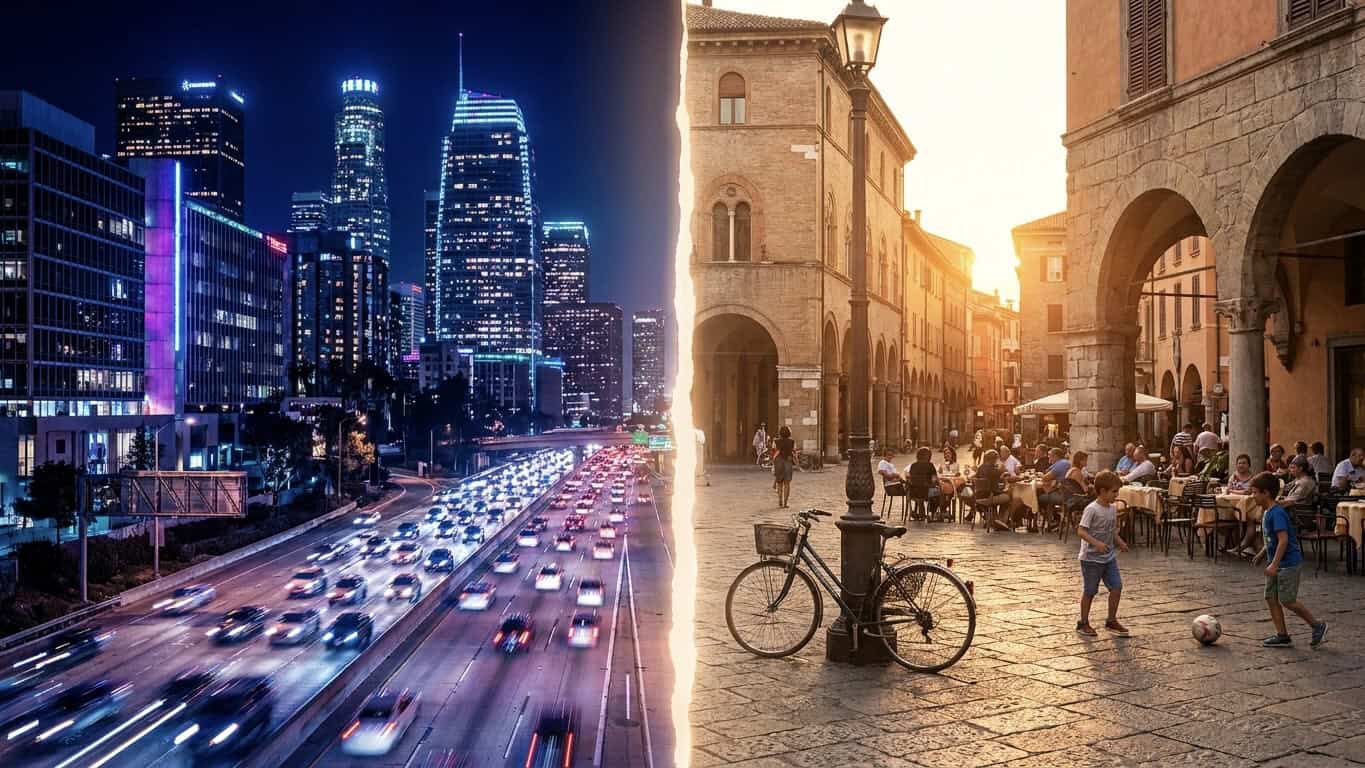
🇺🇸 “All that glitters is not America”
Because between the USA and Europe, I still choose the Old Continent - data in hand
A few days ago, I came across a video reel comparing the US and the European Union on a series of social indicators. Little flags, red and green numbers, dramatic music. The classic three-second attention-grabbing content that fuels three years of distorted beliefs.
But behind that quick-scrolling graphic was a real story. In fact, the comparison between the US and Europe has never been so clear. I took the data, verified it with reliable sources, and made a real post about it. Welcome to my personal blog. dissection of the American dream.
Life expectancy: three years seems short, but it's not.
In 2024, life expectancy in the US reached its all-time high of 79 years old. Excellent. It's a shame that in the same year the European average was 81.7 years old (official Eurostat data), with peaks of 84 years in Italy, Spain and Sweden.
Three years of difference may seem like a small thing. But those three years conceal an inaccessible healthcare system, chronic workplace stress, structural gun violence, and poverty that we would manage differently in Europe. It's not a number: it's a social policy.
Healthcare: Paying Double to Live Less
This is the most grotesque figure of the entire comparison. In 2024 the US spent $14,900 per capita in healthcare, equal to 17.6% of GDP. Europe on average spends around $6,000 per capita — less than half.
The result? 361 TP3T of Americans have forgone medical care for economic reasons. In Europe, "skipping the doctor because it's too expensive" is fortunately still a distant concept (and hopefully will be in the future). Spending twice as much to live less is an extraordinary performance—in the worst possible sense. Does politics want to lead us to that world? Well... let's stop them!
Murders: 5 vs. 0.6 — we're talking about different worlds.
In 2024, the murder rate in the US was 5 per 100,000 inhabitants — a decrease of 15% compared to the previous year, which is undoubtedly good news. The European average stands at around 0.6 per 100,000.
Eight times less. It's not a statistical difference: it's a existential difference. Going grocery shopping, sending your kids to school, attending a concert—these are actions that don't require an implicit risk assessment in Europe. In some American cities, they do.
Prisons: the country of freedom that has the least of them
The USA has 550 prisoners per 100,000 inhabitants —the highest incarceration rate of any independent democracy in the world. Every single American state incarcerates more people per capita than most nations on the planet.
The European average is approximately 100-111 per 100,000. Five times less. And the research is clear: high incarceration rates do not reduce crime and violence. It's a system that grinds people down—at enormous human and financial cost—without even working.
Student Debt: Graduating with a Mortgage
The average debt of an American graduate is $38.500. In total, Americans carry on their shoulders $1.77 trillion of student debt. Not billions: trillions. An entire generation starting adulthood already in the red.
The situation varies across Europe, but the vast majority of countries offer public universities at very low cost or free of charge. In Italy, average tuition fees range from €1,000 to €2,500 per year. It's not zero, but it's a different story.
Paid Vacation: The European Luxury of Existence Outside of Work
In the USA there is no federal law that forces employers to grant paid vacation. Zero days guaranteed. Vacation depends on your boss's benevolence—and if you're unlucky, on his remaining humanity.
In the EU every worker has the legal right to a minimum of 20 days of paid leave, with many countries reaching 25-30. This isn't a contractual detail: it's a worldview. Work is for living, not the other way around.
The bigger picture
Why I still choose Europe
I'm not anti-American. I want to say it, because it's true. American culture shaped me: rock, metal, cinema, the technology I use every day to do almost everything I love to do. It's a country that when it dreams big, it really dreams bigger than anyone else. It sent a man to the moon, invented the internet, gave us Springsteen, Metallica, Kubrick, Steve Jobs. These aren't small things—they're wonders.
And perhaps that's precisely why the numbers are even more impressive.
Because a country capable of that greatness—capable of rewriting the planet's technological future, of creating a culture that spans oceans and generations—then stumbles on much older and simpler things: the right to healthcare without going broke, to graduate without twenty years of debt, to go on vacation without it becoming a privilege to be negotiated. It's like attending a concert with an extraordinary band that plays flawlessly—and then discovering that the roadies don't have health insurance.
Greatness is there. But it's not distributed.
I'd rather live in a place where the light is a little dimmer, less spectacular, less cinematic—but it reaches everyone. Where the average doesn't hide an abyss. Where the state doesn't require you to be lucky to live with dignity.
America shines, sure. But it often shines from afar. And I, up close, still choose the Old Continent. Unless some small, unintelligent character wants to make it look more and more like America.

Digital creative, musician, and storyteller. I explore the intersection of humanity and technology, telling stories of AI, music, and real life. Welcome to my organized mess.”





One Comment