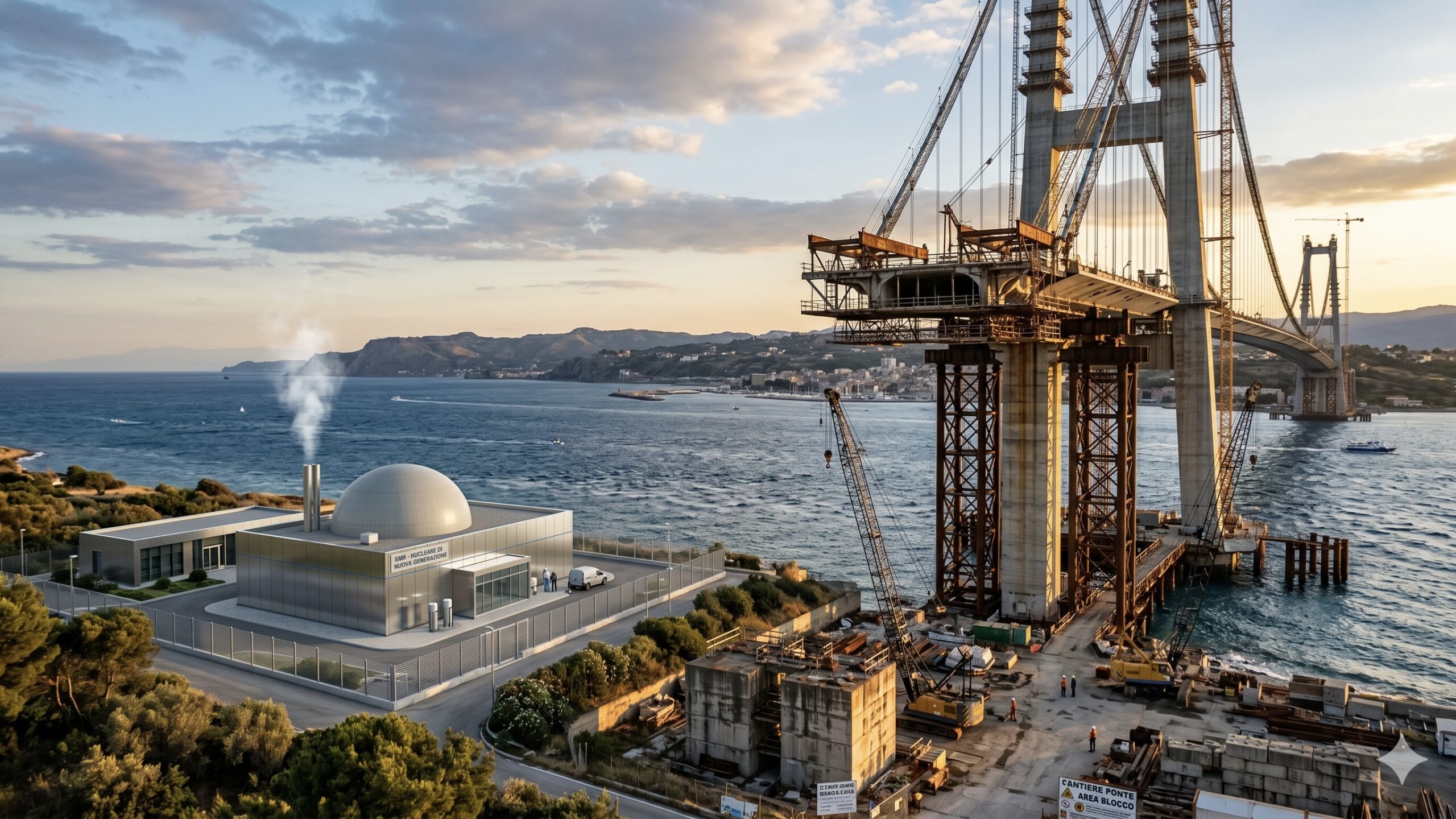
Nuclear: Will it be the new bridge over the Strait of Messina?
Italy just did something typically Italian: instead of building something, it passed a law to approve the decrees that will allow us to start thinking about building it.
It's almost poetic.
The Meloni government has obtained the green light from the Chamber for the nuclear bill, a draft delegation law which — translated from bureaucratese — means: “We are allowed to write the rules to decide where to put the rules.”"The actual implementing decrees will arrive by Christmas. Then the authorizations will begin. Then the sites. Then the construction sites. Then the reactors. Expected to be operational between 2032 and 2033. Optimistic. Personally, I trust them as much as I trust a Roman taxi driver who tells you, 'We'll be there in twenty minutes.'".
But let's proceed in order, as this matter truly deserves to be understood. Because just reading the newspaper headlines this morning made me sick. Bipartisan and hemicyclical.
What the government approved (and what it didn't)
Let's get one thing straight: no reactor has been turned on in Italy. No power plant is under construction. No site has been chosen. The government has approved a delegated law, which authorizes it to write the rules of the game: a regulatory framework to govern the construction, operation, and decommissioning of next-generation nuclear power plants.
The protagonists of this story are called SMR — Small Modular Reactors —and their even more compact cousins, the micro-reactors. These aren't the colossal nuclear power plants of the 1970s that evoke Chernobyl. Conceptually, they're more similar to industrial modules: factory-built, transportable, with passive safety systems (read: they shut down automatically if something goes wrong, even without operators). Newcleo, an Italian-French startup with roots in the Polytechnic University of Turin, is among the most cited names in the Italian debate.
Confindustria President Emanuele Orsini has already raised his hand: he wants mini-reactors right in the manufacturing districts. The idea is tantalizing. A steel mill with its own reactor right on your doorstep. Until a few years ago, it was industrial science fiction. But today, it's science fiction with a certain degree of technological concreteness.
The benefits (the real ones, not the conference ones)
Let's start with the good things, because they exist.
Nuclear energy does not depend on the sun or the wind. This is a fact, not an opinion. When clouds cover the Po Valley for three weeks in winter and the wind doesn't blow, solar and wind power decline. Nuclear power, however, does not. For an industrialized country that requires stable, 24-hour power, this feature is worth its weight in gold—especially for those, like foundries, paper mills, or (excuse me) stainless steel processors, who can't afford outages.
It takes up little land. A small 300 MW modular reactor occupies the equivalent of a few football fields. To produce the same amount of energy annually with solar, you would need a vastly larger area. In a country battling for every hectare between tourism, agriculture, and renewables, this is an issue that cannot be ignored.
If the technology matures, it could really help industrial decarbonization. Sectors that are difficult to electrify—cement, steel, chemicals—require high-temperature heat and constant current. Nuclear is one of the few sources that can provide both.
The critical issues (the ones that the press releases don't mention)
And here comes the best part.
The costs are, euphemistically, high. The levelized cost of energy (LCOE) of SMRs currently ranges between $90 and $160 per MWh. Solar PV hovers around $40-60. Onshore wind, too. It's not a war: it's a cycling race where one rider arrives on a racing bike and the other on a tricycle loaded with bricks.
There is no operational commercial SMR yet on a large scale in the world. The first such 300 MW reactor is expected in Canada no earlier than 2029., under optimistic conditions. NuScale—until a few years ago the most advanced SMR project in the US—was canceled after the costs of the 75% exploded.
The times. Nuclear construction sites have a cosmic history of cost overruns. The average cost overrun for nuclear projects is 2381 TP3T, compared to 11 TP3T for solar and 131 TP3T for wind. This isn't nuclear bashing: it's statistics.
The waste. Italy still doesn't have a national repository for radioactive waste. The official estimate is: site selection in 2027, authorization in 2029, entry into service in 2039. Good. Let's build new facilities while the waste from the old ones, decommissioned in the distant 1980s, still awaits a home.
The phantom referendum. The Italians said no to nuclear power in 1987 and 2011. A delegated law ignored them—legally, formally, but politically, it's not something easily forgotten. Any future site will become a local battleground. Social acceptance of these plants in Italy is, let's say, complicated.
And with that same money?
Here lies the most interesting point, and the one on which the debate is most dishonest.
Nuclear advocates present it as a "supplement" to renewables. But a country's public resources and administrative capacity are limited. Every euro committed to subsidies, tax incentives, or public participation in SMR projects is a euro that goes nowhere else.
With the same investments, in the short-medium term (2025-2035), it would be possible to:
• Tripling Italy's photovoltaic and wind capacity, with construction times of 1-3 years instead of 10-15.
• Build more modern and intelligent transmission and distribution networks — today the real bottleneck for renewables
• Invest heavily in storage (batteries, pumped hydroelectricity) to solve the problem of intermittency.
• Accelerate the energy efficiency of buildings and industrial processes, which provides immediate returns in terms of bills and emissions.
IEA estimates new nuclear power in Europe by 2040 could be Becoming competitive with renewables + 8-hour storage. But it's 2040. And these are estimates. And they need to build something before then.
This does not mean that nuclear power is an absolute evil. It means that in the temporal and financial context in which we live,and renewables + networks + storage are a much safer and much faster bet. If next-generation nuclear power is to remain in the equation, it should be treated as what it is: a long-term technological gamble, to be financed sensibly without draining resources from the transition needed now.
So: Bridge over the Strait or not?
The comparison is not entirely incorrect. Like the Bridge, Italian nuclear power risks remaining a predominantly industrial object for years to come. narrative: a powerful story, useful to different audiences, capable of mobilizing enthusiasm and resentment, but dangerously far from becoming concrete, steel and kilowatt hours.
The difference is that nuclear, at least, makes physical sense. Fission works. SMRs are a real technology, not a fantasy. The point is when and how much it costs.
And the honest answer — the one that no minister will ever say in a press conference — is: not before 2035, most likely more, almost certainly more expensive than what they tell us today.
Italy approving regulatory frameworks for technologies that don't yet exist on the market, on sites not yet chosen, with waste that hasn't been homed, in a country that has already voted against nuclear power twice, is a perfectly Italian image.
It's the country that loves inaugurations. Not construction sites. Not deliveries.
Let's hope this time is an exception.

Digital creative, musician, and storyteller. I explore the intersection of humanity and technology, telling stories of AI, music, and real life. Welcome to my organized mess.”