Du iu spic inglisc?
Why English won — and it's not for what you think
No one has ever voted to make English the global language. Yet here we are: writing emails, watching TV shows, using software, working, traveling, and even arguing online in a language that didn't become dominant because it was "better," but because history gave it a huge boost. Perfect timing, geopolitical power, economics, technology, and mass culture: the rest was a byproduct.
The Foundations: When Britain Was Everywhere
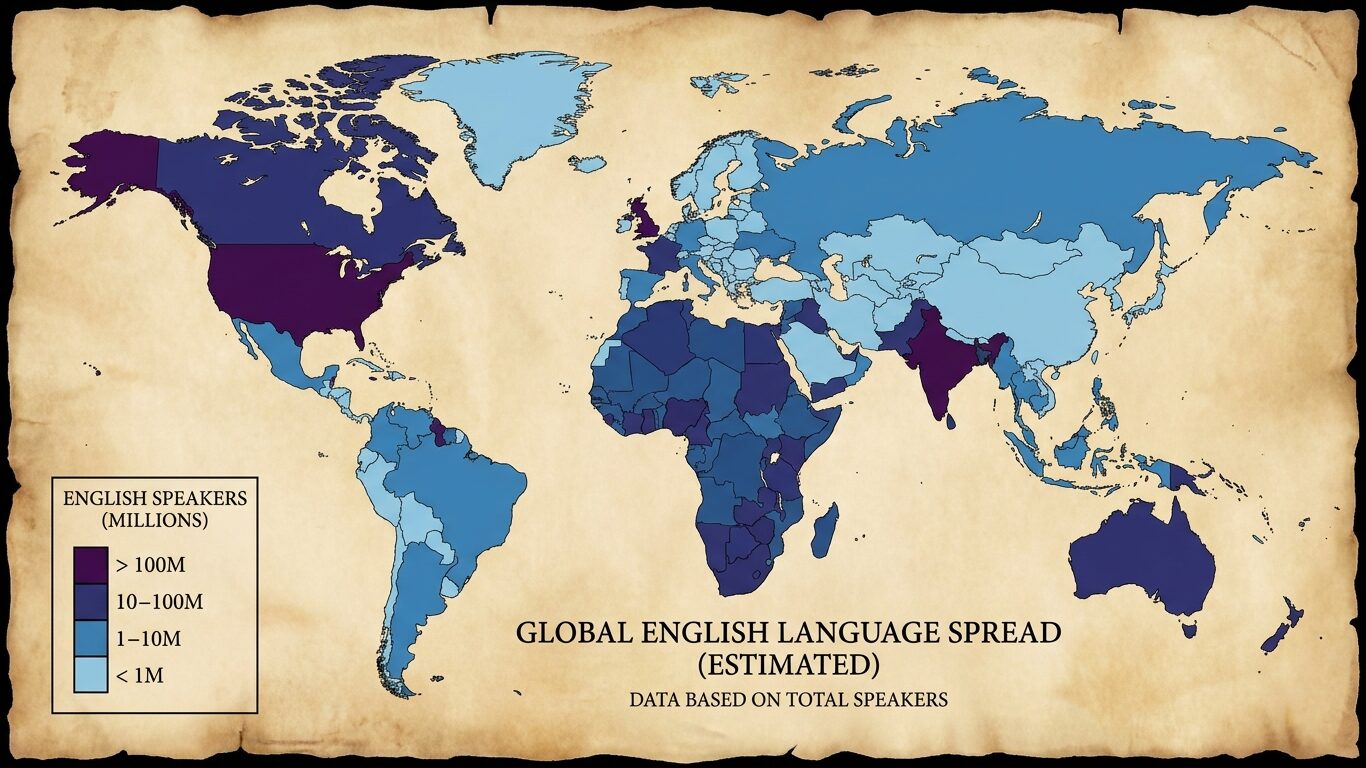
Between the 18th and 20th centuries, the British Empire built the largest colonial empire in history, controlling approximately a quarter of the world's landmass. Ships, trade, administrators, and soldiers carried English from North America to India, from Australia to Africa, leaving the language in places where it previously had no natural right to be. When many colonies gained independence, English often remained as an administrative language or a practical compromise between peoples speaking different languages. In India, for example, its function as a bridge language became almost inevitable.
It's not a romantic story. It's a story of power, organization, and convenience. And convenience, in the real world, often trumps sentimentality.
The Engine: The United States Reaps the Harvest
If Britain planted the seeds, the United States industrialized the harvest. After World War II, with Europe and Asia devastated, the United States became the dominant economic and military power, and English became the natural language of international affairs, diplomacy, and global institutions. Anyone who wanted to trade, study, negotiate, export, or expand faced a simple choice: English, or stay out of the equation.
And we're not just talking about economics. The United States also exported a lifestyle, an imagery, and a hierarchy of desires. They didn't just sell you a product. They sold you the idea of wanting one.
The Code: The Digital Revolution Has Chosen Its Side
English has become the native language of contemporary technology. The first computers, programming languages, Internet architecture, and the giants of Silicon Valley have made English the default code of the digital world. Those who work in software, the web, or high technology operate within an English-speaking ecosystem, even when they try to pretend otherwise.
Error messages, documentation, tutorials, repositories, tickets, tools, dashboards: almost everything flows through there. Basically, if you want to work well with modern technology, you need to at least survive English. The computer, from that perspective, is incredibly democratic: it doesn't care where you come from, it just wants you to know how to read its commands.
The Allure: Hollywood, Rock, and Global Brands
The spread of English was achieved not only through treaties and markets, but also through soft power. The twentieth century was the century of American cultural dominance: Hollywood exported images, myths, and languages to every corner of the planet; jazz, The rock, Pop, and hip-hop have had entire generations singing in English, often before they even understood what they were really saying. Global brands have done the rest, making English synonymous with modernity, consumption, and lifestyle.
There was no pure imposition here. There was something more effective: attraction. The tongue didn't enter just out of obligation. It entered because it seemed cooler.
Practicality: The world needed an agreement
An interconnected world needed a common code, and English was in the right place at the right time. The ICAO chose English as the standard language for international aeronautical communications, precisely to reduce ambiguity and improve safety. Even in science, publishing in English has become almost mandatory to achieve global visibility. In tourism and travel, English is the lowest common denominator: it's not always the most popular language, but it's often the one that works.
It's the classic case where no one is really happy, but everyone understands each other enough to move on.
The truth that many pretend not to see
Then there's an inconvenient truth: the average level of English in Italy is poor compared to many other European countries. The EF EPI 2025 ranks Italy 59th out of 123 in the world and 35th out of 37 in Europe, in the "medium" range but with a decidedly unglamorous continental ranking. Put bluntly: we're not the kind of country that can afford to say, "English isn't necessary anyway.".
I heard it too, yesterday, that phrase thrown out there by two kids, probably in middle school. One said to the other:
“But what do I care about English! I'll never use it in my life!”
Beautiful. Honest. Tragically Italian. It's the voice of those who still live under the illusion that the world ends at the school gate, at home, or at most at the supermarket. And I can assure you, it's the same for many adults. The problem is that today English isn't just for traveling. It's for studying, working, searching for information, understanding technology, reading the present without translation, and, above all, staying connected to the global conversation.

The structural detail that is often ignored
It's not true that English is an "easy" language in its entirety. However, it has some characteristics that, at least initially, lower the entry threshold: no object genders, no declensions, and simpler conjugations than many Romance or Slavic languages. Its phonetics and spelling, however, are a minor crime against humanity. However, its flexible structure and ability to absorb vocabulary from other languages make it an extremely practical tool.
In short: it's not the perfect language. It's the language the world chose because it was the most useful at a time when usefulness mattered more than anything else.
So: du iu spic inglisc?
The English didn't win because they were superior. They won because they found the right historical moment, in the right century, with the right powers on their side. They sailed on the ships of the British Empire, consolidated themselves with American economic power, insinuated themselves into technology, conquered cinema, music, and advertising, and finally sat at the center of the global table without even asking permission.
The next time someone says English is useless, you can think back to that quote about the two kids and smile bitterly. Because the problem isn't English. The problem is believing that the world, by principle, should wait for those who don't want to understand it.

Digital creative, musician, and storyteller. I explore the intersection of humanity and technology, telling stories of AI, music, and real life. Welcome to my organized mess.”