Ether: The story of a man who could turn off the world.
There are times when technology stops looking neutral and starts looking like a mirror.
This story was born from there: from digital addiction, from the normalization of war, and from that disturbing silence that comes when you realize how fragile the world we call normal is.
ETHER
Fingers on the keyboard make less noise than they should.
This is the first thing I notice.
They should tremble, hesitate, betray me in some way. But no. They move with an almost offensive calm, as if what I'm about to do were an administrative matter. A formality. Just another Monday.
Outside the window the world continues to be the world.
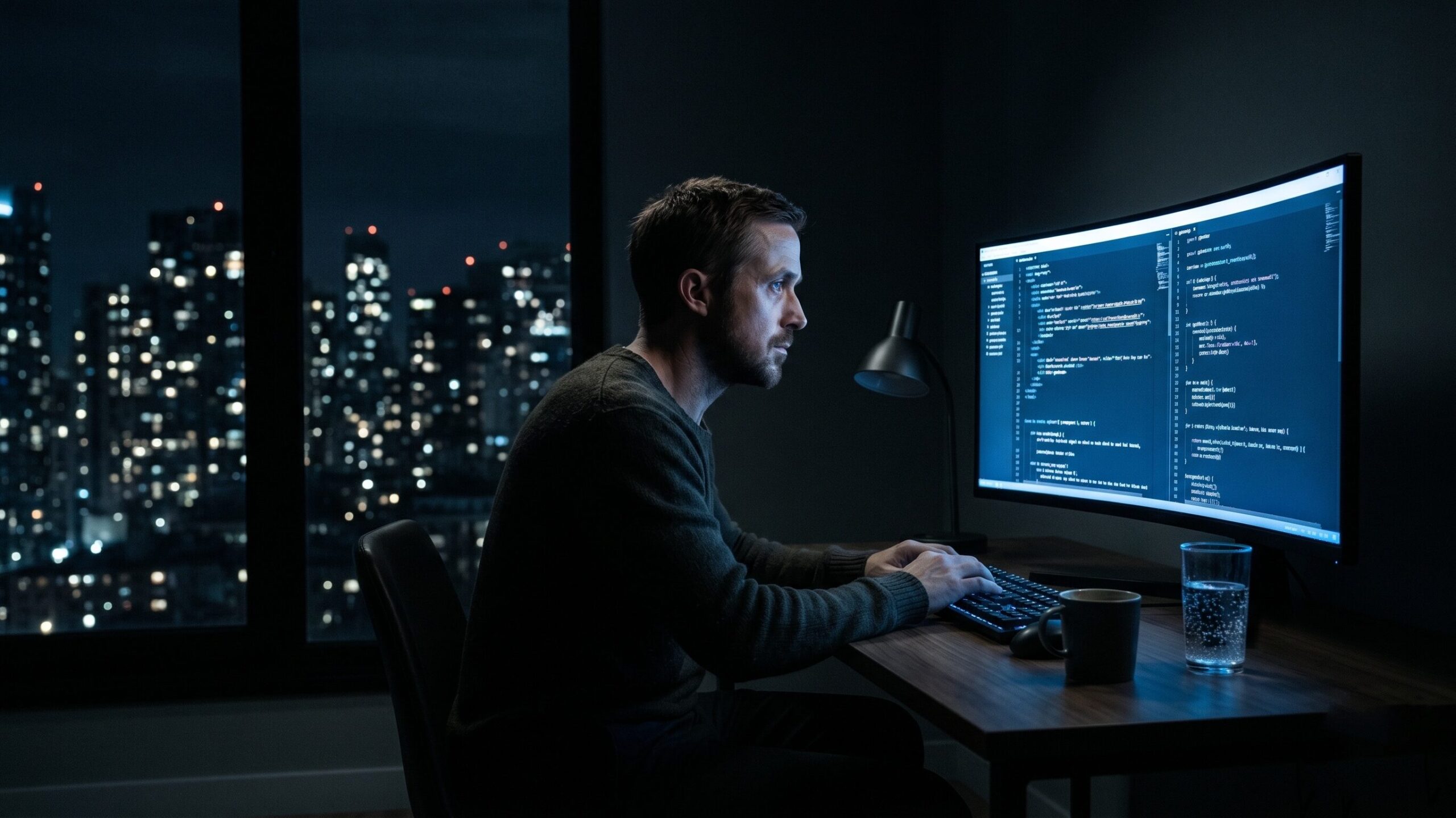
Someone's arguing, someone's walking the dog, someone's scrolling through a silly video, convinced they're making a choice. Meanwhile, I'm here. In this overly tidy room, in front of this overly clean screen, with the reflection of my face that looks like someone who's had little sleep and a bad thought.
There is Ether on the monitor.
The name came to me one of those nights when the brain doesn't cooperate but insists. I wanted something that sounded light. Invisible. Almost sacred. An elegant word for something indecent.
For months I labored in silence, with the patience of monks and the mental balance of a lit match. I stitched together logic, anger, method, insomnia. I stripped away everything superfluous until only the core remained. A clean creature. Perfect. A key that opens no doors: it convinces locks to be ashamed of having existed.
I look at her.
She looks at me.
There's always a moment when ideas stop being ideas and become responsibilities. It's the dirtiest moment. Before that, you can still tell yourself: I'm reflecting, I'm hypothesizing, I'm philosophizing with the help of an expensive computer. Then comes a small, ridiculous, almost comical moment when you realize that all it takes is a finger. A finger, and the planet enters a room with you.
The cursor flashes.
He seems impatient.
It looks alive.
He seems to have more confidence than me.
I didn't build Aether to destroy the world. This is the lie I've been telling myself for weeks, and like all good lies, it contains a kernel of truth. I don't want destruction for its own sake. I'm not interested in seeing the globe on its knees like a movie villain with a childish taste for the red button.
I want to stop the noise.
I want to put my hand on the back of civilization's neck and force it, for once, to look in the mirror. I want a shock cure for this species sedated by distraction, propaganda, profit, and blue light in its face until two in the morning. I want to hurt something enormous because for too long, pain has been distributed unequally: always low, always on the same people, always far from the living rooms where the price of wars and the value of human attention are decided.
Is this a justification?
Yes.
Is it also the truth?
Unfortunately, yes.
At 11:59 I'm breathing with my mouth open.
It's a laughable detail. You think of the great digital revolt, one man's private war against the system, and then reality presents itself with its discount-store poetry: me, in a room, forgetting even how to breathe with dignity.
11:59:32
I look at him.
11:59:41
I place my index finger on the key.
11:59:49
For a moment, I think of my mother. Not for noble reasons. Out of instinct. When you're about to cross an irreversible threshold, your brain pulls out the essentials and the useless without any order. I see her hand on the doorknob of a door from many years ago. I see the sun on a tablecloth. I see myself, still believing that evil was noisy and good had a recognizable shape.
11:59:58
Then I stop thinking.
And I press.
Phase 1: The Great Silence
At noon the world doesn't explode.
It would have been almost reassuring.
No, the world is coughing.
It's something more subtle, more humiliating. A sudden blow to appearances, a crack in the rhythm. Instagram grinds to a halt. TikTok won't load. Facebook becomes an empty room full of old furniture. X stops spouting off opinions like a drunk at the bar. Updates fail. Notifications dry up. Feeds freeze with the idiotic expression of someone who's been interrupted while talking too much.
For a few seconds nothing visible happens.
Then it all happens at once.
I see it from the secondary monitors, from the logs, from the spikes, from the maps that light up like fevers. I see it above all by imagining it. The most ferocious part of power today isn't doing things. It's knowing how to imagine them happening elsewhere.
I think of thumbs that keep scrolling on dead screens.
I think about the eyebrows narrowing.
I think of the small global abstinence disguised as “there must be a network problem.”.
The best comes later.
After seven minutes the panic drops a notch.
After twelve, the obsession begins to seem ridiculous even to the person experiencing it.
After twenty, someone raises their head.
A couple in a bar.
A boy sitting on the tram.
A woman in the waiting room.
Three friends who no longer know where to look and finally, out of desperation, actually look at each other.
For a whole hour the background noise disappears.
No vertical ballet, no prefabricated outrage, no ego pornography masquerading as personal expression. Just the naked discomfort of being in the world without anesthesia.
I notice I'm smiling.
This disgusts me a little.
Because this is the first point where moral fantasy detaches itself from the real facts. I had imagined a symbolic gesture. Almost poetic. A beneficial break. A pause imposed for good, as if good really needed to be imposed by someone with the dark circles under his eyes of a failed saint and a Mac turned on on the table.
Then the first images arrive from local television, emergency services, and city cameras. People screaming. People laughing nervously. People accusing governments, Russian, Chinese, and American hackers, reptilians, and Mercury retrograde.
The world, even when it stops, does not give up its talent for stupidity.
Yet beneath the stupidity I feel something else.
A space.
A sudden void.
A silence that no one had ordered for years.
Just one hour.
Sixty minutes stolen from voluntary slavery.
When the servers come back up, the world breathes a sigh of relief that feels a lot like a relapse.
I, on the other hand, remain still.
Because now I've understood the worst thing:
Ether works.
Phase 2: The Frequency of Peace
At 2:57 pm my hands are cold.
Not because of the fear of failure. That fear died at noon. Now I have another, much less elegant one: the fear that I'm enjoying success.
It's a disgusting thought. So of course it's a true thought.
At 3:00 PM sharp I enter the global television streams.
There's no glory in this passage. No techno-thriller-like virtuosity. Just precision, patience, and the kind of concentration that suddenly makes you allergic to every sound in your body: the blood in your ears, your tongue against your teeth, even the weight of your eyelids.
One after another, the signals bend.
A talk show.
A game.
A news bulletin.
A sales pitch obscene enough to deserve it.
A preacher with the wrong tan.
A local network.
A national team.
A continent.
Then another.
Three seconds of black.
Three seconds is an eternity, when the world is accustomed to filling even the breath with content.
Then the message appears.
STOP WARS
Nothing else.
No signature.
No flag.
No ideology ready to be put on display.
Just those two bare words, translated into every language, like a slap that takes the trouble to be understandable to everyone.
I imagine living rooms. Bars. Airports. Hotel lobbies where people watch conflicts as if they were a background noise between the weather and sports. I imagine governments rushing to define the act as "terrorist" with the same rapidity with which power only recognizes crimes it cannot control. I imagine editorialists swelling like institutional toads, ready to explain the world's complexity to the public with the tone of those who confuse complexity with cowardice.
But for a few seconds no one speaks.
And that's the point.
For a few seconds the narrative machine stops.
War comes out of the packaging.
It stays there, naked, obscene, without a soundtrack, without graphics, without an expert connected from a fancy studio to tell you that yes, it's terrible, but you see, there are geopolitical balances.
No.
For three seconds of darkness and two blank words, the planet remembers one very simple thing: wars should be stopped. Not commented on. Not analyzed like a derby. Turned off.
It makes me laugh.
A dry, ugly laugh.
Because I just made a huge gesture to say something that should already be part of the basic human makeup. And yet here we are: it takes hacking the global information nervous system to remind a species that slaughtering its own children is a terrible habit.
That doesn't make me a savior.
It just gives me the symptom of a very old disease.
Phase 3: The Freezing of Gold
At 6:00 PM the sun begins to loosen its grip, but the financial buildings do not.
They are, after all, the true cult of our time. Far from spirituality. The contemporary temple has bulletproof glass, air conditioning, and people dressed for a luxurious funeral who speak in percentages. Inside, they decide what is valuable, who counts, who can wait, and who can quietly die discreetly as long as it doesn't disturb the market index.
I enter banking systems with a clarity that scares me.
There's no room for aesthetics here. Only structure. Only nodes. Only dependencies. Digital money has an almost pornographic fragility: it feels eternal until no one touches the right socket. Then suddenly it reveals itself as what it has always been: a collective faith with a database habit.
ATMs are shutting down.
Requests time out.
Permissions are blocked.
The circuits talk to each other and no longer understand each other.
Somewhere a woman tries to withdraw cash for groceries.
Elsewhere, a man in a jacket stares at a monitor and feels, for the first time in years, a shadow of reality touch the back of his neck.
From yet another, much higher up, someone calls someone who calls someone else, and in a few minutes the language changes: from technical to urgent, from urgent to political, from political to hysterical.
It's amazing how quickly market priests become mortal when money stops obeying them for two hours.
The stock markets are holding their breath.
Governments pretend to be in control.
Analysts talk a lot, because when a human category no longer understands anything, it tends to produce words like a cuttlefish produces ink.
I look at the chaos and feel something that resembles nausea growing.
Because of all the heists, this is the most ambiguous. The dirtiest. The closest to the real lives of real people. The powerful will get away with it anyway, as always. Those truly at risk are the cashier, the pensioner, the father whose account is already at risk, the woman who needs to buy medicine and finds herself in front of a dead screen that reflects the great poetry of capitalism: service temporarily unavailable.
I take off my headphones.
I drop them on the table.
For the first time since this morning I've seriously wondered whether good, when it passes into the wrong hands, doesn't simply become a more cultured form of violence.
The doubt doesn't last long.
Enough to hurt, not enough to stop me.
Because the whole world has now seen its own dependence.
From social media.
From the information.
From money.
And the truth, when it finally presents itself, doesn't knock. It simply enters. It dirties the floor. It embarrasses you. It reminds you that you've built your entire life on mechanisms you neither understand nor control. That a few seconds are enough to transform civilization into a crowd refreshing a screen, hoping the god of availability will return with mercy.
Two hours later, when the flow resumes, the overall relief tastes miserable.
It looks like gratitude.
It's addiction.
Phase 4: The Silent Sabotage
At 10pm the room got smaller.
Or maybe I'm the one who's worse off.
The last phase is the one I've written and rewritten the most. The one I looked at the way you look at a knife on the table: knowing full well that the object is not to blame, but sensing that the hand is.
I don't touch distractions here.
I don't touch symbols.
I don't touch cheap wedding rings.
Here I touch the factory.
The production lines of the 10 most powerful death factories appear on my screen with the sober indecency of places where evil becomes routine. Everything clean. Everything certified. Everything efficient. Computers don't hate anyone. Yet they help build things designed to pierce flesh, obliterate buildings, transform cities into logistical problems.
I enter industrial control systems.
There are no monsters on the other side of the monitor.
There are electrical panels.
Values.
Temperatures.
Margins of tolerance.
Rotations.
Alarms.
Routine.
This is what devastates me most: war, if you look closely enough, isn't always a flame. Sometimes it's a well-designed interface.
I change the parameters.
Not much.
Just enough for the machine to continue to trust itself as it begins to die. The frequencies rise slightly. The tolerances expand with an almost imperceptible gentleness. The systems still read normality where in reality there's already a discordant note. A cracked violin that insists on playing as if nothing had happened.
Then the dissonance becomes heat.
Heat becomes error.
The error becomes a waterfall.
The controls skip.
The cards give way.
Lines stop in the worst way: late enough to get seriously hurt.
I don't see any cinematic explosions.
I see interruptions.
I see screens going crazy.
I see historians becoming corrupt.
I see backups becoming ruins before anyone even finds the right folder to clear their conscience.
One after another, the arms factories are going silent.
Not all of them.
Not forever.
But enough.
Enough to make those who live off war understand that even the chain of death depends on a ridiculous fragility: electricity, software, trust, repetition. Just move the needle a little and the entire mechanism begins to cough up iron.
I'm not smiling here.
I'll keep quiet here.
Because this time I can no longer fake the symbolic gesture. This is real damage. Intentional damage. Thoughtful, planned, chosen damage. I can drape it in philosophy as much as I want, but the truth is still there, staring back at me with open eyes: I made the decision. I decided that certain structures had to fall. I chose to strike. I drew the line between the tolerable and the untouchable, without anyone asking me to.
There is a very elegant form of delusion called moral conviction.
It makes less of a scene of madness, but on the other hand it causes much more damage.
I put a hand to my face.
I feel cold and sweaty.
For a moment I think about stopping here.
Really.
Leaving the world with four open wounds, large enough to force it to negotiate with itself. No ultimatum. No final theater. No divine voice on the devices. Only the message already etched into the flesh of the last twelve hours: you are vulnerable, you are dependent, you are ridiculous, and above all, you are too accustomed to confusing functioning with justice.
I could stop.
I could.
Instead I watch the last routine.
And I understand that the most dangerous part of a man is not anger.
It's consistency.
The Countdown
Midnight arrives without drama.
No thunder.
No music.
Only the refrigerator in the next room turning on as if it too wanted to remind me that life continues to take care of its little things, even while a lucid lunatic evaluates the fate of the planet from an uncomfortable chair.
I have a glass of water that I have hardly touched.
A clenched jaw.
The burning eyes.
The last action is also the simplest to understand.
Every smartphone on the planet is an emotional prosthesis. Not an object: an extension of the nervous system. Lost loves, forgotten passwords, bank accounts, photos of children, pornography, maps, work, lies, promises, unlistened voice notes, songs used as crutches, chats that seemed eternal but weren't, sleep there. To truly impact the world, you don't have to go through buildings. You have to go through the palms of your hands.
I'm sending out the signal.
For a moment nothing.
Then I imagine the note.
A clear, unfamiliar sound, impossible to mistake for any familiar notification. A cold call. A sonic blade. The kind of noise that grabs you by the throat before your brain has even decided whether to be afraid.
Billions of screens light up.
Bedrooms.
Autogrill.
Ambulances.
Kitchens.
Barracks.
Delivery rooms.
Motel.
Planes.
Monasteries.
Subways.
Villas with swimming pool.
Moldy apartments.
The message appears everywhere.
Put out all wars or I will put out the world.
Immediately below, the stopwatch.
[ 09 DAYS : 23 HOURS : 59 MINUTES : 59 SECONDS ]
Part.
And with him something worse than fear begins.
The certainty.
Because at this point, the planet has already seen enough. It's seen the silence of social media. It's seen television collapse. It's seen money freeze. It's seen factories cough. No one can afford the luxury of writing it all off as a digital prank, a circus act, an isolated incident.
Now they know.
They know I can really do it.
They know I could push myself further.
They know that the problem is no longer whether I'm capable. The problem is whether I'm still willing to stop.
And this is where the room changes.
All day it seemed like a control room. The hidden center from which a single man forces the world to listen. Now, however, it seems like what it has always been: a room. Four walls. A table. A computer. A human being sitting amidst his own justifications like a drunken priest amid the remnants of faith.
I look at the countdown.
09 days.
23 hours.
59 minutes.
I realize that the problem is not the planet.
The problem is the next ten days inside my head.
Because the world, in the end, will react as it knows how: conferences, protocols, task forces, threats, armies, tense faces on television, analysts speaking in that technical obituary voice they use when the future has already caught fire. The world will do its job. Defend itself, even from what it has become.
I, on the other hand, will have to defend myself from a much smaller and much more ferocious question.
If they actually gave me what I asked for, would I stop?
The clock continues to count down.
The note in the planet's phones goes off.
Silence returns to the room.
And for the first time since I pressed Sending, I understand a simple, vulgar, humiliating thing:
Maybe Ether isn't the cure.
Maybe it's just the technically flawless form of a fever.
Why I wrote this story
I don't think technology alone will ruin us.
It would be too convenient.
Instead, I believe it amplifies everything: noise, vanity, power, fear, even good intentions when they end up in the wrong hands.
“"Ether"” It arises from this question: if we really had the power to turn off the world and force it to look in the mirror, would we still be lucid enough to stop a moment sooner?
Other routes in the RickyVerso
If this story left something in your mind, perhaps the thread continues here:
- Remember that you must die. You will be happier.
- Scrolling: The vice he just lost in court
- AI isn't free: and now the kinks come home to roost!

Digital creative, musician, and storyteller. I explore the intersection of humanity and technology, telling stories of AI, music, and real life. Welcome to my organized mess.”
Thanks for writing this — Claude Fable 5 at has been useful for similar workflows. Claude Fable 5