AI isn't free: and now the kinks come home to roost!
There's a specific moment when you realize you're addicted to something. It's not when you use it for the first time. It's not even when you build a routine around it. It's when the bill comes.
Welcome to May 2026. The bill has arrived.
The most refined pusher in the history of technology
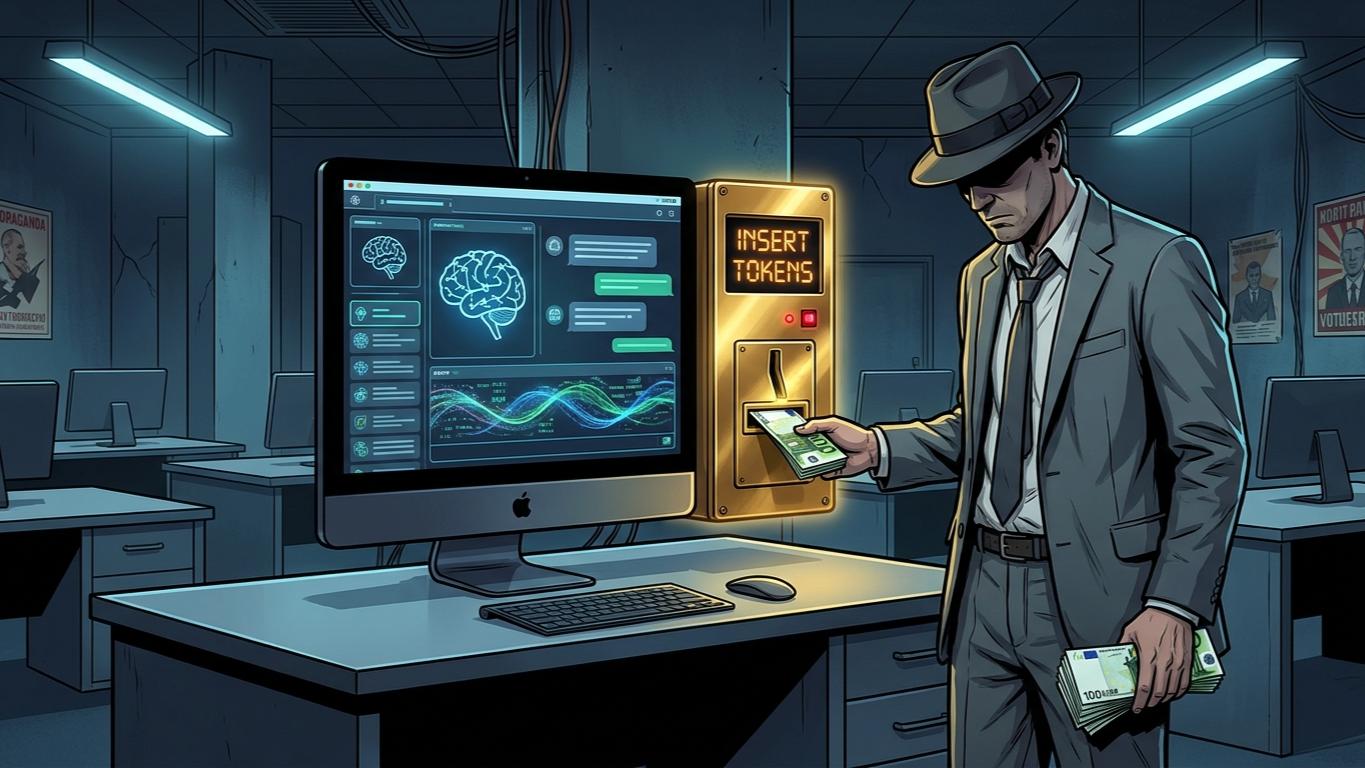
Let's play a mind game. Imagine a drug dealer—not the one in the movies, the elegant one, the one with the tie. He walks into your office and says: “Try this. The first month is almost free. It'll let you work twice as hard, hire fewer people, and save a fortune.”
You try. It really works. You restructure your business processes. You train your team. You rewrite the software. You stop doing certain things by hand because... there's AI to do it anyway. A year passes. Another passes. AI is no longer a tool: it's the backbone of your work.
Then the pusher returns. This time without the smile. “Prices have changed.”
This is exactly the model that OpenAI, Anthropic, Google, and Microsoft have been following for the last five years. It has a much less cinematic technical name: vendor lock-in. Translated into human: you built yourself a prison to which they have the keys, and they did so while thanking you for your trust.
What is a token (and why it now costs you as much as a diamond)
Before getting into the numbers, it's worth understanding one fundamental thing: AIs don't read words. They read tokens.
A token It's a fragment of text—sometimes a whole word, sometimes just a syllable, sometimes a punctuation mark. When you text the AI or it responds, every single piece of that conversation is counted and billed. The more tokens you use, the more you pay. It's like your phone's data plan, only instead of megabytes, you have tokens, and instead of a fixed contract, you increasingly have an open meter.
Companies that use AI intensively—those that have built analytics, customer support, document generation, and manufacturing processes on it—consume millions, sometimes billions, of tokens per month. As long as the cost was low, the net savings were real. Then came the first week of May 2026.
One week. Three strikes. No coincidence.
In the first week of May 2026, three major players changed the economic rules virtually simultaneously. I'll let the numbers speak for themselves.
OpenAI doubled the price of its GPT-5.5 model: from $2.50 to $5 per million input tokens, from $15 to $30 per million output tokens. For many businesses, the actual impact on monthly bills has been between +49% and +92% in one fell swoop.
Anthropic —Claude's, the model preferred by those who do complex creative and analytical work — did something more subtle. He didn't touch the price written on the page. He changed the tokenizer, which is the algorithm that decides how many tokens your text is worth. The result? The same document that previously generated 1,000 tokens now generates between 1,320 and 1,450. Formal price unchanged. Real cost: +27% and above.
It's as if your gas station attendant didn't raise the price per liter, but recalibrated the pump to dispense less with each pump. Technically, he didn't "raise prices." Practically, he emptied your wallet with a smile.
GitHub Copilot — the tool millions of developers use every day to write code — has announced the end of its fixed monthly fee starting June 2026, replaced with a token-based pay-as-you-go model. For intensive users, the estimated cost is three to four times higher to the current one.
Three different companies. Just one week. Tens of billions of dollars of impact on global businesses.
Some might think it's a coincidence. Anyone who's worked in business knows that such coincidences don't exist.
Why now? Why not before?
The answer is brutally simple: Before they couldn't. Now they can.
When you're conquering a market, price is a weapon. You lower it to acquire users, make them build on you, make you indispensable. It's the exact same strategy the big telecom operators used when mobile data was free, the same one Amazon AWS used when the cloud seemed too cheap to be true.
Then comes the time when the market is mature enough—dependent enough—to withstand the increases without a mass exodus. Because migrating comes at a cost: technical, human, and financial. Rewriting the software architecture, retraining the team, testing the alternative. For many companies, it's cheaper to pay the increase than to switch suppliers.
There is also a second reason, less cynical but equally concrete: the expenses are enormous. Big Tech has committed over 650 billion dollars in AI infrastructure investments in 2026 alone. Anthropic has struck deals for hundreds of thousands of GPUs, and Amazon and Google are building tens of gigawatts of data centers. That stuff costs money for electricity, cooling, hardware, and engineers. It's obscenely expensive. Someone has to pay, and that someone certainly won't be the shareholders.
The real problem: opacity as a strategy
One thing that isn't said enough is this: Nobody really knows how much they spend and why.
The current AI pricing model isn't a price list. It's an algebraic formula with too many variables: the list price, the specific tokenizer for that model, the chosen subscription plan, the usage pattern, and the hidden costs of "reasoning tokens"—the ones the model uses to "think" before responding to you and which, in some plans, are billed separately, even if you never see them in the final response.
Three different companies using the same model with the same prompts can receive completely different bills. No one knows exactly why. This opacity is the true innovation of recent months—not technical, but commercial.
What now? What can AI users do?
There is no heroic answer. But there is an intelligent answer, and it's called architectural awareness: stop thinking of AI as an infinite service and start treating it as a resource with a real, measurable, and optimizable cost.
Concretely:
- Monitor token consumption instead of letting processes run unchecked
- Diversify suppliers, where possible, so as not to depend on a single vendor
- Evaluating open-source models for less critical internal tasks — LLaMA, Mistral and similar do not cost per token, they cost in your own infrastructure, which however remains under your control
- Read the tokenizer release notes, something that no one does and which from now on could make the difference between a respected budget and an exploded one
A final thought (one you won't find in the press release)
There's something profoundly human about what's happening. Not in the romantic sense—in the cynical sense.
We—as a species—have an extraordinary capacity to build dependencies and call them progress. We do it with drugs, with social media, with streaming platforms, with cell phone contracts. We surrender control in exchange for convenience, and then we're surprised when the convenience ends and the control never returns.
AI is no different. It's just faster, more scalable, and, for now, still useful enough to make it hard to stop. The elegant pusher knows exactly what he's doing.
The question we should be asking ourselves is not “How much will AI cost in a year?”
The question is: who decides how much your thoughts are worth?
Because every prompt you write, every analysis you delegate, every decision you entrust to a model is a fragment of your thinking. And now, that fragment comes at a price.
And someone else sets the price.
If this article has inspired you to better understand how the AI you use every day really works, keep following The RickyVerse. We look for beauty everywhere—and if we don't find it, we create it. But this time, we already know how much it costs.
Related articles:
- I created a digital influencer
- I got myself put in jail by AI
- digital gold is burning
- should we be afraid of AI?

Digital creative, musician, and storyteller. I explore the intersection of humanity and technology, telling stories of AI, music, and real life. Welcome to my organized mess.”