Will Doug, Danny, or… Batman save us?
The most beautiful words I've heard these days were uttered by an actor disguised as a comedian, with the face of someone who is about to tell a joke and instead gracefully plants a knife in your chest:
«No one laughs in a different language. No one cries in a different language. Parents worry the same, children dream the same: that's why it's hard to believe we're as different as they keep telling us.»
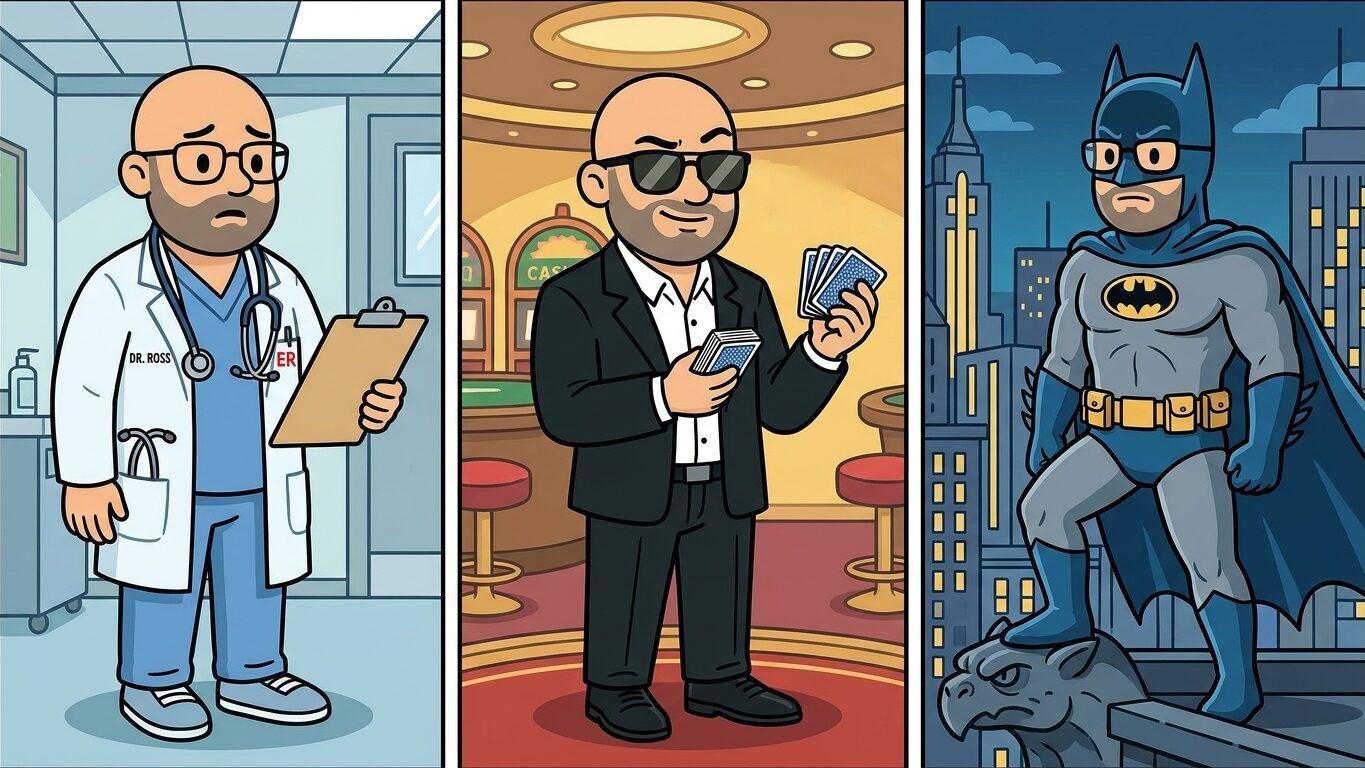
George Clooney said this as he accepted the Golden Lion for Lifetime Achievement in Venice from Pietrangelo Buttafuoco, with Laura Dern testifying to a life spent pretending to be doctors, thieves, and—he himself admits, laughing—a terrible Batman.
Meanwhile, a few hundred kilometers away, the world's ruling classes continue their favorite sport: competing for supremacy in verbal violence and cosmic nonsense passed off as political vision. And who, that evening, gave the most honest, lucid, and unified speech of the year? Not a head of state, but a man paid to pretend to be someone else. If that's not enough to elicit a bitter laugh, read on.
The paradox: to command is theater, to act is truth
Let's put it bluntly, because ceremony doesn't serve anyone here. Those running for power these days rarely develop a platform: they prefer to build a character. They choose the tone of a permanent election campaign, practice the mask of indignation to display at the right moment, calibrate their promise to the week's poll. It's pure commedia dell'arte: fixed personas (the reformer, the strongman, the savior of the country), scripts recycled from generation to generation, and a narrative in which improvisation is permitted only within pre-established lines.
The substantial difference from authentic theater is that in the theater, when the curtain falls, everyone knows it was fiction. In politics, this is not the case: fiction pretends to be government, and the systematic distortion of reality becomes the only instrument of consensus when true facts are no longer useful to anyone.
On the other side of the stage, there are those who openly declare their pretense, put their name on it, and collect their fees openly. And precisely for this reason, in the rare moment when they stop acting, they appear credible in a way no professional politician can afford to be. Clooney summed it up bluntly:
«The first people authoritarians try to silence aren't politicians. They're journalists who ask questions, artists who refuse simple answers, directors, writers, actors, and musicians who insist that someone you've never met deserves your empathy.»
Power fears those who know how to pretend well: those who do it professionally can recognize someone else's act from miles away. And he is the only interlocutor who is not satisfied with a front seat to applaud on command.
The jester had a license. We, apparently, did not.
There's a historical precedent that makes this paradox less bizarre and much older than we'd like to admit. In the Middle Ages, the court jester was the only figure granted the so-called "license": the freedom to throw the most uncomfortable truths in the sovereign's face, provided it was done under the protective veil of mockery. Remove the veil, and the exact same phrase uttered through a stern face would literally cost one's life. Leave it on, and it becomes tolerated entertainment; indeed, necessary, because even the most ferocious tyrant needs someone to show him the truth without making him feel burdened.
Centuries later, the stage changes but the dynamic remains intact. Charlie Chaplin, at the end of The Great Dictator, makes an unimaginable gesture for the rulers of his time: his Jewish barber, mistaken for the dictator Hynkel, stops playing Hitler and speaks in his own name, addressing the audience beyond the screen, with a heartfelt plea against hatred and tyranny. A comedian removes his mask to utter the most serious words of the century—in 1940, while real-life despots held rallies that read like shoddy scripts written by mediocre directors.
Clooney does the same thing in Venice, with the same surgical efficiency. He opens by joking about himself:
«When they tell you you're going to receive a lifetime achievement award, you think two things: what an incredible honor, and maybe they know something I don't... have you spoken to my doctors?»
Within two minutes, however, he puts aside the brilliant entertainer to get to the heart of the matter: those in charge aim to convince us that we are irreducibly different and hostile to one another, because mutual fear is wonderfully governed, while similarity creates community.
«We live in a time when those in power tell us to fear each other. But we know it doesn't work that way, right? Because history teaches us so..»
Who's really afraid of stories?
The most cutting thrust of the entire speech deserves to be printed and posted in several institutional buildings:
«He who is afraid of books, music, and stories is never the hero of the story.»
Reversed, it sounds like a clear diagnosis: those who tell authentic stories don't fear the truth, because they live with it every day on set, on stage, or in front of a score. Those who govern by playing an empty role, however, fear the truth: in contact with it, they dissolve.
Here the speech stops being a formal thank you and becomes a very lucid political reflection disguised as a red carpet, with a tuxedo instead of a toga:
«Movies don't stop wars, they don't lower inflation, they don't change elections. But they do one extraordinary thing: they remind us that a stranger is never truly a stranger, and that he could be the hero in someone else's story..»
No miraculous promises; just a crucial reminder: as long as someone continues to tell honest stories, we'll be able to spot the false ones. Even those uttered by those wearing the official tie and speaking from the pulpit with the most solemn air in the world.
The chilling corollary: what if a machine writes the tale?
There is a piece that makes this reflection even more urgent, raised by Clooney himself in the press conference: artificial intelligence makes it progressively more difficult to distinguish the true from false, launching an open challenge to information, democracy and critical thinking.
If today's absurdity sees those who act telling the truth and those who govern performing cabaret, tomorrow's scenario risks being even more insidious: machines programmed to fabricate fictions without any flesh-and-blood interpreter capable of removing the mask when conscience calls. The jester put his own mind, his voice, and his vulnerability on the line. Deepfake risks nothing, simply because it lacks a heart from which empathy can flow.
So what, Batman?
Let's return to the title, to close the circle with the same irony with which it began. Clooney knows this well: among his famous roles, the one he recalls with the most amused indulgence is Batman, a film he himself calls embarrassing, admitting that only his children find it memorable (perhaps because they've never seen it in its entirety).
It's the perfect detail for this human comedy: the man who just delivered one of the most sincere and profound speeches of the year is the same man who, several years ago, wore a rubber suit with sculpted nipples in a forgettable comic book movie.
The secret lies precisely here: only those capable of laughing at themselves with complete freedom can afford, a moment later, to speak of dignity and truth with such credibility. The actors of power lack this dual gift—the grace of the jester and the courage to drop the mask—completely. And that's why, when it comes down to it, a doctor, a thief, or Batman will save us far more than yet another rally stuffed with cheap promises.

Digital creative, musician, and storyteller. I explore the intersection of humanity and technology, telling stories of AI, music, and real life. Welcome to my organized mess.”