The day Elvis's pelvis shifted the Earth's axis
There are dates that have marked a before and after in history: the October 12, 1492 with Columbus going off course, the July 14, 1789 with the storming of the Bastille, the February 13, 1919 when Charles Strite patented the automatic toaster.
Then there is the September 9, 1956. That evening the world did not see governments fall: it simply saw bourgeois decorum crumble, broadcast live nationwide.
Before that Sunday evening, America floated in a placid, pastel-hued bubble. There was Eisenhower, cars with chrome fins, laundry hanging out to dry, and soothing singers who raised their left eyebrows to convey intensity. Everything was pristine.
Then the CBS cameras came on.
One evening, sixty million people
On September 9, 1956, Elvis Presley appeared for the first time at the’Ed Sullivan Show, in front of an audience of 60.71 million people, equal to’82,6% of American television viewers that night — a figure that would drive any television executive today to sell his soul to the first available devil.
The show's owner, Ed Sullivan, wasn't even in the studio: he was in bed, reeling from a car accident. In his place, hosting for the night, was an Oscar-winning actor on loan for the occasion: Charles Laughton. A detail that seems like a barroom anecdote, but it actually tells it all: the most photographed revolution of twentieth-century America occurred with the host absent, ushered in by a substitute who happened to be there almost by chance. Even history, sometimes, is written while the titular director is convalescing.
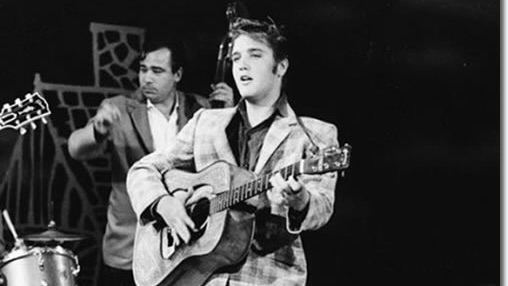
A twenty-one-year-old from Tupelo took the stage, wearing a light-colored checked jacket, a quiff sculpted in brilliantine, and holding an acoustic guitar as if it were a shield. That evening Elvis reeled off Don't Be Cruel, Love Me Tender, Ready Teddy e Hound Dog.
Crooked smile. Dark, shameless voice. But it was the body that detonated the room.
The geological fault
That legwork was a domestic splitting of the atom. At 7:59 PM, young Americans were good sons destined to replicate their fathers' reassuring lives; at 8:05 PM, they were a tribe hungry for electricity, noise, and muscular freedom. Mothers grabbed smelling salts, crying out about moral apocalypse. Fathers watched family hierarchies totter across the kitchen linoleum. Daughters suddenly stopped listening to anyone over twenty-five.
Four songs were enough to trace a geological fault line. On one side, the muffled postwar strings; on the other, the volume turned up to ten, the unapologetically displayed sensuality, the black beat fused with the white dust of country.
It must be said, so as not to write only hagiography: that revolution was also a perfectly commercial affair. CBS knew exactly what it was airing, and it share monster It wasn't a hiccup, but the stated goal. Elvis changed an era, while behind the scenes someone was juggling Trendex ratings. Cultural revolution and editorial planning sometimes walk hand in hand.
If he were born today, would we notice?
Here's the question that's been going around in my head since I reread this story: If a new Elvis was born today, would we recognize him?
In 1956, four songs and a hip movement were enough to split an entire country in two, because that gesture struck a world accustomed to silence, composure, and a raised eyebrow as the ultimate form of transgression. Today, we live in a constant, uninterrupted noise, designed specifically to never shock us for too long. Every day, we scroll past bodies, provocations, and scandals engineered by an algorithm that knows exactly how much shock to administer before moving on to the next content.
We are hyper-exposed, not hyper-sensitive: two very different things.
Maybe a new Elvis would already exist today, and we'd be shrugging him off without realizing it, stuck between a recipe video and a skateboarding dog. Or maybe the revolution that would shift the Earth's axis again would be something we don't consider subversive in the slightest today, just as in '56 no one feared a kid from Tupelo with an acoustic guitar.
That night, rock and roll left the periphery of youth fashions to become a collective liturgy. All because a boy decided that standing still in the center of the stage was an insult to life. Who knows if, somewhere, there is still someone willing to think this way—and if we would still be capable of being shocked enough to notice it.

Digital creative, musician, and storyteller. I explore the intersection of humanity and technology, telling stories of AI, music, and real life. Welcome to my organized mess.”