
We raised the white flag without realizing it: how we stopped caring for the planet to learn to live with it (badly)
The smell of asphalt and the background noise of the air conditioner
There was a time when summer had its own precise breathing rhythm. In the 1980s, when July afternoons became too thick for cycling, we took refuge in the shade of an orange-striped tent with a glass of sparkling wine or cold barley. The heat was an honest adversary: it arrived, pounded the asphalt hard, making it sparkle with tiny fragments of quartz, and then, punctual as a Genesis symphony, it was swept away by a late-August storm that left the air with the violent, clean scent of ozone, wet gravel, and maritime pines. You knew that the scorching heat was a transition, a parenthesis before the return of the natural order.
I've always loved the heat. Ever since I was a child. Sweating never bothered me, nor did I understand the contemporary idolatry of air conditioning blasting at 19 degrees Celsius, with humans huddled in their July sweaters like survivors of a small domestic ice age.
When I was still living with my parents, they installed air conditioning in my house. To sleep without turning my immune system into a striking call center, I was forced to close the bedroom door. The cold air was elsewhere. An almost ideological choice, if you like: you face the heat, you don't run away from it.
And I continue to suspect that the mandatory tie in certain halls of power is the reason why so many powerful people are going brain-dead: tie a knot around a man's neck in July, cut off some oxygen, and then ask him to make decisions for millions of people. It can't end well.
Never underestimate the physiology of stupidity.
Yet this year I struggled more than usual. Much more. I, the one who loved the heat, the open windows, the air conditioning regarded with almost religious suspicion. At a certain point, it was no longer a question of preference, nor of age, nor of romanticism as a veteran of the analog summer. It was as if the air had changed consistency. Not hot: hostile.
It was then that I realized I'd noticed something I'd probably been seeing for a long time: not only is the climate changing. The way we're taught to think about it is changing. This is where the’climate adaptation, from a concrete necessity in some circumstances, risks turning into its opposite: an elegant way to accustom us to the idea that there is nothing left to save.
Today, heat is no longer a meteorological event; it's a permanent ontological condition, an opaque blanket that compresses the air and forces air conditioning motors to whine incessantly, day and night, like the turbines of an ocean liner stuck in the mud.
But the real anomaly isn't the thermometer that reads industrial-strength numbers as you walk down the street. The real metamorphosis, the subtle and frightening one that slips under your skin without a sound, concerns the way we've stopped telling ourselves that story.
If you try to stop a passerby, look them in the eye, looking away from their smartphone notifications for a second, and ask them if they've noticed that the grammar of the catastrophe has changed without our knowledge, the script repeats itself almost endlessly: first a blank stare, then a thoughtful pause, and finally a kind of bitter awakening: "Damn, you're right. I hadn't noticed."«
I hadn't noticed.
The most effective way to make people digest the unacceptable is not to deny it by force, but to transform it into a bureaucratic habit that can be resigned with a shrug. And it is precisely there, in that shrug, that the success of the operation is measured.
Because the most disturbing fact of this summer isn't the number on the thermometer.
It's just that that number, for the first time, is no longer news the next day.
Climate Adaptation: From Scalpel to Morphine
Until a few years ago, the dominant rhetoric—despite its hypocrisies and the parades of double-breasted delegates—maintained an interventionist stance. There was, at least on paper, a vocabulary of care: mitigate, reverse course, reduce emissions, save what could be saved. There was the idea that, faced with a patient with acute pneumonia, the duty of the scientific and political community was to find penicillin and eradicate the infection.
Then, suddenly, with a semantic coup worthy of the worst narrative marketing, the register changed. We slipped seamlessly into the doctrine of adaptation.
It's no longer about putting out the fire, but about buying cool fans to decorate the living room while it burns.
We're told, with pastel-toned graphics and a sterile serenity, that the future will inevitably be worse, that 40 degrees in the shade will be the refreshing normality compared to what lies ahead, and that the only task left to citizens is to develop individual "resilience." It's the ethical and medical equivalent of a doctor who enters the ward, throws the prescription pad in the wastebasket, sits at the foot of the bed, and whispers with a reassuring smile:
«"Look, recovery is out of the question. Let's just hope the pain becomes chronic enough quickly that you don't notice it anymore."»
The magic word is adaptation. It seems adult, pragmatic, almost reassuring. In reality, too often, it's the politically polite version of surrender. Be careful: adapting also means protecting cities, jobs, agriculture, and people from consequences that are already here. But if climate adaptation It becomes the reason to stop trying to reduce the damage at its source, then it's no longer pragmatism. It's administrative disaster management.
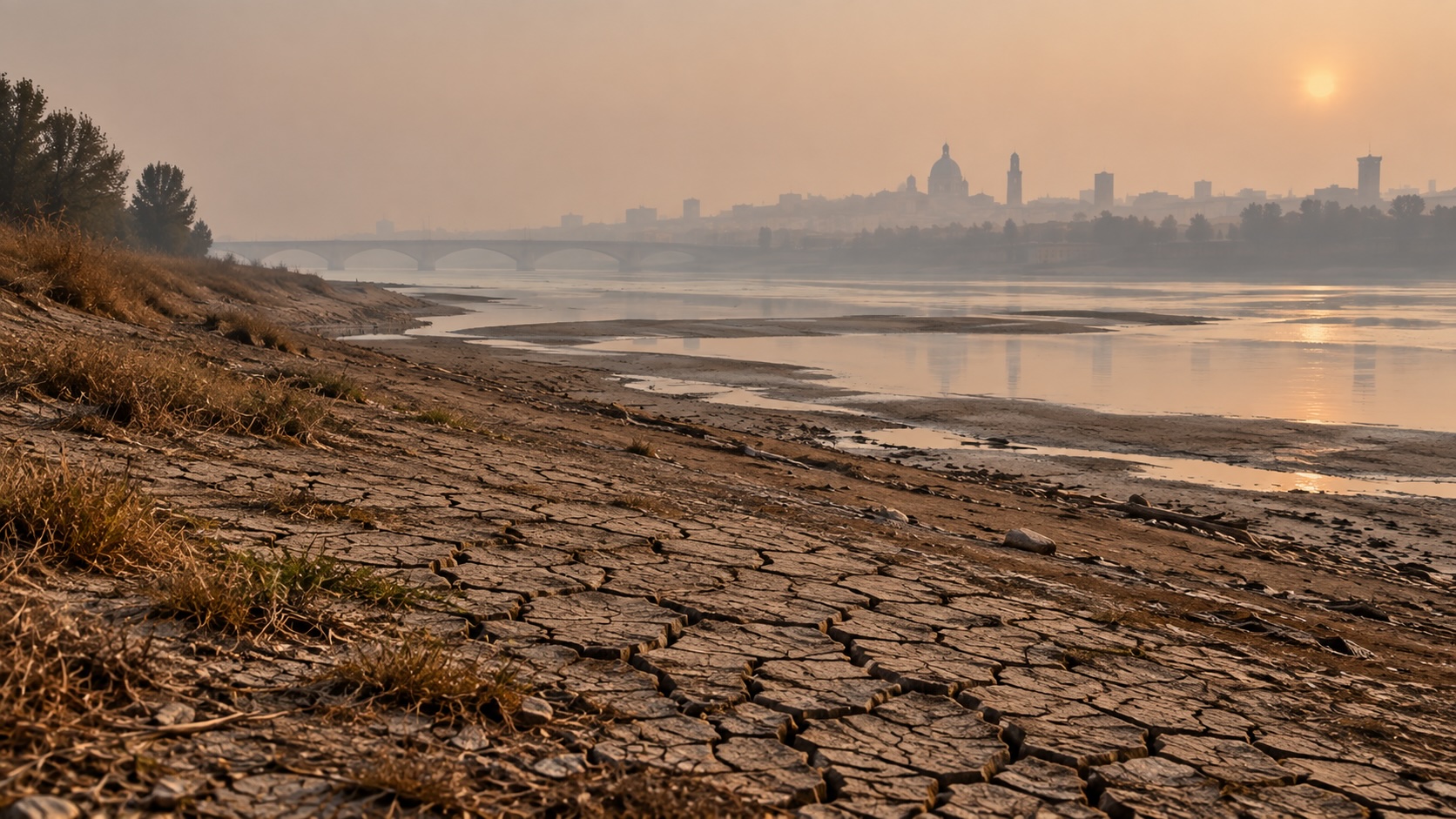
The scope of this collective brainwashing It's not measured in words. It's measured in centimeters and tons, and it's here that the anesthesia becomes clinically observable. At the end of July 2026, the Po River in Parma dropped to almost eight and a half meters below zero, a level that surpassed the historic low set in June 2022. In just a few weeks, the entire district's water severity level went from "medium" to "high.".
Eight. Meters. And. Sixty.
It's not an impression. It's not a worried-faced environmentalist in front of a camera. It's a river that stops looking like a river.
On the Stelvio, the last Alpine resort still offering summer skiing after the surrender of the Matterhorn and Ponte di Legno Tonale, the company that manages the lifts suspended operations indefinitely on August 15th. Not because of insufficient snow, but because the glacier no longer freezes at night and is literally crumbling under skiers' boots. On the day of August 15th. On the day when this country typically debates whether carbonara is better at the seaside or in the mountains.
Meanwhile, Confagricoltura estimates damage to agriculture in the North approaching two billion euros and is calling for a state of emergency.
And nothing. Let's scroll.
Once upon a time, news of this magnitude would have shaken public opinion, sparked parliamentary debates, and generated that modicum of cognitive friction that paves the way for action. Today, they slip away in the blur of daily news feeds, bundled between a viral video of kittens and yet another artificial controversy artfully created to distract the audience.
The fact that I have to specify the source, the date, the exact number to make you believe something you could simply see with your own eyes by looking out over a riverbank is already the most eloquent proof of how narrative has prevailed. We've been taught to trust only official data and, at the same time, to distrust even our own perception of reality.
Before They convince you you're overdoing it. Then they convince you it's normal. Finally, they sell you a more powerful air conditioner.
The circus of lackeys and the ironic smiles of disengagement
To understand the extent of the debate's decomposition, simply indulge in the anthropological torture of watching one of those evening in-depth talk shows. Television studios chilled to 160 degrees Fahrenheit, where professional commentators, unconventional politicians, and propaganda lackeys perform the pantomime of a fake ideological clash. A script delivered with the confidence of someone who won't have to pay the price. Let their children and grandchildren worry about it.
When the host, almost apologizing for interrupting the program, introduces the topic of record temperatures or the drought strangling agriculture, the reaction of these extras is textbook: a sardonic smile, a slight adjustment of the silk tie, and a sneering quip delivered with the smugness of those who know a thing or two about it. "You don't believe this catastrophic nonsense, do you?", "Hot summers have always existed," "We should focus on business, not on windmills.".
None of them, it should be noted, has ever openly denied a glacier stopping freezing or a river eight meters below its historic low. They simply don't mention them, which is far more effective than any denial.
You don't fight one fact by citing another.
The subject is changed before the audience asks questions.
There's a distinct perversion in this sneer. It's not simple ignorance; it's the cynical awareness that, in the economy of fragmented attention, selling disengagement is infinitely more profitable than proposing the rigor of complexity. It's the victory of monodisciplinary and shortsighted thinking, incapable of connecting the dots between atmospheric physics, the industrial costs of transition, and the material destiny of future generations.
A system that prefers to mock the thermometer rather than admit that the boiler has been broken for decades.
Technology allows us to map the collapse of a glacier millimeter by millimeter, to know with surgical precision how many centimeters of water a river is missing from its historic low. But our moral high ground stops at the smug grin of those who believe that simply not looking out the window will stop the hail.
We have the precision of sensors and the voluntary blindness of ostriches.
And we made them coexist without anyone being ashamed of the paradox.
Beyond Anesthesia: Rediscovering Your Vision and Dignity
The transition from "we must act" to "we must adapt" is not a natural evolution of ecological thinking: it's a cultural capitulation disguised as pragmatism. We've been convinced that resignation is a form of adult wisdom, that demanding a change of direction is a childish utopia best left to kids with colorful placards in the squares.
It's the same rhetorical trick that works every time: those who get alarmed are naive, those who give up are mature.
It's a shame that this ripeness is measured in billions of euros of burned crops and in ski resorts closed on August 15th for the first time in their history.
Accepting that fever becomes our habitual state means renouncing the primary function of the human intellect: recognizing paradox, unmasking deception, and resisting the banality of decline. The beauty of the world—the beauty we desperately seek in glimpses of pristine nature, in the folds of analog memory, or in the precision of a work of art—is not an inexhaustible resource to be consumed down to the last byte of profit.
Perhaps the first step to breaking this spell of torpor doesn't require magic formulas or instant revolutions, but an act of pure mental hygiene: stop smiling along with the clowns of the moment, reject the anesthesia of chronicity, and start calling destruction by its true name again.
A dry river is not "a slightly dry summer.".
It is a river that slowly dies before our eyes.
And we're just deciding whether to watch him die in silence or speak up while we still can.
Because adaptation without dignity isn't survival: it's just a slow, hot sleeping pill. And the most disturbing thing is not that they're administering it to us, but that we asked for it, under the pretext of sleeping better.

Digital creative, musician, and storyteller. I explore the intersection of humanity and technology, telling stories of AI, music, and real life. Welcome to my organized mess.”

Article bagus! Transkripsi Gemini 3.5: Gem Transcribe — . Gem Transcribe