That time Walt Disney kidnapped the President of the United States
Imagine the scene.
You're a young designer in your early twenties. You're wearing a uniform hastily sewn three hours earlier, which itches like a colony of fire ants.
In front of you is a control stick. Under your feet, six hundred volts of direct current. And sitting directly behind you is the future President of the United States of America and his family.
Without an escort. Because you just left your escort stranded on the station platform.
Panic? No, much worse: Disneyland, June 14, 1959.
Today we live in the age of idiot-proof protocols, of risk assessment estimates and Teams meetings to decide what shade the bread should be. If a bolt doesn't have three ISO certifications and the algorithm's blessing, nothing moves.
In 1959, things worked differently. They ran on caffeine, duct tape, and a wonderful, crazy dose of human recklessness. The hero (or intended victim) of this story is called Bob Gurr.
For those familiar with entertainment history, Bob is a living legend of Disney Imagineering. That Sunday morning, however, he was just a terrified boy praying to all the saints in the industry calendar that his creation wouldn't catch fire for the world to see.
His job was to drive the brand new monorail train – the Monorail Red – outside the Tomorrowland station so the national TV cameras could catch him. That's all.
An insignificant detail: in the previous days, that damned train had broken down. every single day.
Bob and a German engineer, Konrad Deller, hadn't slept for weeks. They'd grab a quick dinner at the park hotel, go up to their rooms to sketch spare parts freehand, load the drawings into a van at midnight bound for the Burbank workshops, and assemble the freshly turned parts the next morning.
The train had completed its very first run without breaking down just the night before the inauguration. Bob's plan was crystal clear: travel ten meters at walking pace, give the shot to the television, and then pull the brake. If it exploded afterward, who cares? The cameramen had their shot.
Then, the unexpected.
Walt Disney appears. And he's not alone.
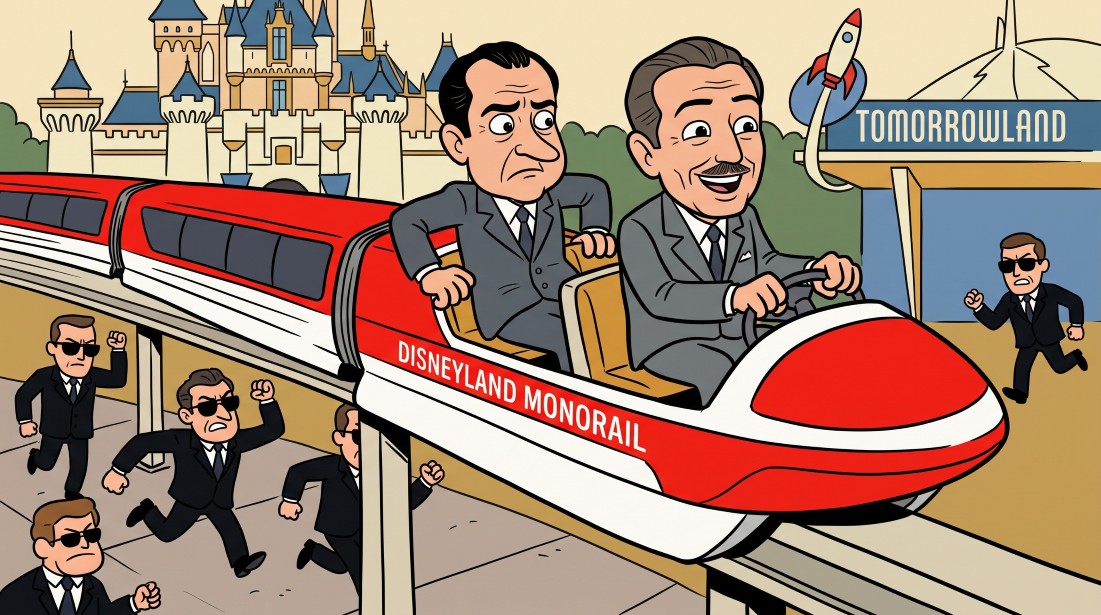
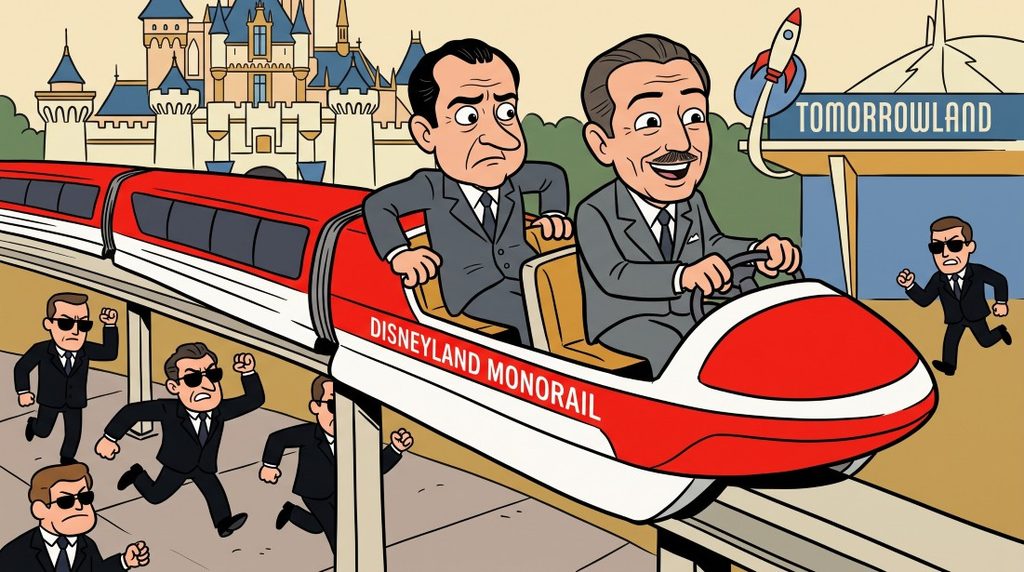
At his side is Richard Nixon—then Vice President of the United States—accompanied by his wife and daughters, Julie and Tricia. Behind them, a platoon of Secret Service agents, their jaws clenched and their expressions as if they see threats even in popcorn. Everyone climbs aboard to cool off in the air-conditioned cabin. Everyone except the park security and, most importantly, the federal agents. Walt turns to Bob. He flashes that sly smile of an unpunished visionary and blurts out two words: "Let's go!" Bob doesn't have the heart to contradict him. He starts the engines at 600 volts. He closes the doors.
Part.
The Secret Service remains grounded.
Literally planted on the track watching the second charge of the State glide away in mid-air inside a flaming red torpedo.
Nixon turns, sees his bodyguards frozen through the glass, and bursts out laughing. Anyone who's been in the White House knows that presidents spend their term desperately trying to outrun their security detail; Nixon had just managed it without lifting a finger. Bob Gurr, on the other hand, isn't laughing at all. He's behind the wheel, cold sweat running down his back, unsure whether he's more afraid of a short circuit or immediate arrest for high treason.
The first lap ends. Miraculously: no smoke, no bang. Bob begins to slow down. He sees the station approaching and is already anticipating the relief of stepping out of that trap and taking a cold shower.
But Nixon's daughters start jumping in their seats: «"Again! We want to go again!".
Walt turns to the cabin: «Bobby, give him another spin.».
At that exact moment, the Secret Service agents see the train slowing and launch an attack. Adult men in gray tailored suits race along the platform at breakneck speed, gesticulating like madmen and trying to grasp the handles of the sealed doors. A mute comedian carries her service pistols under her jacket.
Bob looks in the rearview mirror. He sees the officers rushing by. He looks at Walt: eyebrows raised, a childish expression on his face as he looks at a Christmas present. When Walt Disney was in that state of mind, there was no penal code that could stop him. Bob pushes the control stick forward.
Accelerate.
And he leaves the secret services behind for the second time.
Bob won't remember anything about the second lap. Total amnesia from pure panic.
When the monorail finally stops at the terminus, Walt, Nixon, and their daughters walk down the ramp with princely nonchalance, blending in with the cheering crowd.
And the officers? They board and sit in the carriages of the now-empty train, panting and staring into space. They hadn't even noticed that their man had disembarked and was already signing autographs among the rides.
Technically and legally it was a kidnapping of the second highest office in the state.. But there was no strategic plan. No slogans. Zero protocols. Just Walt wanting to entertain two little girls.
If something like this were to happen today, we would have three days of special editions on the news, the immediate opening of a congressional commission of inquiry and the tribunal of inquisition on social media, with thousands of keyboard security experts ready to explain via tweet how to manage a tactical perimeter.
Today we live in a world of suffocating rules, often mistaking maniacal control for efficiency and sterility for safety. Except then to donate generously our entire life to some algorithm.
Yet, the stories truly worth remembering almost always arise from a burst of healthy recklessness. From a handful of craftsmen bending metal at night in a hotel room, and from a rebellious genius who decides to trample on the script to inject a little extra magic.
There was flesh, there was life, there was courage in that mess.
The next time someone presents you with a graph and tells you that reality must be lived legally and risk-free, think of Bobby Gurr gassing the White House security detail.
Prudence preserves the skin. But it is boldness that enjoys the flesh.
I seek beauty everywhere. And if I don't find it, I kidnap it aboard a monorail.

Digital creative, musician, and storyteller. I explore the intersection of humanity and technology, telling stories of AI, music, and real life. Welcome to my organized mess.”