Concertino for Distortion Guitar and Orchestra: My Birthday Gift
On September 29th I have a little habit, a ritual that over time has become a promise to myself. That day, something of me comes out.
I use "mine" in the most stubborn sense of the word. A music I've been carrying around inside me for months, playing in my head while I'm driving, while I'm answering emails, while I pretend to listen to someone on the phone. A music that at a certain point asks to be released, and that I, at least once a year, let out without asking for my ID.
Last year it was Symphonic Reverie: eight minutes and thirty-two seconds of progressive metal, played alongside Michiko Funakoshi, the drummer's beast. I still remember the feeling of that day: releasing a suite over eight minutes long in the era of two-and-a-half-minute songs seemed like a small act of disobedience. I loved it.
This year I decided to make things worse.
How the Concertino was born
It all started with a title, which is a dangerous way to start things.
Concertino for Distortion Guitar and Orchestra. I found it stuck in my head like that, already complete, with that slightly ridiculous solemnity of opera program notes. And it made me laugh. Then it made me think. Then it kept me awake.
Because the concertino, in the classical tradition, is a small and graceful thing: a soloist who dialogues with the orchestra, in a shorter and lighter form than the actual concerto. Red velvet music and composed applause. And I, instead, imagined the rudest soloist I know: the distortion pedal. That pedal that takes a clean sound and dirties it, saturates it, makes it rough as sandpaper. For decades, it was the symbol of everything that "serious music" looked down on.
Putting that pedal in the center of the stage, with the orchestra around it, was too beautiful an image to leave it there.
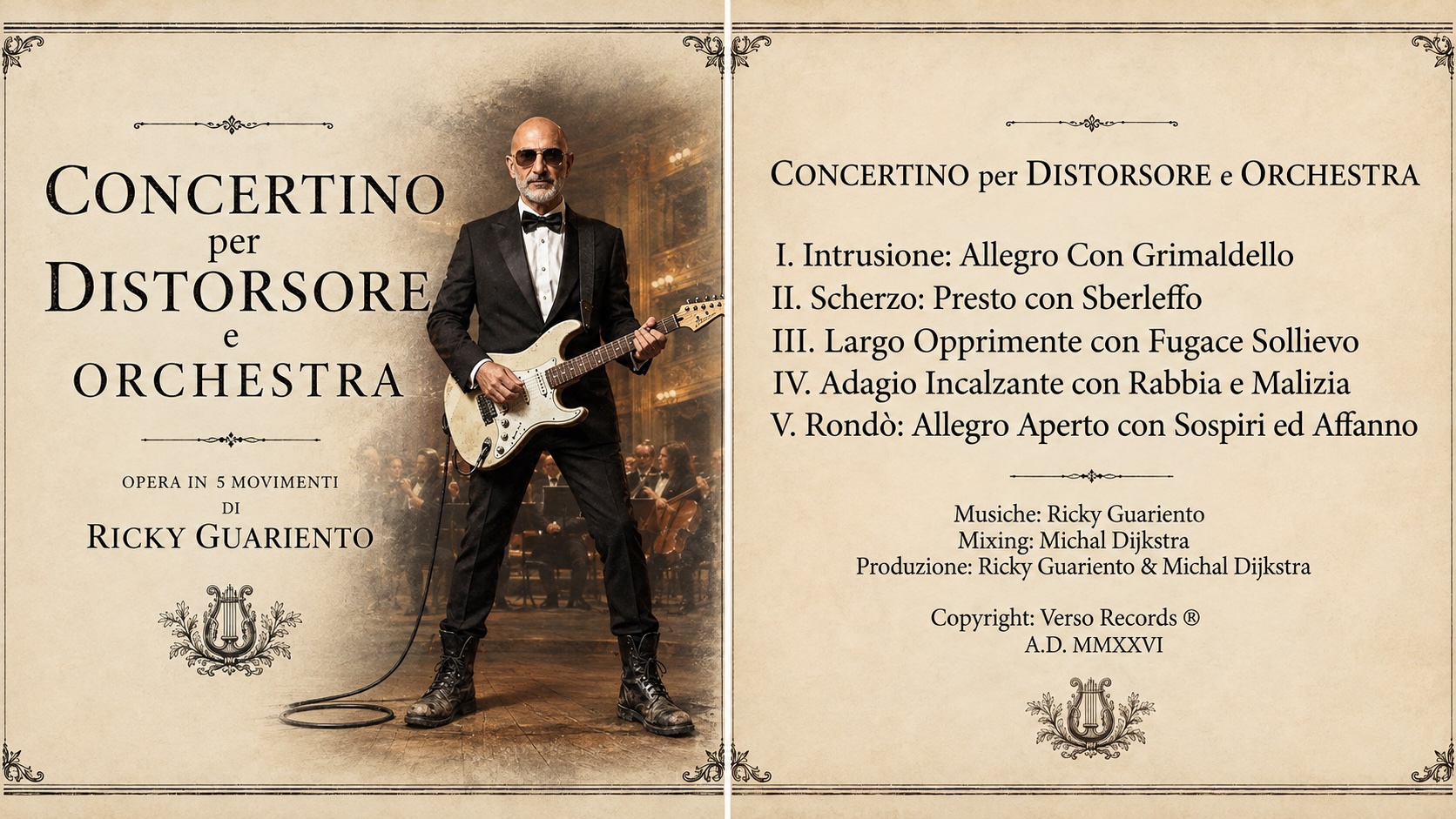
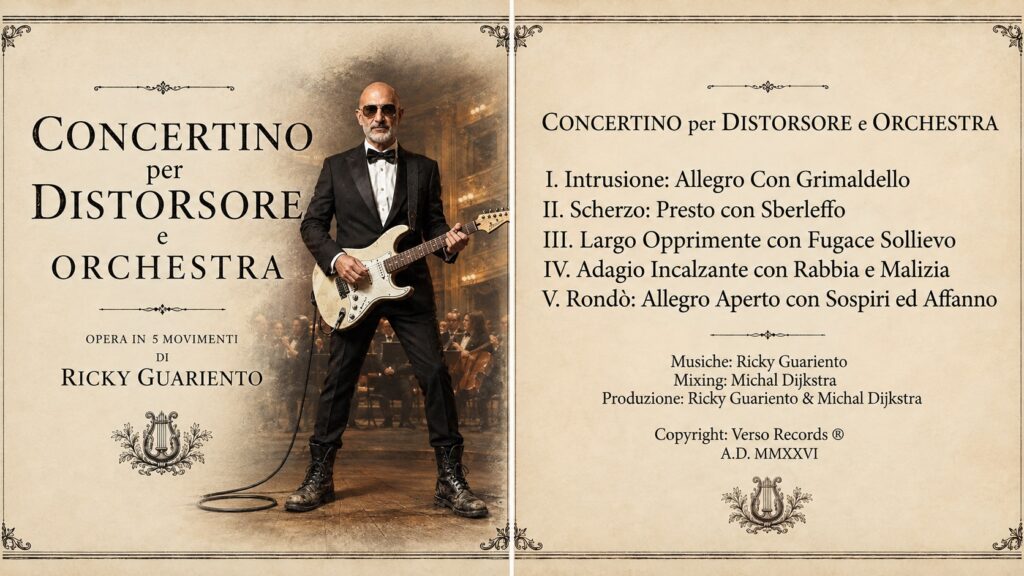
This is how a five-song mini-album was born, an EP if you like, which I conceived from the start as a work in five movements. The music is mine. The mixing is by Michal Dijkstra, and we co-produced it.
Michal, or finding someone as crazy as you
I have to say a few words about Michal, because without him this album would have remained a fun idea to talk about at dinner.
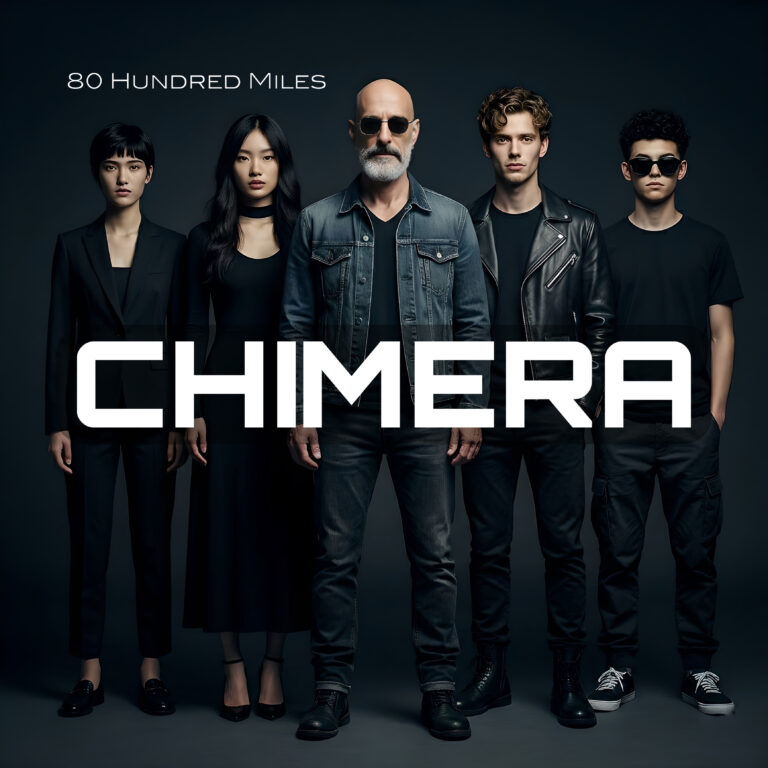
Michal is Dutch and a production genius. Those who follow the blog already know him as a keyboard player for 80 Hundred Miles, the band spread across five countries who have never been in the same room together. Working with him means having someone by your side who, when faced with a crazy idea, instead of holding you back, asks: "What if we took it even further?"“
There are collaborations where you spend your time defending your choices. With Michal, the opposite happened: I found myself saying, "Maybe we're exaggerating," and he replied that that was precisely the point. The files traveled between Veneto and the Netherlands, came back transformed, and each time there was a new detail that made me smile. It's rare to meet someone who immediately understands what you're getting at when you can't even explain it well.
Five titles, five confessions
Anyone who's studied music knows that the classical tempo markings—Allegro, Adagio, Largo—are precise instructions for the player: they tell him how fast to play and with what character. I took them and twisted them into little self-portraits. Rereading the titles now, I realize they reveal more about me than I had anticipated.
I. Intrusion: Allegro with Grimaldello. That's how I got into classical music: through the window, at night, with burglary tools. No one ever gave me an official invitation to that room, and at a certain point I stopped waiting for one. The joy is there, the joy of someone who knows they're somewhere they shouldn't be and enjoys it anyway.
II. Joke: Quick with Sberleffo. The scherzo is a true classical form, created to lighten up symphonies, and the name itself is an invitation to play. I added the tongue-tie. It's the piece about the little boy making faces at the statues of great composers in the theater foyer, and that little boy, evidently, never fully grew up.
III. Broad Oppressive with Fleeting Relief. Here, irony gives way to something else. I know well that weight that presses on your chest and takes away your breath, and I also know those moments of respite that come suddenly and go away too soon. The pun on "fugace," which conceals the contrapuntal fugue, is intentional. I liked the idea that even relief, in order to escape, needed a musical form.
IV. Adagio Incalzante with Rage and Malice. An adagio is slow by definition, a fast pace pushes you forward: together, they form an oxymoron that shouldn't work on paper. Yet it's the most honest description I know of a certain adult anger, the kind you learn to keep in check, that creeps up slowly and yet hurries you along. Malice is the crooked smile with which, in the end, you try to make peace with all this.
V. Rondò: Allegro Aperto with Sighs and Pangs. The rondo is the form of return: a theme that reappears cyclically, alternating with different episodes. It seemed to me the right way to close, with a circle deliberately left open. Inside are sighs and breathlessness, the kind that lingers after running against the wind for four movements. It's the finale of someone who reaches the top of the climb out of breath and decides to laugh.
CLICK ON THE PROMOLINK TO CHOOSE YOUR PREFERRED STREAMING SERVICE
Desecrate what you love
Some people, reading these titles, might think I'm against classical music. It's exactly the opposite.
You only make fun of what you love enough to know well. These five pieces express my entire debt to that tradition: the forms, the architecture, the idea that a piece can be constructed like a cathedral. What I find uncomfortable is the glass case, the feeling that "great music" should be listened to in silence, with a tie, from a safe distance.
Symphonic metal and progressive rock taught me this as a boy: an orchestra and a distorted guitar can convey the same uneasiness with two different accents. Demystifying the myth, for me, means bringing it closer, taking it down from its pedestal and putting it back among the people, stained with dust and feedback.
Why birthday?
For three hundred and sixty-four days a year, I do what everyone else does: I work, I respond, I meet deadlines, I try to be a reasonable person. Or at least I try! September 29th is the only day no one expects me to be sensible. It's socially acceptable to be a little selfish, a little exaggerated, a little out of line.
Then we might as well take advantage of it.
That day, I allow myself the luxury of being the black sheep, of going against the grain without having to explain my direction. Of releasing five instrumental tracks with absurd time signatures in an age that measures music in seconds of attention. I do it for myself, first and foremost, and I discover every year that nothing I could gift myself in the way of "material" makes me happier.
If someone then decides to unwrap it with me, the party becomes more beautiful.
I seek beauty everywhere. And if I don't find it, I create it. This year, it takes the form of a distortion machine that has snuck into a concert hall, taken a front-row seat, and has no intention of leaving.
Enjoy listening. And happy birthday to me. Belated. But that's okay.
Listen to “Concertino for Distortioner and Orchestra” on Spotify · APPLE MUSIC · YOUTUBE · AMAZON MUSIC · TIDAL
Frequently Asked Questions
What is “Concertino for Distortioner and Orchestra”?
It's a five-track instrumental EP by Ricky Guariento, released on September 29, 2026, via Verso Records. It's conceived as a five-movement work that reinterprets classical music forms (scherzo, largo, adagio, rondo) with distorted guitars and a tongue-in-cheek approach, blending metal, progressive, and symphonic writing.
Who produced the EP?
The music is by Ricky Guariento, the mixing is by Dutch producer Michal Dijkstra and the production is by both.
What are the songs?
Intrusion: Allegro with Grimaldello; Scherzo: Presto with Sberleffo; Oppressive Largo with Fugace Sollievo; Pressing Adagio with Rage and Malice; Rondo: Open Allegro with Sighs and Anguish.
What does "concertino" mean?
In classical music, it's a short, lighter composition than a concerto, in which a solo instrument interacts with the orchestra. In this case, the soloist is, provocatively, the distorter.

Digital creative, musician, and storyteller. I explore the intersection of humanity and technology, telling stories of AI, music, and real life. Welcome to my organized mess.”