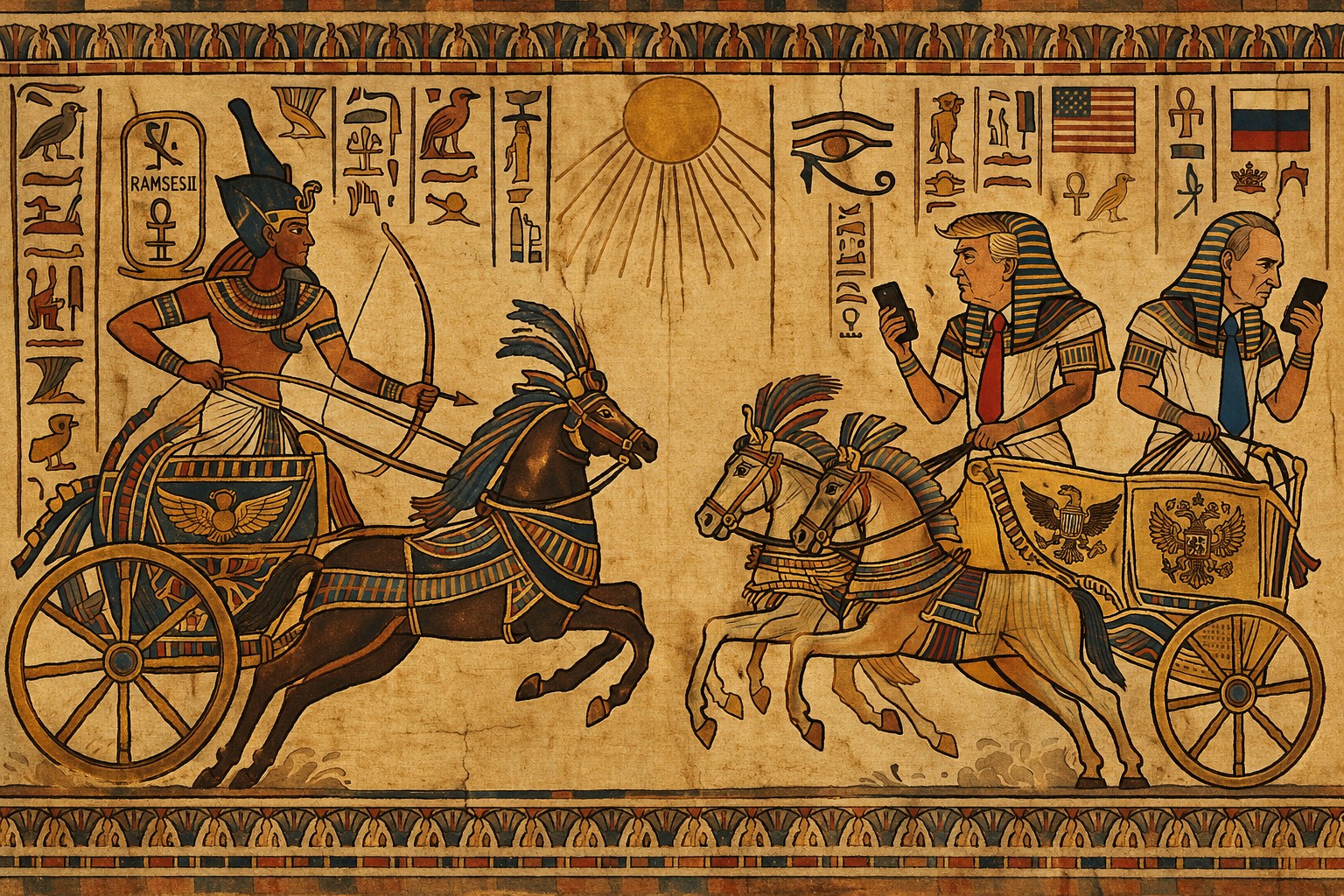
From Ramesses II to the New Pharaohs: 3,000 Years Without Changing a Thing
I have a terrible doubt.
Are we really the most evolved species on the planet, or are we just primates with a fiber optic subscription and a desperate desire to be fooled?
Take three minutes. Take a deep breath and join me on a journey into the past.
The year was 1274 BC. Orontes Valley, Syria. Battle of Kadesh. On one side stands Ramses II, Pharaoh of Egypt, the man with the proud profile and inflated ego. On the other, Muwatalli II, king of the Hittites, a man who didn't have Instagram but knew how to set ambushes.
Ramses falls for it hook, line, and sinker. He falls for the trap, the Egyptian army is overwhelmed, his generals flee in terror, and the Pharaoh finds himself surrounded, isolated, on the verge of being turned into meatballs for jackals. Strategically, a disaster. Kadesh remains in the Hittite hands, and Ramses must make a desperate retreat, saved by the skin of his teeth by reserve contingents arriving at the last minute.
End of story?
Deluded.
Back in Thebes, Ramses does what every ruler with delusions of grandeur does best: fires reality and hires its own creatives. He has the famous engraving on the titanic walls of Abu Simbel, Karnak and Luxor Poem by Pentaur. His version of events? Stuff that would make Marvel Studios pale: the Pharaoh claims to have been abandoned by everyone, to have invoked the god Amun, and to have single-handedly massacred the entire Hittite army, one hand tied behind the golden chariot. Ramses is the true pioneer of the fake news, the leader of shameless political propaganda.
An epochal blunder transformed by decree into a celestial apotheosis. And for nearly three thousand years everyone believed him, until modern archaeologists unearthed the cuneiform tablets at Hattusa and discovered that the Hittites, laughing heartily, had written: “We actually won and the Egyptians fled.”.
Now, I can understand the farmers of the Nile. They didn't have the internet. They didn't have satellites. They could read hieroglyphics as well as I can interpret ancient Aramaic blindfolded. If the god-on-earth carves ten meters of granite for you, with him exterminating monsters, you bow your head and applaud..
But what about us?
Today, we have a supercomputer in our pockets, connected to orbiting satellites, OSINT networks, global databases, and real-time fact-checking. Yet, the script hasn't changed a bit.
Look around without cheering like a stadium. Take that ladies from overseas with a peroxide orange quiff and an extra-long tie. Someone who has made rewriting reality an Olympic discipline. If the economy creaks because of tariffs, he declares that "money rains from the sky and China pays for us." He loses the elections? He claims aliens stole them. If a truce lasts forty-eight hours, he claims to have pacified the globe in an afternoon of golf. The sublime thing is that he uses his proprietary social network like Ramses used blocks of sandstone: with the brute force of performative advertising.
On the other side of the chessboard, in the Kremlin, there is the cold and stiff clone. The one who was supposed to perform a "three-day surgical operation" and has found himself stuck in the mud for years, with a decimated fleet and a creaking war economy, while from the megaphones in Red Square he continues to explain that "everything is proceeding exactly according to plan.".
The technique is identical to that of Kadesh: the lone hero against the betrayal of the world, the victory proclaimed on all networks to consolidate the internal front.
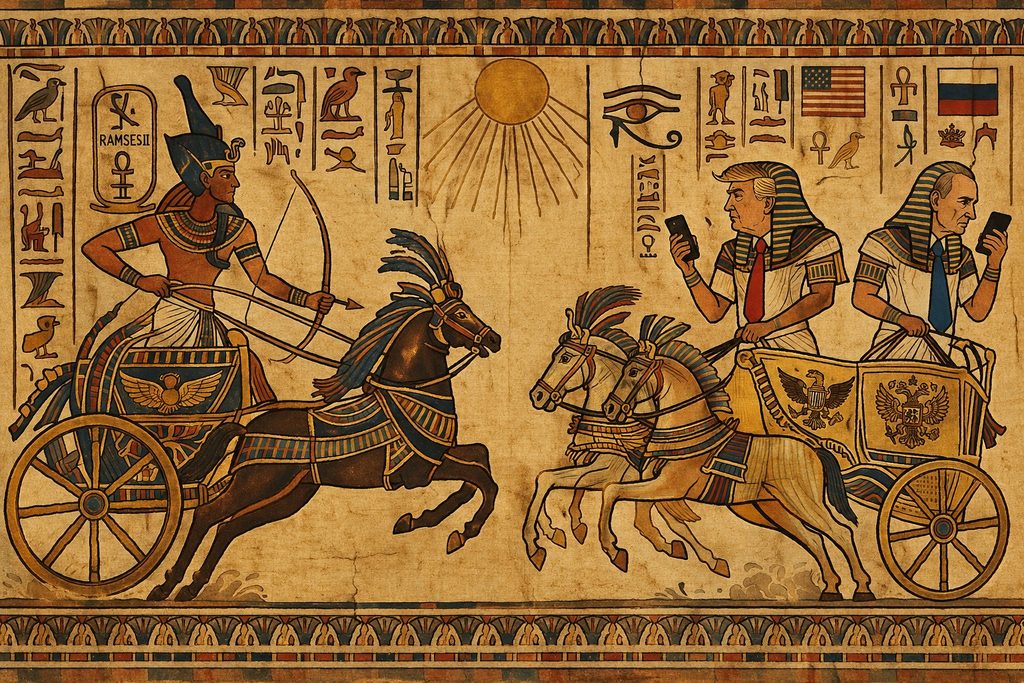
The real difference isn't in the leaders. Megalomaniacs have been an anthropological constant ever since man discovered that a bigger club attracted attention. The real, tragic difference is us. The problem isn't who fires the colossal ball. The problem is the Fan Club. We've gone from the subjects of ancient Egypt to keyboard-swimming fans. Those who don't seek the truth: they seek easy digestion. They seek their sweet and lazy cognitive comfort food. The political fan doesn't read the analyses; he defends his idol. Faced with a scientific denial or satellite evidence that destroys the narrative of his King of Wands, the average fan doesn't say, "Maybe I was wrong.".
No.
He says: “Eh, but the media lies!”, “The powers that be are plotting!”, “Our Pharaoh knows things you sheep cannot understand!”. We have become willing accomplices to the lie. Because admitting that our leader made a colossal blunder would mean admitting that we were fools to believe him. And the ego of the’Homo Digitalis He can't tolerate the frustration of mistakes. He prefers to live in a virtual Abu Simbel of manipulated posts, reassuring algorithms, and monumental lies.
How sweet they are. They hold humanity's entire library in their hands and use it to get bedtime stories from billionaires with delusions of divinity. Ancient propaganda was based on imposed ignorance. Modern propaganda is based on chosen ignorance.
Ramses, at least, had to break tons of stone and pay a fortune to tell his lies. Today, a squalid 280-character post fed to a tribe of functional illiterates who have mistaken blind faith for critical thinking is enough. So let's give ourselves this gift every now and then: let's step outside the fan base. Let's reclaim that shred of intellectual decency that allows us to look at a disaster and call it a disaster, without seeking mystical excuses. Reality has a rough, angular consistency; it often hurts our vanity. But it's the only truth we have underfoot.
I seek beauty everywhere. Even in the naked truth that demolishes false idols. And if I don't find it, I create it.

Digital creative, musician, and storyteller. I explore the intersection of humanity and technology, telling stories of AI, music, and real life. Welcome to my organized mess.”