The Big 16-Year-Old Bluff: We Ban Kids from Social Media So They Don't Look at Our Screens (And the Dog Gets Depressed)
There's a great, reassuring myth that we adults love to tell ourselves before going to sleep — strictly with our smartphones on the bedside table: “Young people today are lost inside a screen, we must save them from themselves.” We indulge in this generational superiority, convinced that the registry office automatically awards us the title of “village wise men.”.
The political response? Drastic. Australia led the way by banning social media for children under 16—the law comes into effect on December 10, 2025, and affects ten platforms, including Instagram, TikTok, YouTube, Facebook, X, Snapchat, and Reddit. The United Kingdom is considering similar measures with the stated goal of "giving children back their childhood." Public health is invoked, and—rightly—a wealth of scientific studies are cited linking compulsive scrolling to anxiety, depression, cyberbullying, and sleep disorders.
All very well. But there's a huge elephant in the room. And that elephant is us.
The Age Bluff (What Science Says)
While governments raise age barriers, psychological research dismantles our certainties. A comparative study published in the’International Journal of Indian Psychology He analyzed levels of internet addiction and emotional maturity among adolescents and adults. The results are a cold shower for Sunday moralists:
- We are dependent in the exact same way. There's no statistical difference in addiction levels between teenagers and adults. We surf, scroll, and alienate ourselves with the same relentlessness.
- Age does not make digital wise. Emotional maturity doesn't magically increase with age when there's a screen involved.
- The emotional escape. There's a clear correlation between internet addiction and emotional immaturity. Put simply, we use our smartphones compulsively as an anesthetic to avoid dealing with boredom, frustration, or loneliness.
So when we see an adult waging a "holy war" in Facebook comments or isolating themselves during a family dinner, we're not seeing a mature person using technology. We're seeing the exact same escape mechanism as a sixteen-year-old. Just with a few more wrinkles.
If even dogs get depressed
But the most tragicomic—and painful—side effect of our digital inattention doesn't just affect our children. It affects our dogs.
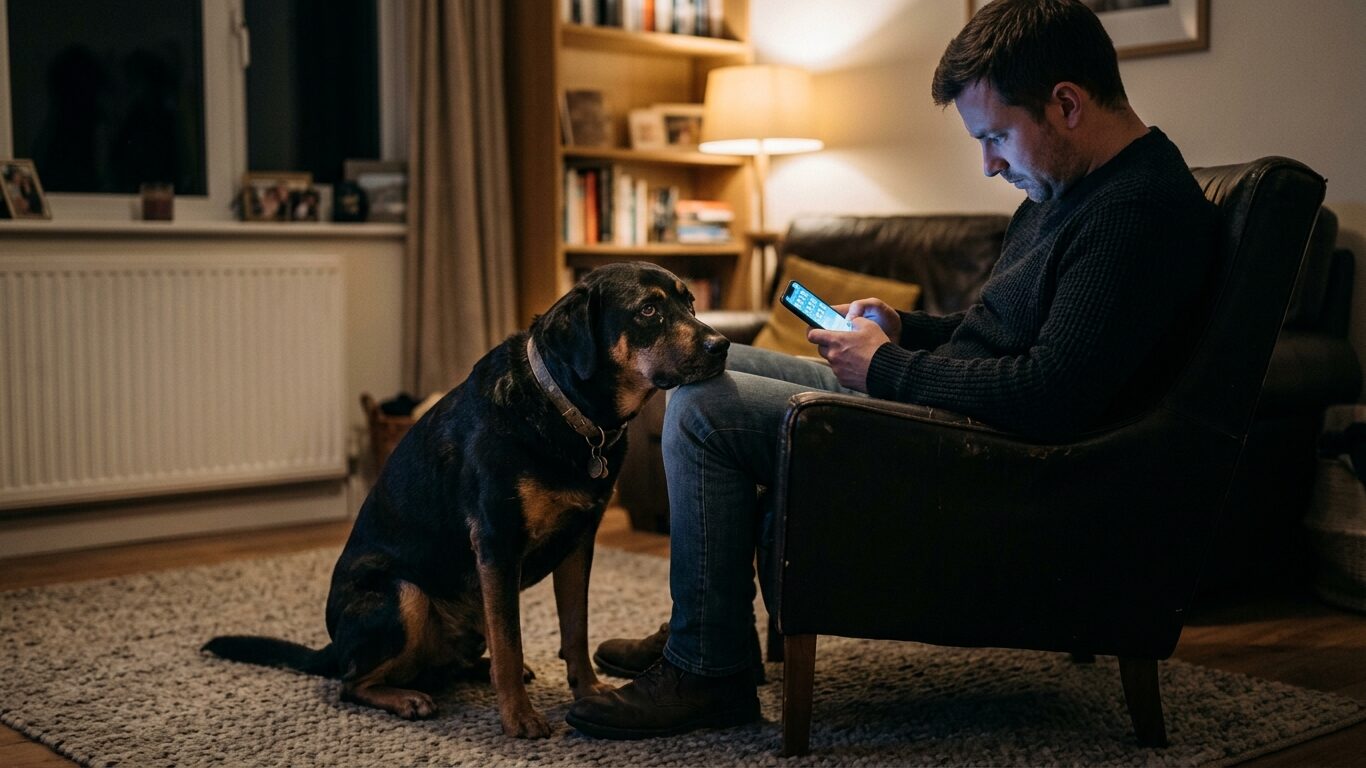
Researchers in the United Kingdom have documented that dogs whose owners spend time staring at their smartphones develop symptoms of anxiety and depression. Dogs are social creatures: they thrive on eye contact, body language, and attention signals. When we're constantly engrossed in our Instagram feed, our pets perceive that dull, slumped face as a form of rejection. They stop socializing, change their eating habits, and develop destructive behaviors.
Digital betrayalWe ignore our kids, we ignore our partners, and we even break our dog’s heart—all to watch videos of someone else pretending to have a great life.
To Ban or to Cultivate?
The restrictive laws are already showing the first cracks. According to a survey by the Molly Rose Foundation, among minors who still manage to access banned platforms, 70% said circumventing the ban was "easy." VPNs, despite platforms being required to detect and block them, remain a widespread tool. And the overall results of the Australian measure, six months after it came into force, are described by CNBC as "mixed": some kids have embraced new habits, others have simply shifted the problem.
Because technology shouldn't be shut down by decree. And the real risk is a boomerang effect: depriving young people of even the positive aspects of the internet—the search for community for those who are isolated, the exploration of their own identity, creativity, activism—without addressing the root of the problem.
The real issue isn't chronological age. It's the emotional education about technology, which we adults lack as much as they do.
The Freedom Fighters (with wallet)
There is another actor on stage, and he plays the most cynical part of all.
The major platforms—Meta, TikTok, YouTube, and Snapchat—have spent the last year vocally opposing the Australian law, waving two noble banners: freedom of enterprise and the freedom of expression of minors. A seemingly seductive argument. Unfortunately, the same companies have since demonstrated, in practice, that they are incapable—or willing—to enforce even the rules they themselves had committed to. In March 2026, the Australian eSafety Commissioner opened a formal investigation against Meta, YouTube, and TikTok for violating the ban: the platforms were still allowing minors to access their services, were not asking for their age, and were not blocking new accounts. They risked fines of up to $34 million each.
It's not incompetence. It's a business model.
The algorithms of these platforms are not designed to keep you safe, but to to hold you in. For as long as possible. According to an internal report cited by Reuters, in 2024 alone, approximately 101 TP3T of Meta's advertising revenue—over $16 billion—would be derived from fraudulent content. Around the same time, Zuckerberg announced the abolition of external fact-checkers: from now on, users will decide what's true. He called this decision "freedom of expression." His lawyers reportedly called it "traffic optimization.".
Elon Musk, for his part, has turned X into a megaphone for algorithmic extremism: incitement to hatred, Manipulation and fake news aren't system bugs—they're features that maximize engagement. And engagement sells.
The picture is this: Big Tech opposes laws banning minors from using their services, citing freedom. But they are the first to fail to make those services safe. Meanwhile, a New Mexico jury ordered Meta to pay $375 million for failing to protect minors from online exploitation. Welcome to surveillance capitalism, where the well-being of a child is worth exactly what it costs to lose them as users.
The mirror we don't want to look at
Before invoking a "nanny state" that would legally take away smartphones from sixteen-year-olds, try answering these questions honestly:
How many times have you checked your phone during your last family dinner? Or has your dog looked at you without you actually seeing him? How many times have you called? digital laziness what, in a teenager, you would call dependence?
The real work isn't what governments do. It's what we do, every day, with screens in hand.
Perhaps, instead of waiting for a law, we should start doing something much more difficult, intimate, and revolutionary: look at what our screen reflects. And then put it on the table, apologize to the dog, and take him for a walk. Looking him in the eye.

Digital creative, musician, and storyteller. I explore the intersection of humanity and technology, telling stories of AI, music, and real life. Welcome to my organized mess.”