
Cannibal Cancer: When Finance Stopped Building
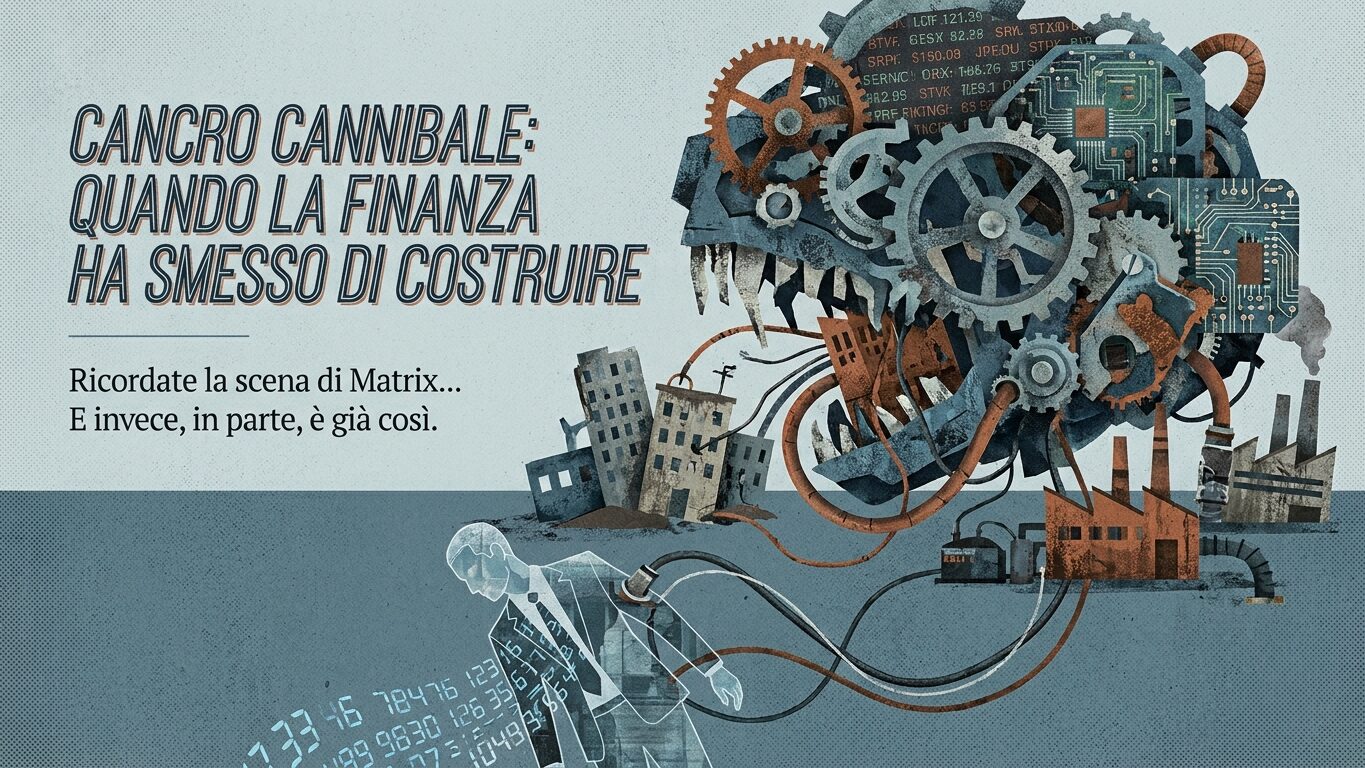
Do you remember the scene of Matrix in which Neo, after taking the red pill, finds himself in a pod full of tubes and it turns out that humans are nothing but fuel and energy source for machines?
Science fiction…
Yet in part this is already the case, and we don't even realize it.
Make yourself comfortable as we take a nice journey through history and especially finance. There will be no red or blue pills to swallow, but numbers. And the numbers, when they are like this, hurt more than any slow-motion bullet.
Act I: The scaffolding and the original pact
What is finance, in its origins? Since I know little or nothing about it, I've been doing some research. What's happening in the world is making me think a lot, and I'm convinced that human beings can't be as stupid as they seem. And in very "ancient" texts I've found that finance is a tool at the service of man and matter —not the other way around.
There was, in fact, a time - not too long ago, in reality - when finance had an honest profession: anticipate the real future.
The farmer who sold his grain forward before harvesting it wasn't speculating: he was protecting himself from hail, drought, and the vagaries of the weather. This is exactly why the 19th century saw the birth of the Chicago Board of Trade: not to create wealth out of thin air, but to give a man dependent on rain the certainty of a price, months before the harvest hits the ground.
The entrepreneur who asked for credit from the bank was not gambling: he was transforming the trust of an institution into a lathe, into a warehouse, into a plant that would produce concrete goods —and with them salaries, related industries, and a future for an entire community.
Savings, in this original pact, was a bridge. A bridge between those with idle capital and those with a real project but no means to realize it. Finance was the midwife of that project, not its master.
Money, in other words, was a means to anticipate the real future, not an end in itself. It was used to build a factory, not to bet on how many factories would fail by the end of the quarter.
This is the floor upon which everything rested. And it's exactly the floor that, at a certain point in history, someone decided to blow up.
Act II: The detachment and the great casino
When did finance separate from the real economy? The moment the derivative stopped insuring a real risk and began to betting on someone else's risk.
The crack begins where the real collateral ends and the bet on the bet begins.
Derivatives, in their most honest form, were supposed to do exactly what the Chicago farmer did: hedge a future price against a real risk. The problem is that, at a certain point, someone stopped buying derivatives to hedge against a risk they actually owned, and started buying them for the pleasure—and profit—of betting on a risk that didn't concern them at all. The futures contract, multiplied infinitely, ceases to be insurance and becomes a Wall Street lever slot machine.
The numbers here leave no room for imagination: according to the Bank for International Settlements, the notional value of derivatives Over-the-Counter in circulation globally has reached the 640 trillion dollars. To understand what this figure means, just compare it with the world GDP, which is around 90-100 trillion dollars.
Shadow finance built on derivatives is worth six or seven times the entire real economy of the planet. Not a growth multiple: a detachment multiple.
And then there are algorithms. High-frequency trading (High Frequency Trading, (HFT) doesn't buy a company because it believes in its future. It doesn't finance a plant, it doesn't pay a salary. It extracts a price differential that exists for a handful of milliseconds, exploiting a computing speed no human could ever match.
According to ESMA estimates, in Europe HFT represents between 24% and the 43% of stock exchanges; in the United States, in certain historical phases, this share has reached 73% of total traded volumes.
Stop for a second on this data: nearly three-quarters of the movement of a stock market can be generated by machines who buy and sell the same stock dozens of times in the blink of an eye, without a single one of those transactions having produced a single gram of steel, a kilo of wheat, or a single additional job.
Money, at this point, has stopped creating goods. It has learned to generate only debt and fictitious wealth—a value that exists on screens, inflated, fast, and no longer needs to touch matter to multiply.
Act III: The Rigged Bet and the Factory of Consensus
Here the terrain becomes slippery, and must be crossed with feet firmly planted on the data — not on suspicions.
The big funds do not passively wait for the market outcome, for the simple reason that they possess, at the same time, too large pieces of too many different things to remain neutral spectators. BlackRock, Vanguard and State Street — the so-called Big Three of asset management — together own approximately 90% of the companies listed in the S&P 500 Index.
And here comes the dizzying detail: these same funds are mutually invested in, in an almost circular ownership structure. Vanguard controls more than BlackRock's 13%, BlackRock owns significant stakes in itself and Vanguard, and State Street sits somewhere in between. It's not a pyramid with a single apex: it's a tightly woven network where very few individuals are major shareholders practically everywhere.
Everywhere also means in the media.
The same funds that own energy companies, pharmaceutical companies and technology giants hold significant stakes in the large corporations that control more than 90% of information in the United States. There is no need to imagine a smoky room where they decide what to say to the world: just look at who has, at the same time, economic interest in the outcome of a news story and the ownership of the channel that reports that news story. The conflict of interest is not a conspiracy theory: it is written in black and white in the prospectuses filed with the SEC.
And when it takes a crisis to generate monstrous profits, recent history has shamelessly shown us this. The five largest oil companies in the world have cashed in. nearly $467 billion in profits in the four years following the outbreak of hostilities in Ukraine. Of this, a full 444 billion were returned to shareholders in the form of dividends and buyback —not reinvested in clean energy, not used to control prices. In the first quarter of 2022 alone, share buybacks by oil major amounted to 24 billion dollars: the 15% more than all that spent throughout 2021.
I'm not saying that an armed conflict was orchestrated solely to please energy shareholders. I'm saying that when a dramatic event systematically and repeatedly produces the same exact beneficiary, at a certain point it's legitimate—indeed necessary—to ask ourselves: who has the incentive to make the next event happen, and those who have the megaphones in hand to make it, in the eyes of all, simply "inevitable".
(…yes, maybe I am saying that a little).
Act IV: The restaurant bill (paid by the usual people)
Who's really paying for the AI bubble? Not the investors who finance it with debt, but those who suffer from higher bills, depressed wages, and jobs degraded to "resources to be optimized.".
In the end, the bill always arrives at the same table: our.
Skyrocketing fuel prices and empty shopping carts aren't some atmospheric mystery: they're the direct consequence of profits being concentrated elsewhere while costs are spread everywhere, particularly heavily on those with the least room to absorb them.
And today the new challenge is called Artificial intelligence. Capital spending on AI infrastructure and data centers is expected to surpass $400 billion in 2025, with estimates that among the five hyperscaler Globally, investments exceed $700 billion. These figures are constantly doubling in a race where, according to extensive industry analyses, almost all companies that have invested heavily in generative AI have yet to see a real and measurable economic return.
And how do you finance a bet of this size when cash flow isn't enough? With the debt. Bond issuance tied to the development of data centers and computing power has reached record levels, draining huge portions of new bond issuance on the market. It's not real revenue that backs that debt; it's the promise of future revenues. And it's a promise that, like any commitment made to creditors, must be honored sooner or later. With interest.
When the promise isn't enough, the bill falls on the real world:
- On the energy bills, swollen by the electrical voracity of the computing centers.
- On the’employment, degraded to a “cost to be cut” in the name of algorithmic efficiency.
- On the household savings, called upon to support — through pension funds, ETFs and asset management — a bubble that no one chose and whose risks very few truly understand.
In this scheme, human beings and their work are no longer the goal of finance. They are the fuel that holds the pyramid up — just like in the pods of Matrix, only here nobody even asked us if we wanted to take the pill.
The question that remains, at the end of the journey, is not whether finance will spontaneously return to construction. It's whether we—savers, workers, citizens—will still find the voice, the awareness, and the tools to force it to do so.

Digital creative, musician, and storyteller. I explore the intersection of humanity and technology, telling stories of AI, music, and real life. Welcome to my organized mess.”

Article bagus! Transkripsi Gemini 3.5: Gem Transcribe — . Gem Transcribe