Me, Dolly Parton, and Francesca (maybe 🤔)
There was a country party in Arcella, a neighborhood of Padua famous for something completely different, and there was a broomstick dressed as a metalhead who didn't know he was one step away from one of the few artistic certainties he'd carry with him for the rest of his life. I'll get to that later.
Let's start with the facts: Dolly Parton He left us on August 25, 2026, in Nashville, at the age of 80, after a brief battle with cancer. An official statement, measured words, the same discretion that accompanied every corner of his private life for sixty years. The entire world reacted as it always does when an icon passes: rivers of crocodiles, playlists on repeat with “Jolene” e “I Will Always Love You”, headlines about mind-boggling numbers. Over 100 million records sold, 11 Grammys, more than 3,000 songs written. All true. All sacrosanct. And all already written elsewhere, perhaps better than I could copy from a press agency.
Here on the RickyVerso, however, I would like to tell you the other Dolly, the one I discovered by chance under a dance tent in 1998 and who over the years has proven to be immensely more interesting than the chart-topping singer I absentmindedly listened to on the radio.
A broomstick, a Francesca (maybe 🤔) and a voice from Tennessee
It was 1998. With my historical group, the PraeTEXT, we had just won the Rock Day Festival: a period full of stages, Prog Rock, Hard Rock, visceral Rock Blues, and that pure, hard metal soul that never left me. Back then, I wouldn't have considered country music even through a telescope. Then she came along: I don't even remember her name, I think it was Francesca (maybe 🤔), a fan of Western gatherings and dances, a friend of friends in the band. And you know: the blink of an eye is faster than a team of oxen.
We found ourselves at a Country Festival in Arcella, a Padua neighborhood known for its decidedly less bucolic dynamics than hay bales. The atmosphere, however, was impeccable: endless racks of smoking shanks, polished boots, spurs, cowboy hats, horse corrals, Mustang V8s, and gargantuan pickups parked like trophies. And then there was the large dance tent, with its wooden floorboards.
In the center, a perfect square of people moved in unison: forward, backward, diagonal, thumbs tucked into belts and heels pounding the floor in an incredibly coordinated mess.
«"Come on, let's go inside!"» she tells me.
Immediate cold sweat. The classic broomstick He was about to give the audience the embarrassment of the decade. And yet, to both of us, within five minutes I was moving at ease in that synchronized mechanism. Only two years earlier, I had done my military service: parades, marches on the parade ground, and cadences in unison all work on the same principle. The uniform changed, but the internal rhythm was identical.
At first, I didn't pay attention to the music: I counted the hits on the snare drum so as not to lose time. Francesca (maybe 🤔) tried to educate me on the sacred monsters coming out of the PA: Jimmie Rodgers, Willie Nelson, Johnny Cash, Patsy Cline. Names that meant little to me, having grown up on Pink Floyd and Black Sabbath. Then, at a certain point, something unexpected happened: a voice literally nailed me.
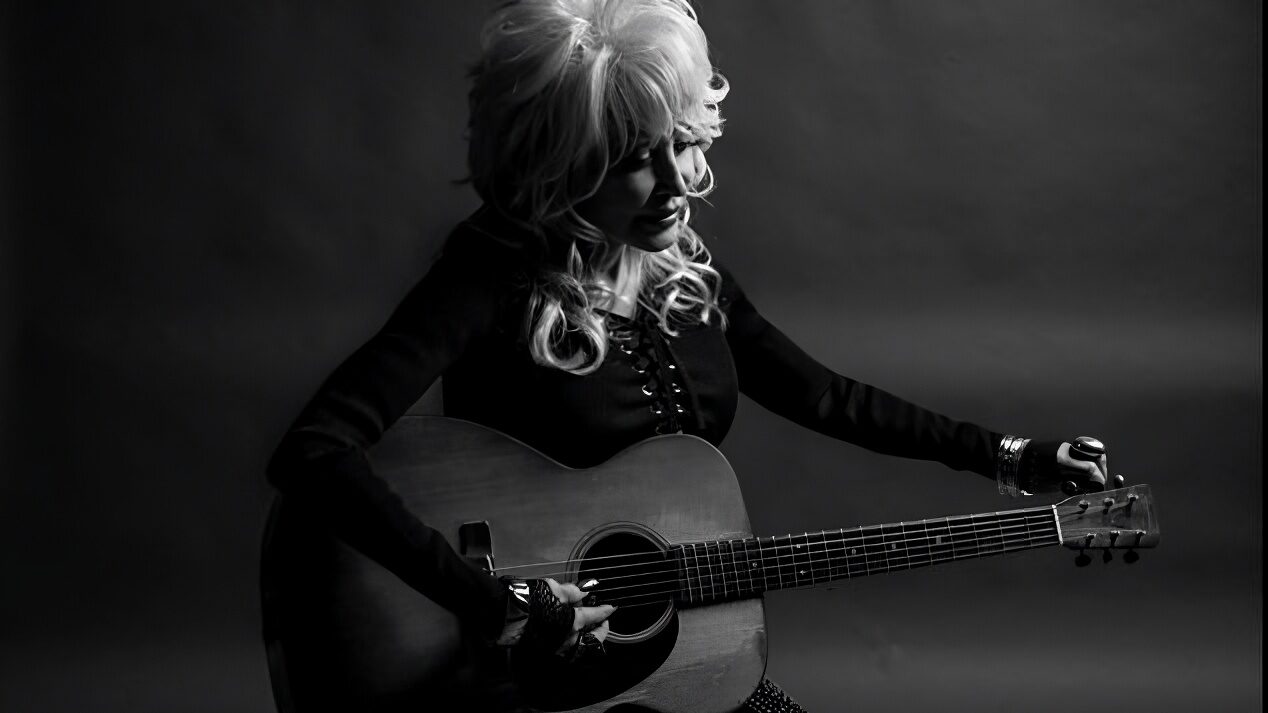
It was crystalline, luminous, warm, deeply emotional without ever falling into pathos, with that thick Southern accent. She sang of a house lost in the mountains of Tennessee.
The blonde with blue eyes named Francesca (maybe 🤔) disappeared from the radar shortly after. I discovered that same evening that her real interest was another dancer in the group and that I had only acted as a trusted taxi driver, a great classic of my youth. But since that night, Dolly Parton And that voice stayed with me. Not so much the genre itself, but the voice. And, as time went by, everything it represented.
The Dolly that conservative America wanted to ignore
Country music, seen from the outside, is often labeled the most identitarian, traditionalist, and conservative musical domain in the United States. Stars and stripes, suburban churches, and untouchable dogmas. Well, within that ecosystem, Dolly Parton has done for over fifty years what no other superstar has ever dreamed of: he reiterated with disarming naturalness that love is love, decades before it became a convenient slogan to bandy around.
He openly supported same-sex marriage, declaring on CNN with his typical sharp wit: «"Why shouldn't they be able to get married? They should suffer just like the rest of us!"». She publicly defended the transgender community when her Tennessee was passing discriminatory laws, explaining that she had seen firsthand the pain of those marginalized simply for existing. And she did so without lecturing or ideological proclamations, but speaking as one would at the family dinner table:
«I have relatives who are transgender, gay, lesbian, and struggle with alcohol and addiction. They're all part of my family. I know them, I love them all deeply, and I don't allow myself to judge anyone.»
These were not just empty phrases. Dollywood, its gigantic theme park, regularly welcomed the Gay Days. Then there is a fundamental and often silent page: between the 80s and 90s, while AIDS was treated as a sin or an unspeakable taboo, its production company (the Sandollar Productions) co-produced “Common Threads: Stories from the Quilt”, the extraordinary 1989 documentary about the AIDS victims' memorial, which won an Oscar. In 1994, he took the front lines in the campaign Break the Silence to combat health stigma in rural communities.
Jane Fonda, her co-star in the iconic “9 to 5”, he summed it all up with breathtaking clarity: «"To her gay and trans fans, I just want to say: know that she truly loved you. But I'm sure you already knew that, without me needing to remind you."»
The woman who said “No” twice at the White House
If you think these positions have transformed her into the mascot of a political party, you haven't grasped the greatness of this woman. Dolly Parton defended her artistic freedom with adamant honesty, always repeating: «"I don't belong to politics, I belong to music and people."».
In 2016, the Trump administration proposed it to her. Presidential Medal of Freedom, the highest civilian honor in the United States. Dolly refused. They offered it again a second time: she refused again, first to care for her sick husband, and then out of respect for pandemic travel restrictions. When the Biden administration later attempted to reopen the case, it maintained the exact same line of independence: «"If I accepted now, it would seem like a political ploy. I don't sing for medals."».
In a society split in half by ideological support, being worshipped equally by the rural working class of the South and by the crowds of metropolitan clubs is not a coincidence: it is the consequence of those who choose to be an authentic human refuge instead of a flag of convenience.
The Million Dollars and the 300 Million Books
There's a concrete gesture that captures his moral stature better than a thousand interviews. In April 2020, in the darkest and most uncertain moment of the pandemic, he wrote a personal check from a million dollars intended for the Vanderbilt University Medical Center. That fund made it possible to finance the crucial preliminary research phase that led to the development of the Moderna vaccine. No fanfare, no self-congratulation.
But his most enduring masterpiece, the true living monument, is called Imagination Library. Founded in 1995, it's an initiative that gives a free book to any child between the ages of zero and five and sends it home every month. The idea was born from a personal wound: His father Robert Lee had never had the opportunity to learn to read and write.
Today that program has surpassed the record figure of 300 million volumes donated across the world, with an impressive average that in recent years has reached a book delivered every 0.78 seconds. While the tabloids were discussing the volume of her blonde wigs, she was building the most extensive traveling children's library in history.
A fortress called intimacy
Let's go back to that starting point: that pure voice that struck me in Arcella in '98 belonged to a woman married for almost sixty years to the same man, Carl Thomas Dean, a lifelong companion away from the spotlight until his death in 2025. Carl did not like the social scene and Dolly protected that love pact with exemplary rigor: almost no public photos, zero gossip, no compromises.
He had erected an impassable boundary between the stage mask — made of sequins, bold makeup and sharp self-irony — and the real person, jealously guarded away from the media noise.
A consistency that was even reflected in his spirituality: a profound Christian faith, lived in acceptance and never wielded as a club to judge the choices of others. When asked why he welcomed everyone without distinction, he responded simply by recalling the teachings of the Gospel: the judgment is not up to us.
Because this voice still belongs to me
I haven't become a country purist. My musical core remains anchored to the skewed progressions of prog, raw distortion, and auteur rock. Yet that evening, amidst the dust and blasting speakers, I learned a fundamental truth: Genre labels say absolutely nothing about the soul of the composer.
Dolly Parton demonstrated that one can remain true to one's roots without ever turning them into a prison of exclusion. She spread the seeds of care, dignity, and culture, making her resources available to anyone in need.
That night at the Arcella I was just a young singer, stiff as a broomstick, who discovered he could dance in a line thanks to his time in the barracks. Francesca (maybe 🤔) It's been lost in the mists of time. But the voice of that girl from Tennessee is still here. Because true beauty doesn't ask for permission, nor does it care about context: all it needs is a dusty curtain, a speaker, and a melody that speaks straight to the heart.

Digital creative, musician, and storyteller. I explore the intersection of humanity and technology, telling stories of AI, music, and real life. Welcome to my organized mess.”