$24 to Close a Counter: New Jobs Created by AI
We put in fifty years. Fifty years of equations, radar, LiDAR Capable of mapping reality in 360 degrees, and microchips trained to predict the blink of an eye three intersections away. Engineering has performed a miracle: it has taught a metal box to drive with the precision of a surgeon and the patience of a Zen monk.
Waymo has covered millions of miles on the square avenues of California until it gave birth to the definitive vehicle, the’OjaiNo steering wheel, no pedals. Just pure code and iron discipline.
On paper, it was a triumph of technology. The future was ready, clean, and ready to use.
Then we put the human being inside. And the utopia collapsed miserably.
The damages of freedom
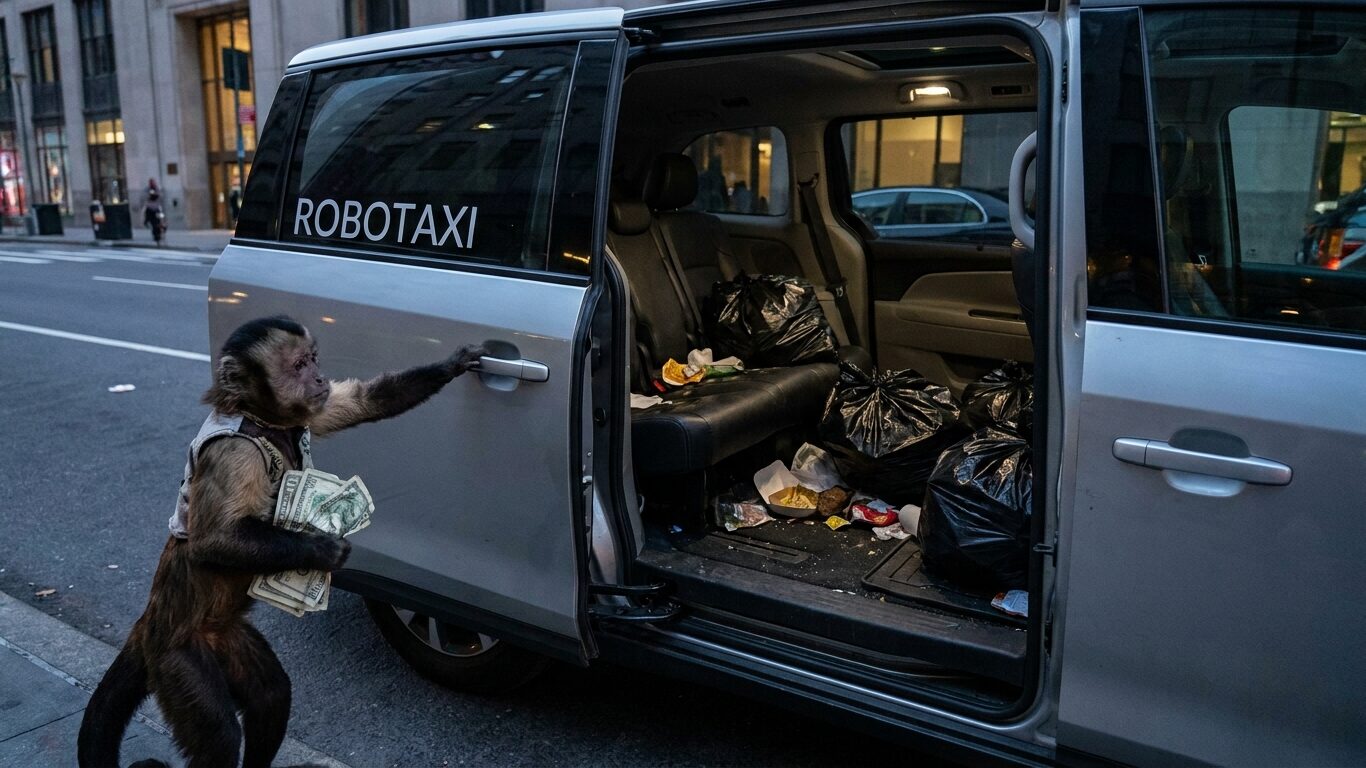
Without the stern eye of a taxi driver in the rearview mirror to act as an inhibitory brake, the’Homo Sapiens regresses At the speed of light, reaching the primate stage. News reports from the United States tell what happens when you remove social control. Here's ketchup smeared on door handles, mountains of garbage abandoned as souvenirs, and scenes worthy of a scientific investigation that require chemical sanitization of the passenger compartment. The result? Tech giants forced to invent the “tax on incivility”, with fines of up to $150 for anyone confusing a technological gem with a suburban landfill.
And it doesn't end there. In Austin, dozens of emergency calls have been recorded for the so-called sleepers. They're genies who fall asleep on board, accumulating such a level of recklessness that the onboard software fears death. Not to mention the sublime technological short circuit in the doors: passengers disembark with the door wide open, paralyzing the entire fleet.
The big AI industry's answer? Hiring real humans, paid up to $24 per call, with the sole herculean task of walking to the car and close the door. The algorithm of the new millennium finds itself bent on itself because of a kindergarten gesture.
Imagine what would happen here!
Now, let's try to catapult this overseas wonder into an ordinary day in Italy.
The algorithm stops at yellow lights, following the manual. Reaction time of the driver behind: three milliseconds before a concert of horns and colorful exclamations. The software tries to maintain a safe distance, but the free space is instantly colonized by a scooter on the right, a sandwich van double-parked on the left, and a pedestrian crossing with his head down while watching videos on his phone, confident in his metaphysical right of way.
Processor overloaded, sensors short-circuiting. I picture it there, the car of the future, stopped in the middle of a Padua intersection during rush hour. The screens flashing desperately and a synthetic voice trembling: «"Please wait, I'm recalculating the meaning of life."», while an Ape car scratches her mirror. In California, they should set up a dedicated helpdesk for our country, with the sole task of reassuring the engineers in Palo Alto: «"Don't worry, it's not a hacker attack. It's just traffic at 6 PM."»
Testing is about to begin here too, amidst decrees, bureaucracy, and infrastructure that needs updating. The stark truth transcends regulations and is infinitely more subtle.
Every single technological breakthrough ends up telling the same human comedy: the Internet was supposed to open the doors of knowledge universal and has become the arena of keyboard warriors; social They were supposed to connect us, and they turned us into hyperconnected solitudes. Today, the robotaxi was supposed to guide us toward the perfect order of autonomous mobility, and we find ourselves paying someone to lock the doors we leave unlocked like spoiled children.
Technology does exactly what it was programmed to do. It is the mirror in which we reflect ourselves that is merciless: it shows our extraordinary capacity to touch the stars and, a second later, our embarrassing naturalness in leaving ketchup fingerprints on each other.

Digital creative, musician, and storyteller. I explore the intersection of humanity and technology, telling stories of AI, music, and real life. Welcome to my organized mess.”