The truth is simple. We are the complicated ones.
There's one thing I've understood, and it's been hard for me to understand: the truth is one of the simplest things in the world.
Yes or No. Black or White. Good or Bad.
In its purest form, it is like this. Binary. Essential. Without margin for error.
The problem isn't the truth. The problem is us, and our relationship with it.
The Truth lays us bare
When a truth is truly true, it leaves no room for negotiation. It can't be negotiated, it can't be smoothed over, it can't be personalized. And that's exactly why it scares us.
Admit one inconvenient truth It often means having to face something we don't like about ourselves. A bad choice. A person we were or weren't. An expectation we projected onto someone who never asked for it.
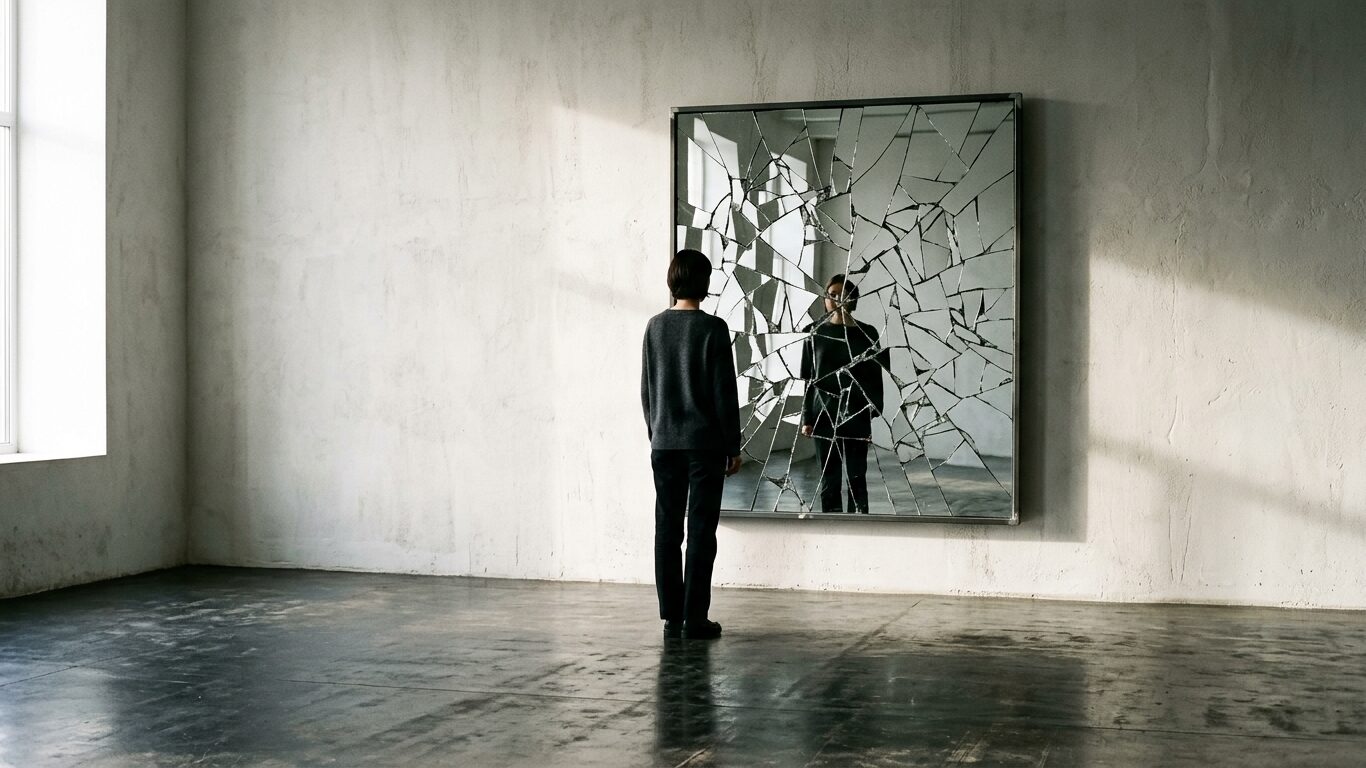
The truth doesn't accuse: it simply reflects. Like a mirror that doesn't lie. And that's why many prefer to live without mirrors.
The Game of Fragments
So what do we do? We break it up.
Let's take the part that suits us. The one that supports our story, our benefit, our internal narrative. And that becomes our rLoyalty. The kind we defend, the kind we share, the kind we sometimes fight over, even violently.
The paradox is stark: the more you fragment the truth, the more inaccessible it becomes. Each piece seems coherent on its own. But the sum of the pieces creates invisible contradictions, blind spots, and shadowy areas where we hide.
Eventually, you find so many fragments that reconstructing the original picture becomes impossible. And you stop trying.
Psychology calls this mechanism cognitive dissonanceWhen a truth contradicts our belief system, the brain attacks the truth rather than changing beliefs. It's cheaper for the mind. It's devastating for the individual.
Protagoras had already understood everything - and he was already wrong
“Man is the measure of all things.”
Protagoras said it 2,500 years ago, and since then it has become the favorite phrase of those who want to avoid a clear-cut answer. Relativism—the idea that all truth is subjective, personal, contextual—is the most convenient philosophy history has ever produced.
Postmodernism then pushed the concept to the extreme: there are no truths, only interpretations. Unfortunately, this statement is self-defeating. If there are no truths, then there are also “there are no truths” It's false. The contradiction is logically devastating.
Yet we continue to use it as a shield.
The honest and the cowardly nuance
Mind you, I'm not saying reality is always simple. Life is full of genuine complexity, real gray areas, and contexts that change the meaning of things.
But there is a huge difference between the nuance that deepens e the nuance that avoids.
The first brings you closer to the truth. The second takes you further.
The question to ask yourself every time is only one: “Am I trying to understand better, or am I trying not to answer?”
It's a difficult question. Because it requires honesty. And honesty, as we've already said, is uncomfortable.
The courage to stay on the track
The truth doesn't need defending. It won't crumble unless you uphold it. It's not up to you.
The only thing it requires is for someone to have the courage to look it in the face.
Don't take it all. Don't understand it all—that would be presumptuous. But at least don't break it up for convenience. Don't use it as a tool. Don't pretend to be in good faith when you've already chosen the piece you want to keep.
The truth is simple.
We choose to complicate it.
And that choice, that one, says everything about who we are.

Digital creative, musician, and storyteller. I explore the intersection of humanity and technology, telling stories of AI, music, and real life. Welcome to my organized mess.”