Sewing Time: A Friend's Workshop and Slowness as an Act of Love
There's a sentence Laura wrote that I can't get out of my head.
“Do you know the exact drying time for a blanket? No one knows. There's no timer.”
I could have written it myself. Word for word. Except I'm not talking about covers—I'm talking about certain musical passages that you can't rush, that need to settle, that exist precisely in the time they exist in and no other. And they are the mantra of an artisan bookbindery where creative slowness is in its DNA.
I met Laura when she was still a young girl. She was a member of the choir I direct for many years—one of those kids you watch grow up without even realizing it, until one day you turn around and see no longer the little girl but a person who has built something of her own. Something real.
Laura did something rare. She stopped everything.
She had over a decade of experience as a graphic designer, visual identities for hospitality, years of screen time and briefs to meet. Then, at a certain point, she realized she was hungry. Not for work—for material. For substance. For something tangible.
He turned off the computer.
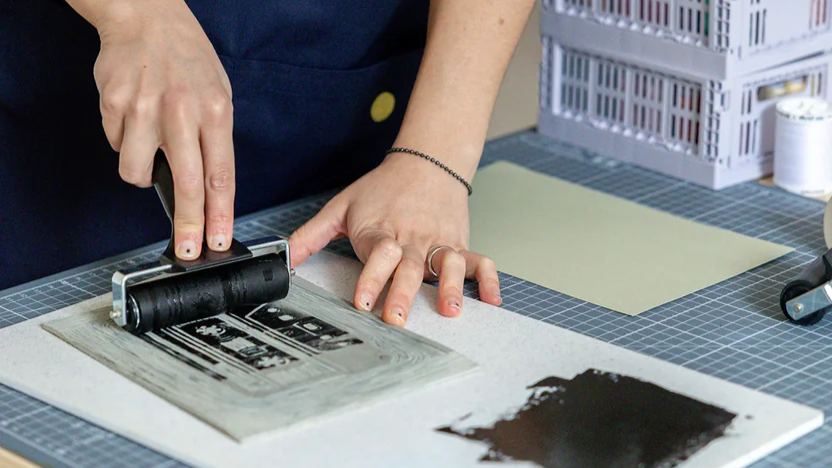
I don't say this as a romantic metaphor. He actually did it. He took his experience as a designer and dragged it out of the monitor, bringing it to the physical plane—literally, onto a work surface where real things are cut, glued, sewn, and dried.
He called this place Saimai. A "just in case" from which the superfluous, the excess words, have been stripped away. A philosophy can already be sensed here.
In the Saimai laboratory, time isn't a problem to be solved. It's the key ingredient.
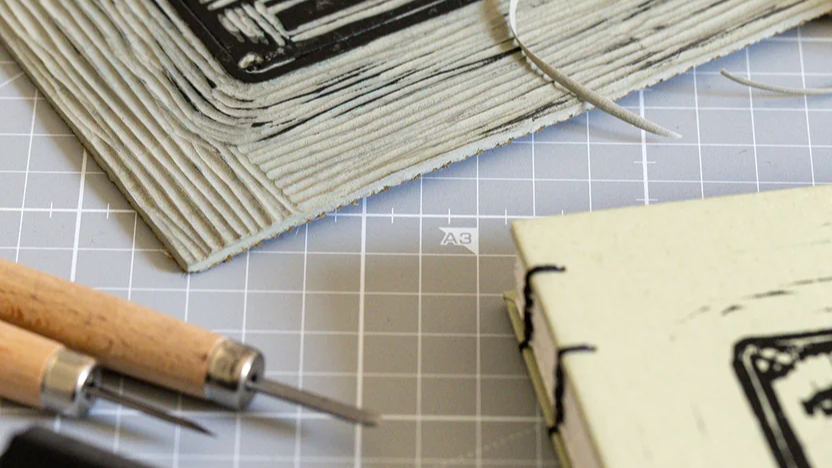
Laura works with upcycled paper, printing scraps, fabrics, and threads. Materials that others have already used and then discarded, to which she gives form and function again. Each piece is unique. Okay, it's an overused phrase in marketing, but here it's meant literally: there's no other like it, and there never will be.
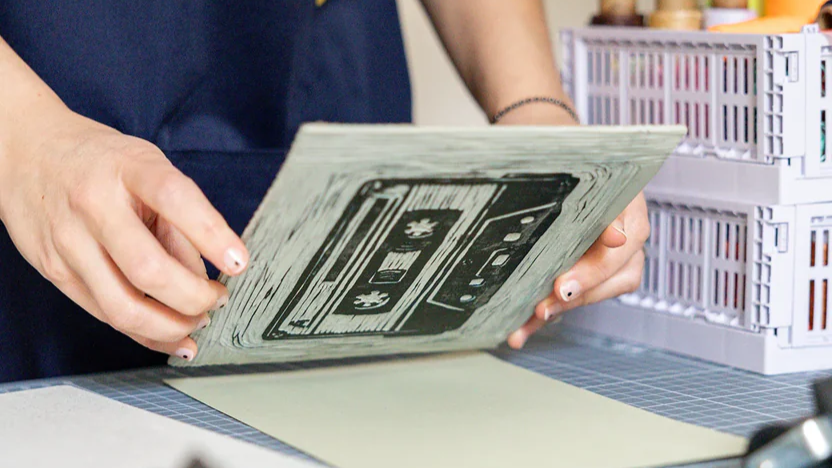
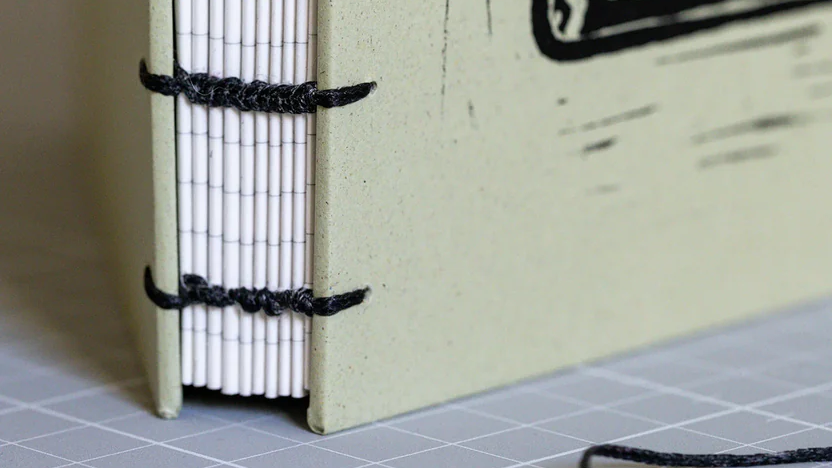
One of his works that I promised myself to make my own is a notebook that celebrates analog culture —cover made from recycled typography scraps, a hand-drawn, linocut, and printed audio cassette, and interior pages made from eco-friendly paper made from corn scraps. A binding that allows the notebook to lie flat on the table, never closing in on the writer's thoughts.
An object that exists so as not to interrupt the flow.
I stopped on this one. A notebook designed to not interrupt the flow. How rare is it to find something—a tool, an environment, a person—that can stay "open" while you think?
I was thinking about how similar, ultimately, the problems we face are.
How do you convey the value of what's unseen? Design time. Prototypes. Materials research. Everything that disappears in the finished product and that social media compresses into a fifteen-second reel with fast-paced music in the background.
I have the same problem with music.
My songs last as long as they need to last. Eight minutes, ten, sometimes more. Not because I want to be difficult—but because the journey needs that time to complete. Cutting it to fit the format would be like tearing out the last pages of a book because the reader is in a hurry.
Yet we both know that feeling: explaining yourself to a market that wants everything now, everything easily, everything consumable in a subway ride. Feeling out of time. Out of proportion. Out of place.
And instead…
Instead, every now and then someone comes along and stops. And then everything changes.
Someone who picks up a hand-sewn notebook and finally finds the right space for their thoughts. A tool that doesn't close, that doesn't protest, that stays there—open, patient, available. A physical place where ideas can settle without haste.
Someone who listens to music for ten minutes without looking at their phone and feels something shift inside them—they're not sure what, but they know they needed it. That they were looking for that exact breath.
It's for them that we do all this. Not to prove a point. Not to resist the algorithm on principle. But because there's someone out there who needs something carefully crafted—an object to touch, a sound to lose themselves in—to remind themselves that slow time still exists. And that it's worth inhabiting.
Laura knows it. She says it clearly, without victimizing herself: “We're not here to convince everyone. We're here for those who still have the patience and sensitivity to read the hidden time within things..”
I subscribe to it. Note for note, point for point, thread for thread.
Maybe we really are anachronistic—me with my songs, she with her notebooks. Or maybe we've simply remained faithful to something that has never gone out of style, even when it seemed to.
Slow beauty. The depth that cannot be explained, but touched.
If you want to see what comes from those hands: saimai.it — and on Instagram @saimai_lab.

Digital creative, musician, and storyteller. I explore the intersection of humanity and technology, telling stories of AI, music, and real life. Welcome to my organized mess.”