THE METAL FAN'S PARADOX: WHY METAL FANS ARE THE QUIETEST PEOPLE YOU KNOW
(and science proves it, in case you don't trust me)
There's a prejudice that's as hard to die as a 200 BPM guitar riff: the idea that anyone who listens to heavy metal is potentially dangerous, unstable, and worth keeping an eye on. The grandmother who crosses the street when she sees a black Metallica T-shirt. The coworker who lowers their voice. The neighbor convinced something dark is going on in there.
Spoiler alert: You're simply processing your emotions better than anyone else in the office in there.
Noise as medicine (no, seriously)
Let's start with the science, so no one can accuse me of being a gender fanatic.
Dr Leah Sharman of the University of Queensland has published on Frontiers in Human Neuroscience A study that officially confirmed what every metalhead has known for a lifetime: listening to extreme music—death metal, heavy metal, the whole glorious rainbow of the genre—reduces hostility, irritability, and stress levels. All it takes is ten minutes. Ten.
The mechanism is called catharsis, and it works like this: when you're angry, frustrated, on the verge of giving up, metal music doesn't amplify that anger. meets. It mirrors it. It tunes it to you like a Marshall amp cranked up to full blast, and then—boom—it completely drains. What's left afterward is an inner silence that meditation takes half an hour to achieve.
Study participants showed no increase in heart rate or increased hostility. Instead, they showed an increase in their sense of inspiration. Someone should tell this to those who still think Black Sabbath makes you want to destroy things.
The Pogo Law (which no one wrote, but everyone respects)
Let's now look at the point that I find most fascinating: what physically happens inside a metal concert.
The mosh pit. The wall of death. The bodies colliding, the sweat, the collective kinetic energy that transforms the pit into something primal. From the outside, it looks like pure anarchy. From the inside, it's one of the most in solidarity that you may live in a contemporary society where people fight over parking spaces.
There is an unwritten rule, as rigid as the code of a monastic order: if someone falls, you pick them up. Immediately. Without thinking. No matter how intense the moment, no matter who that person is. They fall, you pick them up. Period.
This instinctive ethical code generates a beautiful paradox: the seemingly most chaotic event produces one of the most cohesive and cooperative communities. And when the evening ends, the audience flows out in an orderly, tolerant manner, emptied of any remaining nervous tension. Because they've already left that tension there, where it belongs.
The ogre voice that speaks of love
There is a phrase That Arianna Porcelli Safonov he pronounced at the Festival of Beauty at the Sforza Castle in Milan in June 2026, and which is worth more than any academic essay:
“Metal used an ogre's voice to talk about love. Today, a love voice is used for ogre's words.”
Keep it in your head. Because it's exactly the knot no one wants to untie.
Heavy metal — with its visceral growls, its guitars distorted to the point of saturation, its album art that would make an emergency room pale — has always used the aesthetics of chaos to contain something profoundly human: anger against injustice, the pain of abandonment, the fear of death, the critique of power. Even the most extreme lyrics bring something real to the surface. Something that already existed, before anyone put it to music. “I wanna give you every inch of my love” —Led Zeppelin, 1969—is a text of pure, visceral passion, raw and direct. But there's no woman as an object. There's a burning desire that offers itself entirely.
Now make an honest comparison with what dominates the Italian charts today.
A quantitative study published in Languages and Media Cultures analyzed a corpus of Italian rap and trap songs from 1993 to 2025. The result: about a third of the texts contain misogynistic expressions. But that's not the creepiest part. The creepiest part is that the songs with love connotations... positive They contain more derogatory terms than those with a negative narrative. That is, when a trapper talks to you about love, he uses more insults than when he talks to you about hate. Sexism is so normalized that it has become the affectionate register.
Tony Effe—to cite the case that sparked public debate at the end of 2024—was banned from Rome's New Year's Eve celebrations for lyrics describing women who should be "put on a leash" or "muzzled." All this is crafted over accessible melodic bases, with a glossy, magazine-cover aesthetic. The voice is soft. The words are ogre-like. Exactly as Arianna said.
Metal was accused of corrupting the minds of young people in the '80s and '90s—the "Parental Advisory" stamps, the US Congressional hearings, the parents in revolt. While Ozzy Osbourne was screaming about the decadence of the world, no one was actually describing a woman as a package to be delivered. That stuff came later, with its easy melodies and danceable rhythms.
It's not a question of musical genre per se. It's a question of aesthetics as a Trojan horseWhen the sound is aggressive and scary, society raises its guard. When the sound is catchy and the video is well-researched, it lowers its guard. And meanwhile, certain messages enter the heads of twelve-year-olds as if they were normal.
Metal has always known who it was. It never pretended to be anything else. It had the face of an ogre and the heart of someone who wanted to tell the world without lies. That consistency, ultimately, is a form of respect.
Sublimation: The Art of Transforming Chaos into Identity
There is a third level, the most intimate one, which concerns the musicians and loyal listeners.
In psychology it is called sublimation: taking something with critical potential—unresolved conflicts, anger, frustration, pain—and converting it into an expression that not only doesn't hurt, but builds something of value. A riff. A lyric. A twenty-second solo that contains everything you couldn't put into words.
Those who regularly practice this discharge through music — whether playing it or listening to it — simply he doesn't need to look for conflict outside. He's already solved it. He's turned it into art, or he's let it explode safely in front of a Peavy monitor at eleven o'clock at night. The result, in everyday life, is that somewhat legendary calm of the typical metalhead: thoughtful, direct, with a sense of irony honed by experience with complex themes, and a surprisingly high tolerance for everyday stupidity—because he's already channeled it all elsewhere.
Grandma was wrong (but we still love her)
Heavy Metal is not a generator of tension. It is, for all scientific and anthropological purposes, a tool of emotional regulation exceptionally efficient.
Sonic violence is the medium, not the message. And the message, if you really listen to it, it's been the same for sixty years: surviving yourself, transforming weight into power, and doing it with a community that picks you up when you fall.
Maybe that's the most punk thing about it all: that the loudest music in the world produces the quietest people around. And that in 2026, while certain glossy artists rake in millions singing about nothing or worse, the old ogre in the black t-shirt still has more to say than mainstream culture would like to admit.
AND NOW A SURPRISE!
🎼 World Preview — Intrusion: Allegro con Grimaldello
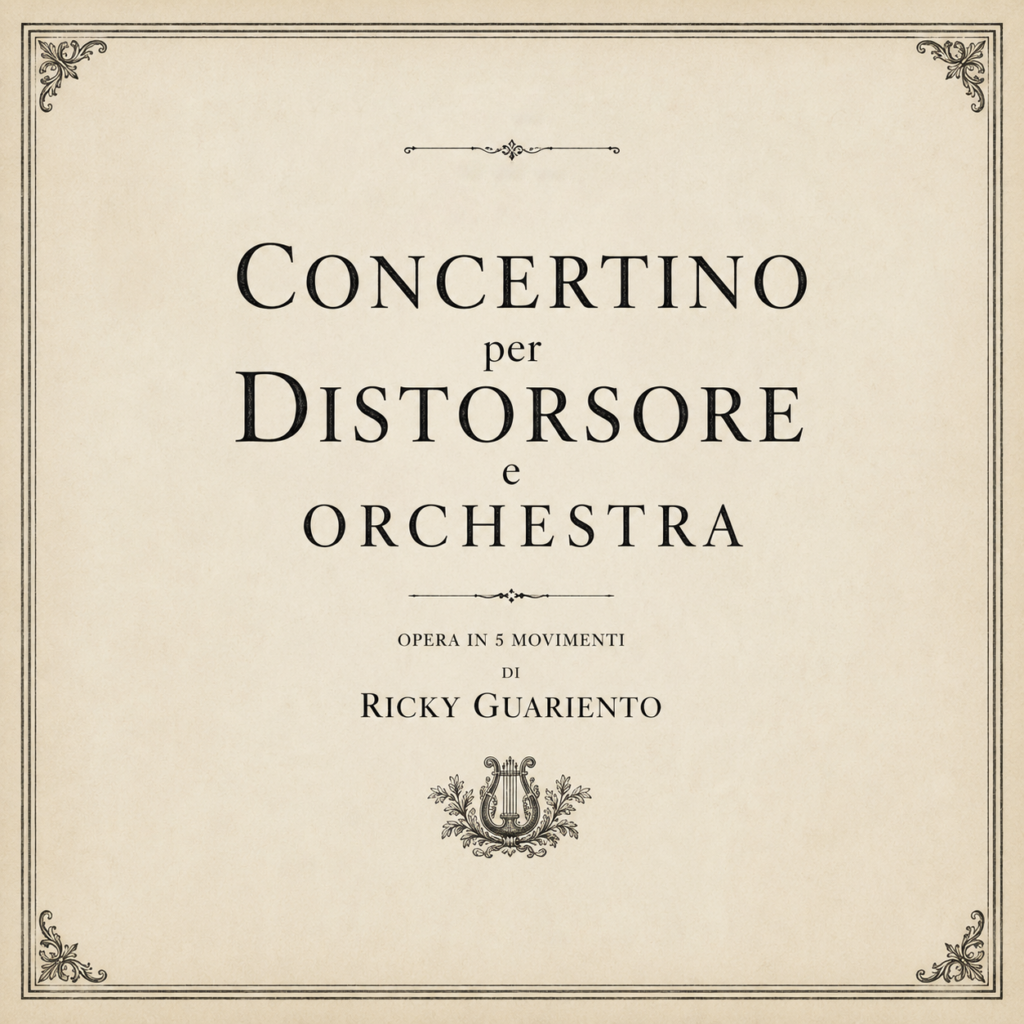
Concertino for Distortioner and Orchestra — First Movement
As I write about catharsis and sublimation, I feel the words finally giving way. So here it is: the first movement of my Concertino for Distortion Guitar and Orchestra. Symphonic metal, distortion and strings, chaos and structure chasing each other.
Listen to it. Then let me know if you still need theoretical explanations.
PRESS PLAY!!!

🎸 Are you a hardcore metalhead, or have you experienced this cathartic experience firsthand? Share 🙂

Digital creative, musician, and storyteller. I explore the intersection of humanity and technology, telling stories of AI, music, and real life. Welcome to my organized mess.”