Why do bar towels hate us?
A phenomenological study on how to spread the problem instead of solving it.
The accident
It happened to you. It happens to everyone.
You bite into a cream doughnut with the enthusiasm of a child and the coordination of a drunken sloth. A drop of cream—thick, sweet, lethal—lands on your lip.
Your reptilian brain sends the command: “Emergency Protocol: Clean.”
Your hand grasps the object intended for the purpose: the Bar Napkin 17×17. The one that fits in the spring-loaded metal dispenser, squeezed like a commuter on the B metro during rush hour.
You pass it over the stain.
And here physics collapses.
Instead of absorbing, the napkin accelerate. Instead of cleaning, drag.
The 2-millimeter stain is now a 15-centimeter stripe across your cheek like a failed war paint job. Why?
Political Hydrophobia
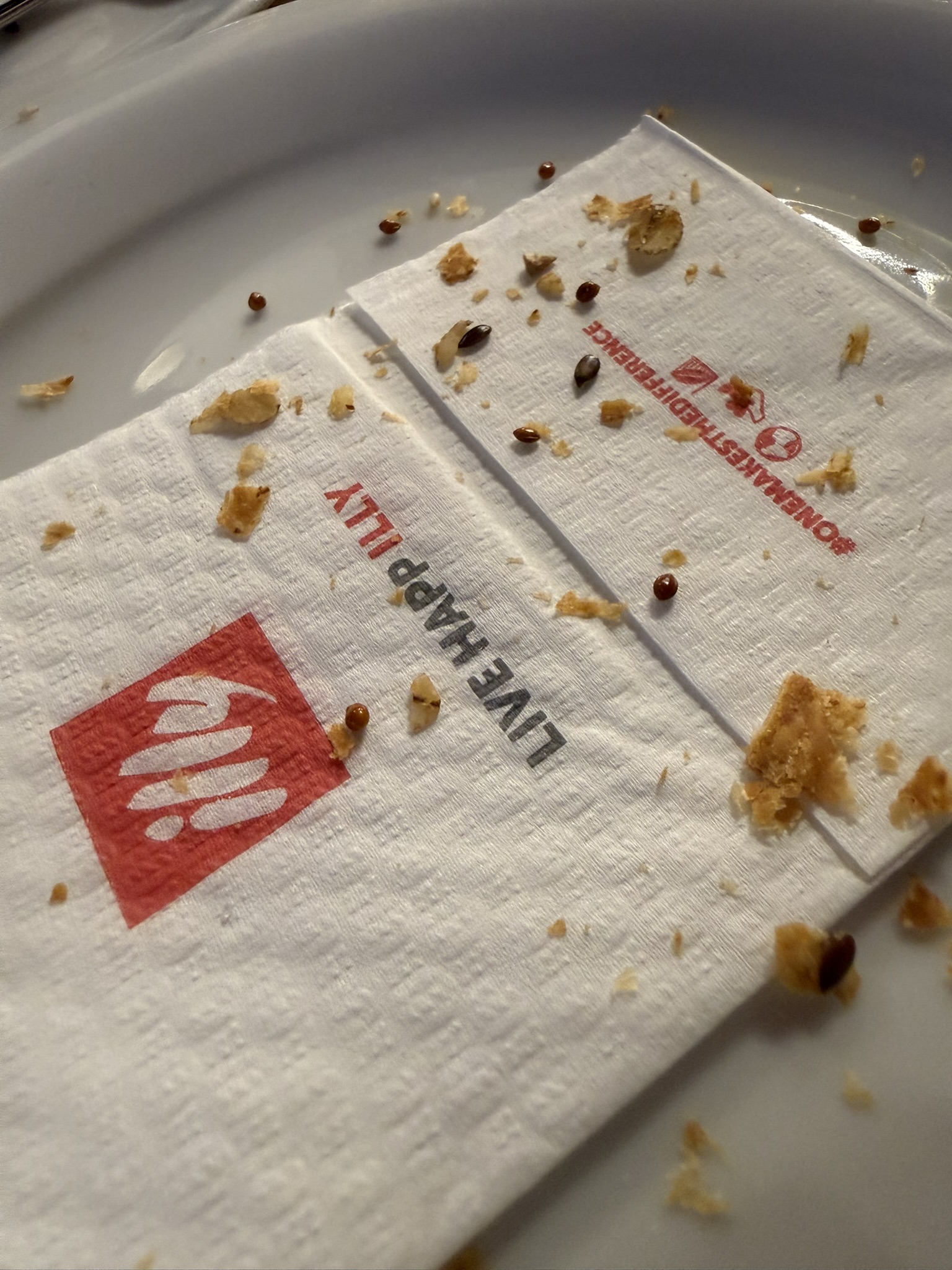
I brought a sample to the lab (i.e., to the kitchen table) to analyze its structure.
The data is shocking. What we call "paper" is actually a metamaterial made of cellulose treated with the tears of those who weren't called back after an interview.
Its main feature is the Low Moral Friction Surface.
Unlike kitchen paper (which has open, honest fibres, ready to welcome mistakes), the bar napkin is calendered (polished) to the point of becoming impervious to reality. He is hydrophobic. He is afraid of water.
A napkin that's afraid of liquids is like a metal guitarist who's afraid of distortion: useless!
Who benefits?
It can't be a design flaw. No engineer would design an absorbent object that rejects the fluids.
So, the question is: who profits from it?
- The Dry Cleaners' Lobby: It's obvious. The napkin is designed to divert stains from the (washable) leather directly to the (expensive) shirt collar. It's a system of GDP redistribution towards the textile sector.
- The Inverse Turing Test: Maybe they're psychological tests. The powers that be are watching us from security cameras as we try to clean the coffee shop with a sheet of noisy plastic. If you give up after three seconds, you're a robot. If you keep scrubbing until your skin breaks, you're human (and stupid).
- The Theory of Big Data: What if they weren't napkins? What if that shiny surface was a rewritable storage device? Every time you wipe, you leave a biological trace. They're sampling our DNA to clone an army of perfect consumers who never get dirty.
The Truth!
Let's take off our tinfoil hats for a second. The truth is more cynical than conspiracy.
Those napkins are single-ply, with ridiculous weights (18 g/m²). They're designed to cost fractions of a cent.
Their function is not clean. Their function is to be there.
They're the physical equivalent of a "How are you?" from an acquaintance who doesn't listen to the answer. They're pure etiquette. They're used to help you pick up the croissant without getting your fingers greasy, not to fix the mess when the croissant explodes.
The next time you pick one up and hear that synthetic hiss, know this: you're not holding a cleaning tool. You're holding a life lesson.
Some mistakes can't be erased. They can only be smoothed over.

Digital creative, musician, and storyteller. I explore the intersection of humanity and technology, telling stories of AI, music, and real life. Welcome to my organized mess.”