
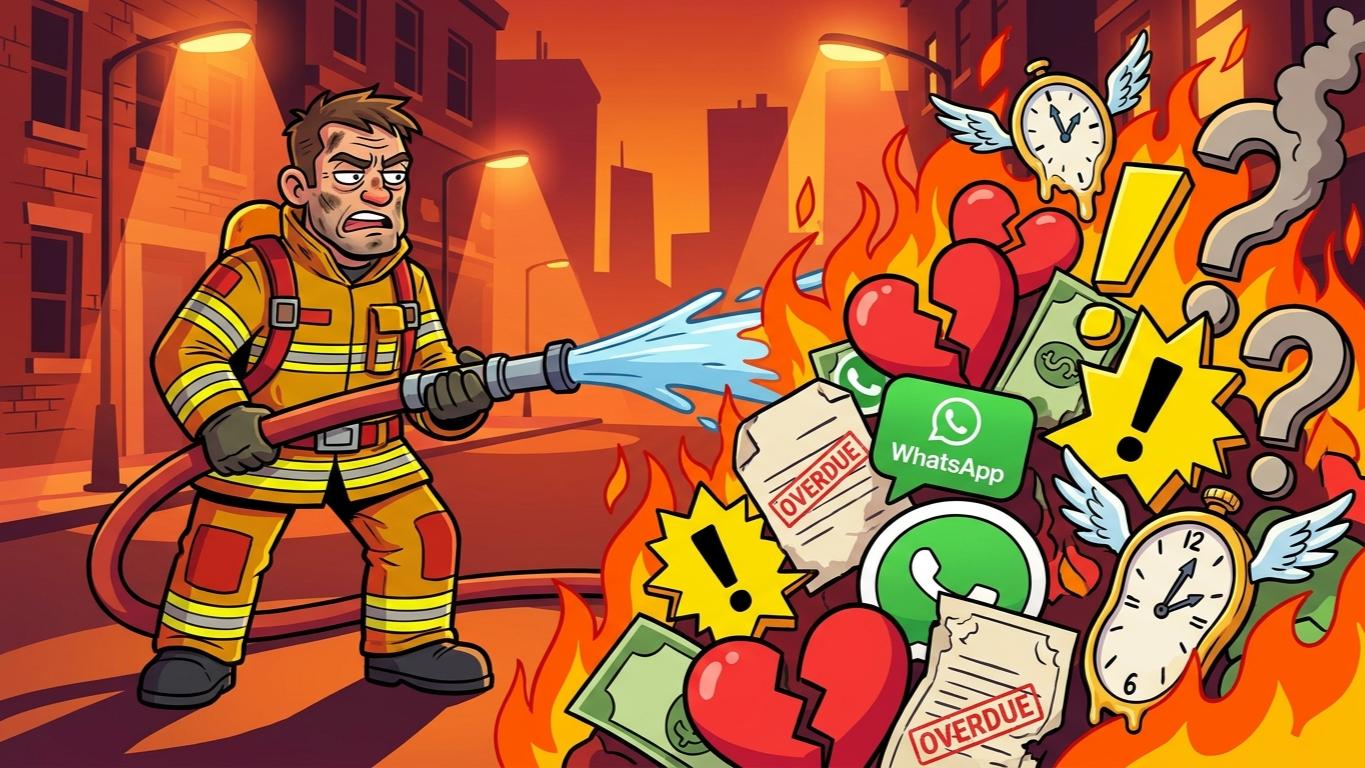
🏆 The Empathic Firefighter Paradox (or: Why Acting a Nice Guy Automatically Makes You a Nag)
There's a mythological figure, a paradox that exists in every group of friends, in every couple, in every work circle. He doesn't have a cape, he doesn't have... superpowers, but he's always there. Available. Ready. With the phone in his hand at 11:00 PM when you have a mess to sort out, with the right word when the world falls apart, with the time that, who knows how, he always manages to find even when he doesn't have any. He's the Empathetic Firefighter.
That figure is me. It's probably you. We've probably all been there, at least once.
And we probably hurt ourselves.
The Great Illusion of Empathy
Empathy is a wonderful thing. It makes you feel close to others, it allows you to understand without judging, to put yourself in the shoes of those who are suffering and find solutions instead of running away. In a world of people who avoid the complexities of others as if they were taxes to be paid, those who are empathetic automatically become valuable.
The problem? Precious doesn't mean reciprocated.
There's a subtle and almost universal mechanism: the more available you are, the more you become others' natural outlet. They seek you out in dark times, they thank you, they tell you “I don't know what I would do without you” —and meanwhile, without anyone explicitly saying so, an unwritten contract is established. You are the strong one. You are the one who holds. You are not in need.
The Empathic Firefighter Paradox
You do it for free, without any pretense, without any ulterior motive or interest. But sometimes that day comes. Something happens—work, love, health, life in general—and you, for the first time after years of performing as a listening athlete, step forward and say: “Hey, I need some help.”
Silence.
Not a dramatic silence, mind you. They don't disappear like ninjas. It's more subtle. They become vague. “Sure, let me know.” “"We will talk soon."” “I'm going through a tough time too.” —and suddenly even those who were doing fine three days ago have a full schedule until 2031.
The truth is this: When you ask for help, you break the balance that you yourself helped build. You were the firefighter. The firefighter doesn't catch fire. The firefighter doesn't need firefighters. And if he does, it creates a cognitive and emotional short circuit in the other person, who has two options: genuinely help you, or avoid you until the problem goes away on its own.
Guess which of the two is more common…
The Guilt That Isn't Said
There's an even more interesting variant, one that's psychologically richer (and more annoying). Sometimes the other person isn't avoiding you out of malice or indifference. They're avoiding you because... he feels indebted and he doesn't know how to handle it.
You've done too much. You've given too much. And now that you arrive with your request, that person finds themselves faced with an uncomfortable mirror: they should reciprocate, but perhaps they're not capable, perhaps they don't want to, perhaps they don't know how. And so the only strategy they find is to unconsciously make you the problem. Transform you from a savior to a burden. From a resource to a pain in the ass.
It's an elegant defense mechanism, in a way. Almost admirable, if it weren't so irritating.
The Mea Culpa (Why Honesty Costs)
But. But.
Before putting on a crown of thorns and parading in the role of the misunderstood victim, we must have the courage to ask an uncomfortable question: Did I do this to anyone too?
And the honest answer, for many of us, is: probably yes.
Maybe we didn't do it maliciously, maybe we didn't even realize it. But there was definitely someone who gave us so much—time, energy, a listening ear—and when they came knocking on our door, we found them inconvenient. Inconvenient. Untimely.
Selective empathy is human. The problem is when we elevate it to a system.
No Morals: Morals Are Boring
There's no clean solution to this. It won't be solved with a nonviolent communication course or a motivational Instagram post. Asymmetrical relationships exist, they will continue to exist, and anyone who tells you otherwise is selling you bullshit.
What you can do is stop feeling weird for needing. Stop apologizing for existing, even with your pains in the ass.
And maybe—maybe—start choosing better who to dedicate that wonderful availability you have.
Because your time is worth it. Even when you're not in a firefighter's uniform.
“I seek beauty everywhere. And if I don't find it, I create it.”
— The RickyVerse

Digital creative, musician, and storyteller. I explore the intersection of humanity and technology, telling stories of AI, music, and real life. Welcome to my organized mess.”





One Comment