Alex Zanardi: The Champion Who Never Played the Hero
I waited a few days before writing this piece. Not for lack of things to say—I had plenty—but because I can't stand the idea of using someone's death as a springboard for engagement. That social media automatism whereby, when a grown-up person falls, everyone rushes to position themselves, to demonstrate how much they knew them, how much they were touched, how much they were there. I saw the videos of the funeral. People filming themselves next to the coffin. Touching it to show themselves in the act of touching it. I found that in extremely bad taste, almost violently at odds with everything Zanardi stood for: sobriety, concreteness, no performance of grief. Then I thought: the best way to avoid doing the same thing is to wait for the noise to subside, and then say something heartfelt rather than timely.
When he passed away on May 1, 2026, the internet was flooded with uniform messages. “He never gave up.” “An example for everyone.” “He proved that limits don't exist.”
All true things, for goodness sake.
But Alex Zanardi It deserves more than a motivational calendar slogan with mountains in the background.
I was lucky enough to meet him in person. Once I almost argued with him and nearly ran over him as he was speeding along on his handbike. I didn't encounter a monument. I met a man who smiled as if life were a race he still found tremendously fun, despite everything. Above all despite it all.
Before the legend, the fierce pilot
There's a part of Zanardi's story that tends to disappear in the wave of tributes: he was a thoroughbred driver, in the most competitive and unpoetic sense of the term.
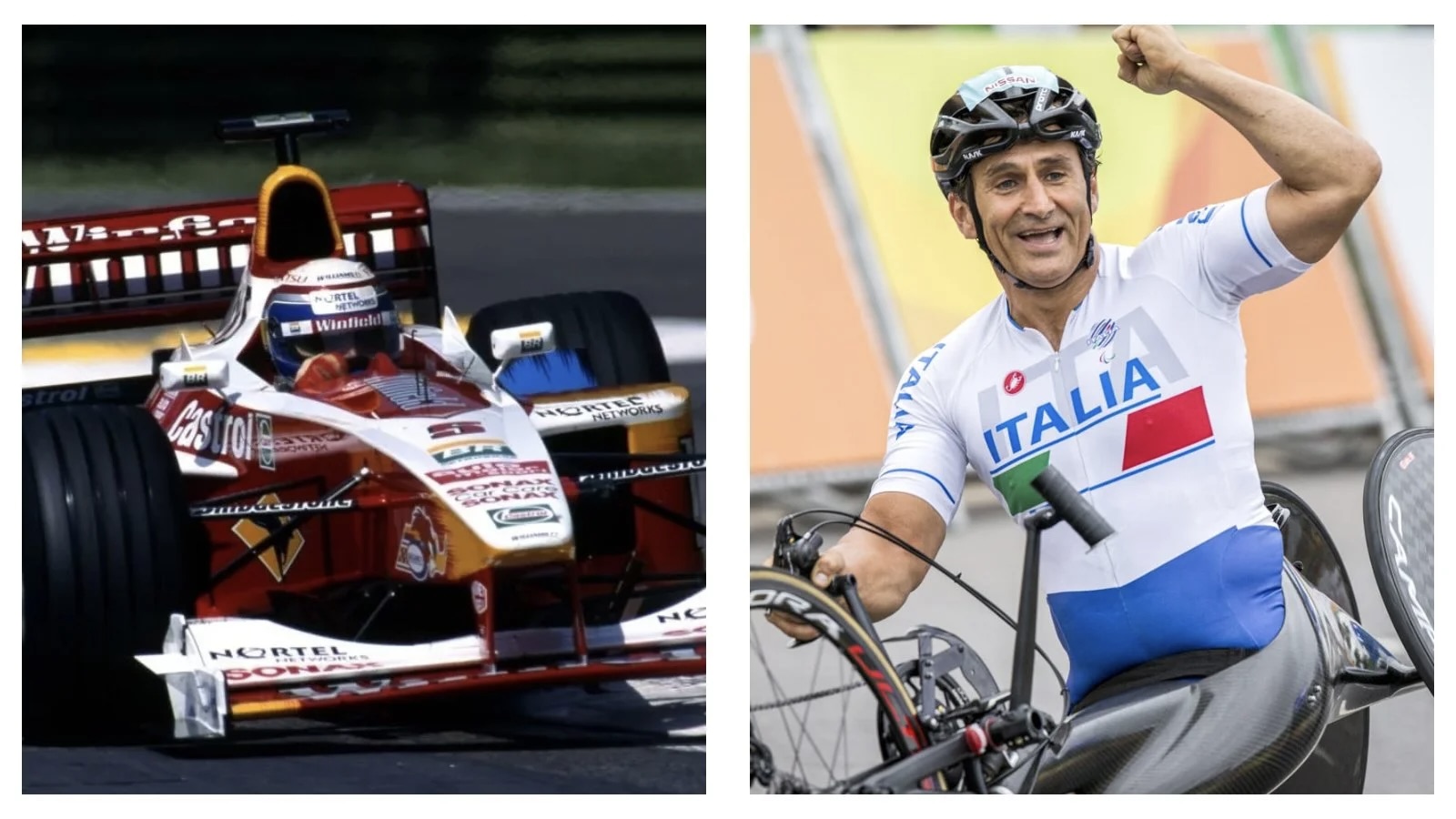
Formula 1 with Jordan, Minardi, Lotus, and Williams. Then the American CART, where in 1997 and 1998 he won two consecutive titles against rivals who gave him no mercy. He's not a romantic outsider who miraculously makes it: he's someone who has a real, technical, and sometimes ruthless hunger for victory in the car.
Then 2001. The Lausitzring. Exiting the pits, hitting the center of the road, the amputation of both lower limbs after fifteen surgeries and more than one cardiac arrest.
Here begins the hero's narrative. But first, there was already a champion.
The return was not a metaphor
When Zanardi returned to racing, he did so with prosthetics that he partly helped design himself. He won the Italian Superturismo Championship in 2005, then competed in the WTCC. He then discovered handcycling and built a second Paralympic career of the highest caliber: four Paralympic gold medals (London 2012 and Rio 2016) and twelve world titles.
Let's stop for a second.
This isn't the story of a survivor who "does his best." It's the story of an elite athlete who dismantles his sporting identity, reassembles it on a different physical basis, and returns to winning at the international level.
There's resilience, yes. But above all, there's a fierce competitiveness that hasn't been extinguished by the legs. If anything, it's readjusted. Like a fire when you remove the wood: it looks for something else to burn.
The question no one asks: Did he overdo it?
In 2020, during the "Obiettivo Tricolore" charity relay race in Tuscany, Zanardi lost control of his handbike on a downhill slope, veered into the oncoming lane, and collided with a truck. Six years of silence. Then, death.
It's the uncomfortable question: why was he still there? With all he had already demonstrated—his wife Daniela, his son Niccolò, the medals, his television career—why did he continue to seek that speed, that curve, that risk?
The honest answer is that it wasn't a coincidence: it was consistency. Zanardi couldn't be anything else. Taking away the race from him would have been like taking away his breathing space, not to take away the risk, but to take away the reason he got up in the morning.
Can we call it "exaggeration"? Perhaps, from the perspective of a life calibrated for minimal risk, yes. But then we have to be honest: that same excess was the very root from which the world titles, the impossible comebacks, the smiles in front of the cameras arose.
You don't choose the flame only when it gives light and reject it when it burns.
The paradox: he also knew how to give up
Here's the part that motivational posters don't tell.
To build his second life, Zanardi had to surrender to his first. He had to accept that he would never be that Formula 1 driver again, that those legs would never return, that a part of him had remained on the asphalt of the Lausitzring forever.
That surrender wasn't defeat. It was emotional intelligence at its finest. Anyone who knows someone who desperately clings to what was to avoid reckoning with what they've become knows how rare and difficult it is to do the opposite.
Zanardi chose not to chase the ghost of himself. He built something new with the materials he had. And it is for this reason—much more than "willpower"—that his story makes sense.
Irony as a style, not as a defense
One thing that anyone who met him always remembers: the ability to laugh.
At his first public appearance after the amputation, he said he was so emotional he sat down next to the press that "his legs were shaking." Perfect line, perfect timing, no drama.
It wasn't a tic. It was a way of being in the world: acknowledging the weight without being crushed by it, without even pretending it doesn't exist. Zanardi's irony wasn't armor. It was an invitation to look at reality straight on, without running away or heroizing it.
That's why the "indestructible champion" persona felt a bit tight on him. He was a man, with real scars and real laughter. We built the monument, and he just stood there shrugging his shoulders.
What does it really leave us?
Not an unattainable model. Not a moral duty to "never give up," otherwise you're not trying hard enough.
He leaves us with a posture: the ability to hold together surrender and relaunch. To accept what cannot be changed without letting ourselves dissolve. To want to win again, not out of revenge for misfortune, but because competition was his way of saying, "I'm here, I'm alive, and I still find this thing wonderfully interesting."“
Sometimes I think that the true act of respect towards Alex Zanardi is not to make a poster with his face and the words “NEVER GIVE UP”.
Let us remember that he was a whole person, complicated, fierce and tender, ironic and serious, capable of giving up and starting over again.
As we all are, or would like to be.

Digital creative, musician, and storyteller. I explore the intersection of humanity and technology, telling stories of AI, music, and real life. Welcome to my organized mess.”