
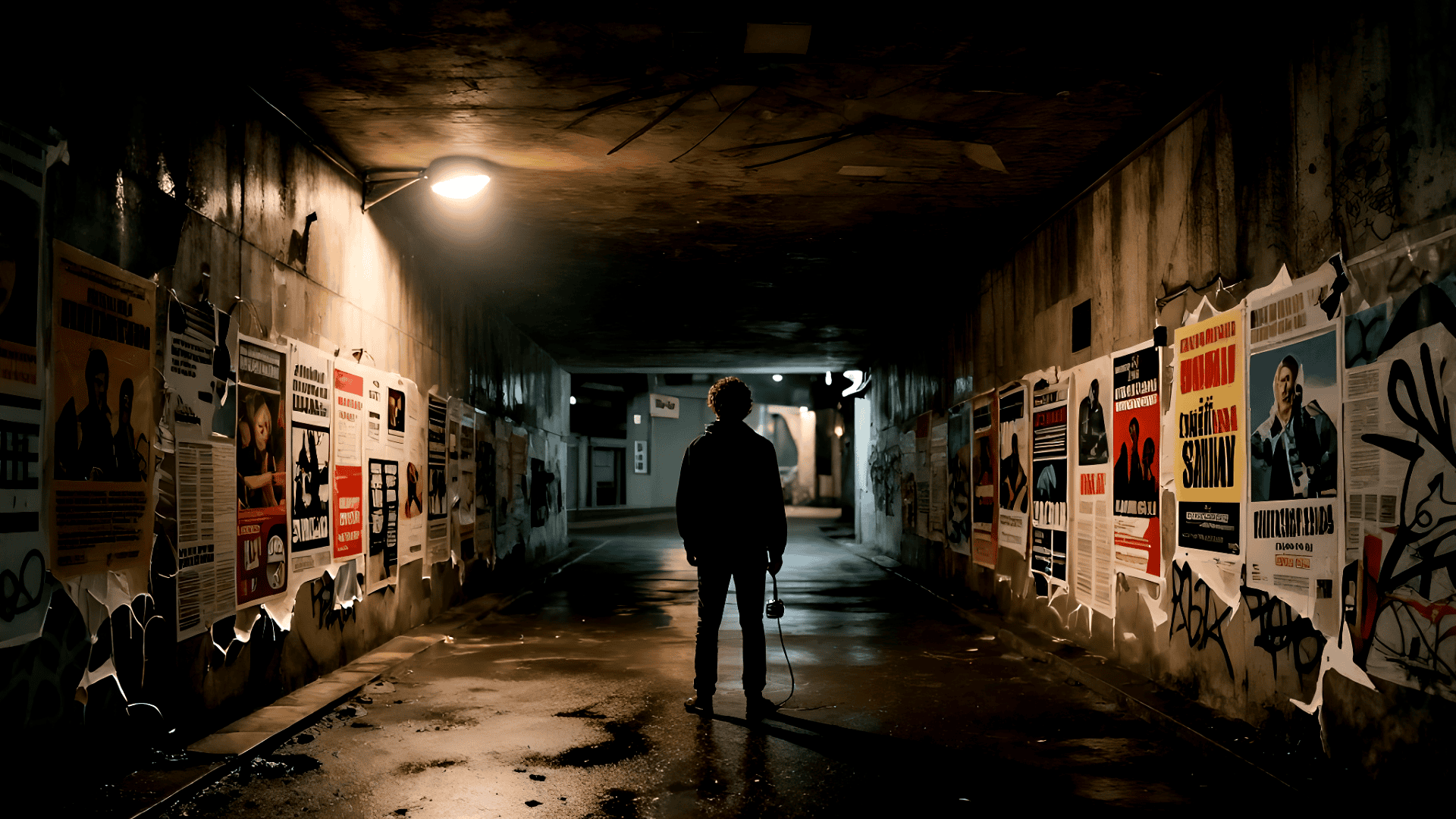
Protest music is dead. Long live protest music.
(Or: How we sold anger in installments, and who refused to sign)
🎵 If you want to listen while you read, here's a playlist of 10 historic songs.
Let's start with an uncomfortable truth: protest music isn't dead. It just disguised itself so well that it seemed dead, and we fell for it like fish.
For decades, we've believed the fairy tale of rebel rock. The distorted guitar as an act of war. Long hair as a political manifesto. Concerts as popular assemblies. Then, with the quiet efficiency of those who know their job, the music industry took that anger, packaged it into a €9.99 record, and built a sold-out world tour and a line of limited-edition sweatshirts around it. Revolution, it seems, needs merchandise.
We drank it all.
Rap was the reserve. Then they discovered it was also a fishy thing.
When rock was domesticated, many of us looked to rap as the final frontier. And for a while, it truly was: no arena-sized guitars, just rhymes that spat out truths about racism, police, poverty, and forgotten suburbs. A grassroots commentary, brutal and necessary, that no mainstream newspaper would ever publish on its front page.
Then something happened: some of those chanting "fuck the system" discovered that the "system" pays very well. And then the center of gravity shifted, slowly, almost imperceptibly. The anger remained—but now it was directed at the guy who dared to look at your Rolex the wrong way. The social commentary turned into a flex. The women, who had previously been comrades in the verses, returned to being furniture in the video. The circle was complete.
I'm not saying that all rappers have become leasing charlatans. I'm saying that the charlatans have become the most visible, and that the algorithm, in its infinite wisdom, has decided that their songs deserve more streams than anything with anything to say.
2020: The flame that no one could keep alive
There was a moment in 2020 when it seemed like something was about to happen. American streets erupted in flames after the killing of George Floyd, a torrent of songs emerged in weeks, almost live—hip hop, R&B, jazz, electronic music, all speaking the same language for once: that of legitimate anger. Public radio stations compiled veritable timelines of protest songs released in response to those days.
For a few weeks it seemed that music had regained its most ancient function: being the voice of those who do not have an institutional microphone.
Then the platforms updated the algorithm, the news cycle moved on, and the playlist “Black Lives Matter”" ended up in the "archive" section next to the Christmas 2018 ones. Not because the anger was fake. But because the system is very good at absorbing shocks without moving an inch.
It still exists, but it's hidden in places that no one looks.
That said, protest music exists. This isn't a consolation: it's a fact.
There are those who write entire albums about climate collapse, not as a vague metaphor but as a precise indictment against those who know and choose not to act. There's also a vast feminist canon, made up of anthems ranging from suffragette songs to songs against contemporary femicide, re-proposed in public squares, re-shared on social media, used as soundtracks for demonstrations where people march with justified anger. There's even a specific strain of Italian anti-fascist rap, which isn't nostalgia for 1990s community centers but rather a contemporary narrative from those who have actually encountered the new fascisms.
In Italy, there's a multilayered history that many pretend not to know: from pre-fascist anarchist songs to partisan songs, to the workers and rice weeders who put exploitation and violence to music long before anyone coined the term "engaged singer-songwriter." Some of those songs are resurfacing online, rediscovered by feminist groups who use them as bridges between past and present.
The problem is not that it doesn't exist. The problem is that It is not found by those who do not seek it.
And by now we are used to everything being taken care of by the For You page.
The question of broken mirrors
There's something else that few admit: part of the emptiness we feel stems from the fact that rock had convinced us that protest had to take a specific form. Guitars, stadiums, crowds raising their fists. A recognizable, almost consoling aesthetic. A hero identifiable by the right t-shirt.
Today, that form is in tatters. There's no universally recognized Dylan of 2025, no group officially recognized as "authentic rebels." There are dozens of micro-scenes that speak to different communities—environmentalists, feminists, anti-racist collectives, diaspora communities, scattered social spaces—and often don't even talk to each other.
It may seem like weakness. I call it capillary resistance. Which is the only kind of resistance the system has really struggled to buy, because it doesn't know who to buy the rights from.
And then there are the noisy crumbs
I could be modest here and not quote myself. But in the face of injustice and decay, I can't! It's stronger than me.
With the 80 HUNDRED MILES let's face it violence against women, alienation of social media, the power of those who sit on thrones without ever having earned them. We're a scattered, geographically dispersed group, with zero chance of ending up on a Spotify editorial playlist unless a secular miracle happens. Yet every song we write about those topics is, on a smaller scale, the same gesture someone made in 1968 with an acoustic guitar in a university courtyard. The scale is different. The intention is not.
The point isn't size. It's the refusal to pretend things are okay when they're not.
And in a panorama in which the dominant tendency - even in so-called "alternative" music - is to aestheticize the malaise without naming its causes, naming the causes is already an act of disturbance.
So?
Protest music is dead only if you think it needs the body of '70s rock, the nastiness of early Public Enemy, and a credible major label deal. If you look further, you see it everywhere: in the choral collectives singing in front of climate change parliaments, in the feminist playlists circulating on WhatsApp among survivors, in the anti-fascist rappers who release on Bandcamp instead of Amazon Music, in the mainstream bands making prog metal about gender violence without asking anyone's permission.
It's not a comforting answer, I know. It would have been nicer to tell you there's a new movement, a new genre, a new band that's about to change everything. But 2026 doesn't work that way, and ignoring reality isn't my style—nor is it yours, reader.
There's a protest. She just refused to go to the casting.
⸻
If you found something that rings true in this post, perhaps it's because you, too, sometimes look for beauty in places where it shouldn't be—and you find a fair amount of righteous anger there, too.
The 10 most famous protest songs
Billie Holiday — Strange Fruit (1939)
Topic: racism, lynching, South America
Before the term "protest song" existed, this one already existed. A plantation. Bodies hanging from trees. A voice describing them with the calm of someone who knows true horror doesn't require screams. Holiday sang it at the end of her sets, with the lights off. No encore. No applause requested. She simply walked out.
Guaranteed side effect: you realize that certain things haven't changed enough.
Bob Dylan — Blowin' in the Wind (1963)
Theme: war, peace, civil rights
Three minutes and twelve seconds. A guitar. Nine rhetorical questions that no one had yet answered in 1963, and many of which remain unanswered now. Dylan's trick: don't give the answer. Leave it there, blowing in the wind. So everyone has to take it home and deal with it for themselves.
Extremely annoying. Brilliant.
Sam Cooke — A Change Is Gonna Come (1964)
Theme: Civil Rights, Black America, Hope
Cooke wrote it after being kicked out of a white hotel. He released it knowing he was taking a risk. A few months later, he was dead, killed in circumstances that are never fully clarified. The song is about change, but it's imbued with the knowledge that change can cost you everything.
The heaviest hope you've ever heard sung.
Fabrizio De André — Piero's war (1964)
Theme: war, military madness, the futility of death
Italy had its voice of protest, and his name was Faber. A soldier who dies killing an enemy he doesn't know, on a battlefield whose meaning he doesn't understand. De André tells it in medieval-style octaves, with the grace of someone who knows that sarcasm applied to death is the highest form of respect for the dying.
Seventy years later, it remains more relevant than any newscast.
Creedence Clearwater Revival — Fortunate Son (1969)
Topic: Vietnam, class inequality, who goes to war and who doesn't
Three minutes of rock that explains better than any sociological essay how war works: those who can't afford not to go go. The sons of senators, generals, and industrialists stayed home. The rest didn't. John Fogerty shouts it like it has a deadline.
Spoiler: That deadline was "before it was too late." It was already too late.
Marvin Gaye—What's Going On (1971)
Theme: Vietnam, police brutality, American fratricide
It was born after a member of the Four Tops witnessed firsthand a police charge on anti-war protesters. Gaye took it, transformed it into a secular prayer, and released it against the wishes of Motown, which did not want to "politicize" the catalog. It sold millions of copies. Motown quietly cashed in.
Moral: Even record labels slowly learn who's right.
Grandmaster Flash & The Furious Five — The Message (1982)
Theme: urban poverty, systemic crime, suburban degradation
“It's like a jungle sometimes / It makes me wonder how I keep from going under.” Before rap became a business for rich blacks.
NWA—Fuck Tha Police (1988)
Topic: police brutality, institutional racism
The title is already the manifesto. No metaphors, no turns of phrase: five black boys from Compton put the American police on trial with rhymes so direct they open the door. an FBI investigation into the song. The U.S. government literally wrote a letter to the record company to "report" the song. There's no better publicity—and no clearer proof that music can be scary to those in power.
The disturbed disturber: when the State fears a disc, the disc has already won.
Rage Against The Machine — Killing In The Name (1992)
Theme: institutional racism, complicity of power, civil disobedience
Written in the wake of the police brutality against Rodney King and the Los Angeles riots, it surpassed one billion streams on Spotify in 2025—proving that righteous anger never dies. Guitarist Tom Morello commented, thanking "those who listened to it, those who hated it, and those who loved it without understanding it." That last category is probably the largest.
Fun fact: in 2009, he won the British Christmas number one thanks to a social media campaign against the talent show system. The protest, at times, can be quite amusing.
Childish Gambino — This Is America (2018)
Topic: gun violence, racism, mass distraction
Three minutes and forty-five seconds that shift registers at unexpected times—gospel, trap, chaos—while the video builds one of the most powerful images of the decade: a man dancing while the world burns behind him. He needs no explanation. He demands attention. Which is precisely the point: in America, it's easier to dance than to watch what's happening off-camera.
End of playlist. Now you have seventy years of protest in ten tracks. Press play and then tell me music is pointless.

Digital creative, musician, and storyteller. I explore the intersection of humanity and technology, telling stories of AI, music, and real life. Welcome to my organized mess.”
2 Comments