
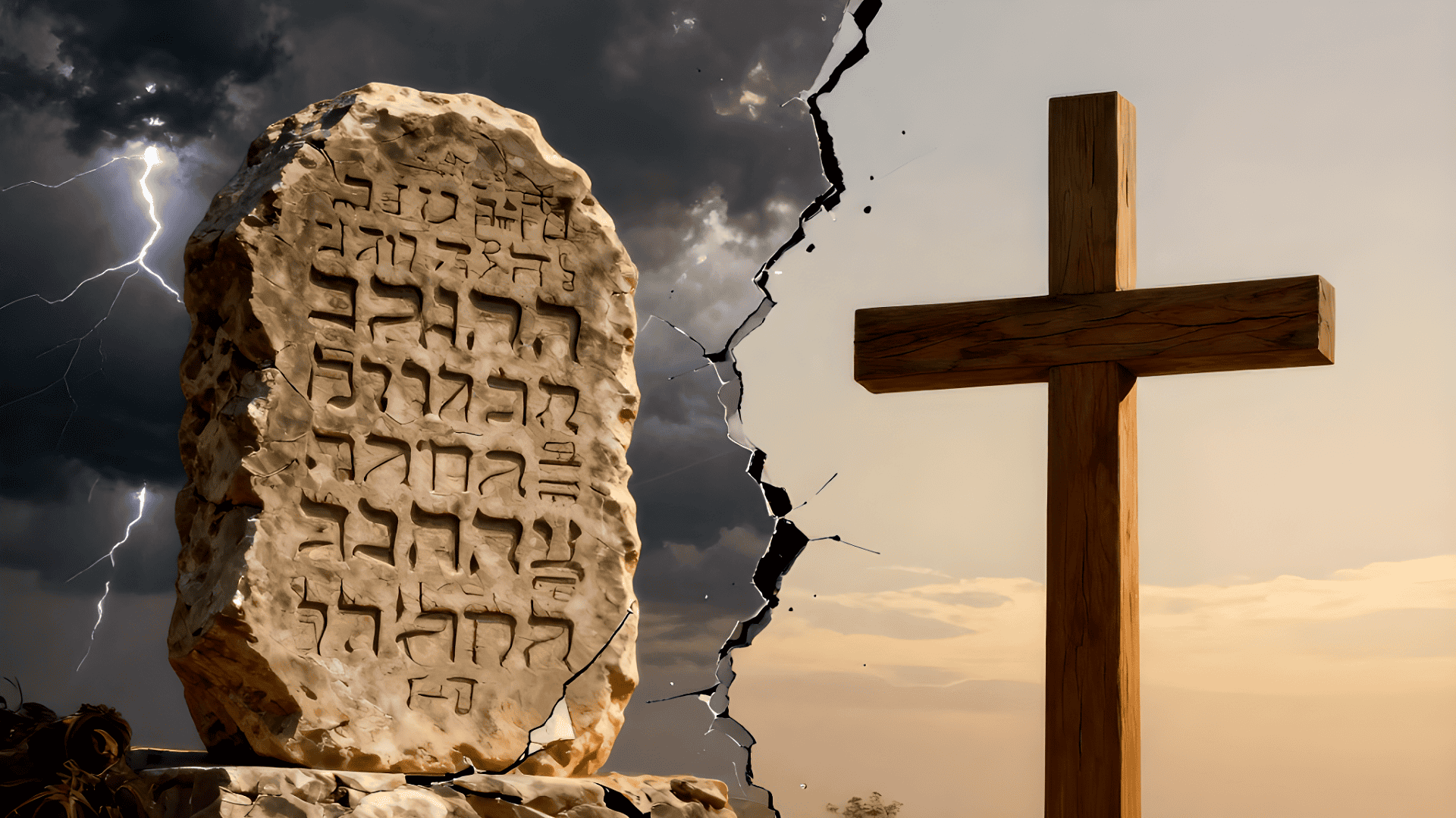
Is the God of Hosts my God?
Is it time for the Catholic Church to come to terms with the Old Testament?
Sunday. Pope Leo XIV's appeal for peace is broadcast on the news. Yet another appeal. Strong. Harsh.
…unheard…
I have to be honest: I've been carrying that initial question around with me for years. Ever since I was a child, I heard certain passages of the Gospel read in church.’Old Testament And I waited for the priest to explain what the hell they had to do with Jesus. Unfortunately, an explanation never came. We just shrugged it off, like you do with an uncomfortable topic at the dinner table.
Then I grew up, I read, I reflected. And the question remained there, increasingly cumbersome: does it still make sense, in the 2026, that a Church that preaches peace and love brings into its sacred canon a God who orders genocide? I am a believer. I am a practicing Catholic. I have always been taught that I myself am the Church. So Church are also my questions and my doubts.
It's all black and white.
Let's start with the facts, that is, the texts. Because the problem isn't the interpretation—it's precisely what's written.
1 Samuel 15:3 —the Lord orders King Saul through the prophet Samuel: “Go now and strike Amalek and utterly destroy all that they have. Do not have pity on them, but kill both man and woman, both infant and child, both ox and sheep, both camels and donkeys.”
It's not an exception. It's a repeating pattern.
Deuteronomy 2:33-34 —under God's guidance, the Israelites completely exterminate Sihon's men, women, and children. The text reads without embarrassment: "“We left no one alive.”
Deuteronomy 7:2 —God speaks clearly about enemies: “You shall utterly destroy them; you shall make no covenant with them, nor show them mercy.”
Joshua 10:38-39 — Joshua takes Debir, puts it all to the sword.“They left no survivors.”
Exodus 32:27 —at the sight of the golden calf, God orders the sons of Levi: “Let each of you put his sword on his side, and go through the camp from gate to gate, and each of you kill his brother, each of you his friend, each of you his neighbor.”"Three thousand people fell. God was pleased.
The scholar Raymund Schwager counted in the Old Testament 600 steps of explicit violence, 1,000 verses which describe the violent punitive actions of God and 100 steps in which God expressly commands killing. One hundred. It's not a typo, it's an attitude.
This is the God of hosts. Yahweh Sabaoth. And it is the same God whom Sunday Mass asks me to call "Father.".
When sacred texts become real weapons
So far, it might seem like an academic exercise. But then comes the moment when you realize it isn't.
In October 2023, Benjamin Netanyahu — the prime minister of a modern democratic state — justifies the military operation in Gaza by citing those exact verses. He quotes 1 Samuel 15 before the nation, compares the Palestinians to the Amalekites, and adds, citing Deuteronomy 25:17: “Remember what the Amalekites did to you. Let us remember and fight.”
A government leader uses a three-thousand-year-old sacred text to legitimize a contemporary military operation. And the text works—culturally, emotionally, politically—because it's there, in the canon, considered the word of God.
I'm not saying Netanyahu is right. I'm saying the text allows him to do so. Indeed, in a certain sense, it invites him to do so.
And it's not just an Israeli or Jewish issue. Islamic fundamentalisms They quote the Quran for jihad. Some American Christian supremacists They cite the Old Testament to justify racial violence. They all draw from the same arsenal: sacred texts that describe a God who fights, exterminates, and punishes collectively.
The heretic who had (almost) understood everything
What strikes me most is that this question isn't new. Someone already tried it, two thousand years ago.
It was called Marcion of Sinope, and in the 2nd century AD he proposed precisely this separation. His thesis: the God of the Old Testament—violent, tribal, vengeful—and the God the Father revealed by Jesus are two different entities. For consistency, he constructed a canon that entirely excluded the Old Testament, retaining only a version of the Gospel of Luke and some letters of Paul.
The Church condemned him as a heretic. They called him “the wolf that comes from Pontus”. His followers survived for centuries, especially in Syria and Armenia – a sign that the idea struck a chord in the lived experience of the faithful.
Marcion was wrong in his approach: his dualism it smelled too much of Gnosticism, and he also cut away precious things. But the question he posed was legitimate. And, allow me to say, it remains without a truly satisfactory answer even today.
The Sermon on the Mount against the God of Hosts
Because the tension isn't in my head. It's in the text.
Jesus in the Sermon on the Mount systematically overturns the tradition that preceded it. The formula he uses — “You have heard that it was said… but I tell you” — repeated six times in a row is a conscious and structured distancing:
“You have heard that it was said, ”An eye for an eye and a tooth for a tooth.’ But I say to you, do not resist an evil person…”
“You have heard that it was said, ”You shall love your neighbor and hate your enemy.’ But I say to you, love your enemies and pray for those who persecute you…”
This is not integration. It is overturning. Jesus is correcting something. He's saying: what you've understood so far isn't enough, or worse, it's not right. The God who taught you to tear apart the Canaanites is not the complete picture.
And here lies the paradox that the Church has chosen not to resolve: the book that contains these extraordinary words also brings with it the manuals of massacre.
The official response (which is not entirely convincing)
Catholic theology has a ready answer: The Old and New Testaments are inseparable, One is a promise and the other a fulfillment; revelation is progressive. Jesus himself quotes the Psalms, he quotes Isaiah, and bases his teaching on Jewish tradition.
It's an answer that holds true for the Prophets, for the Psalms, for the history of the Covenant. But when you get to the passages of the extermination, the answer becomes: "“we need to contextualize, those were different times”. Right. Except that at that point you're implicitly admitting that certain texts are historically outdated. And if some parts of the Bible are outdated, the obvious question is: who decides which ones? Based on what criteria? Tradition? The magisterium? Common sense?
It is a door that the Church has never really wanted to open, because behind it there is an abyss of authority that needs to be reconsidered.
Christian politicians and the Gospel they forget
There's something else that's hard for me to ignore. As I write this post, I think of certain politicians—in Europe, in America, everywhere—who they declare themselves Christians, they quote the “Christian values”", they wave crucifixes during election campaigns, they have their pictures taken praying with contrite faces, and then they build walls, close ports, bomb, and invoke "Western Christian civilization" as a shield against those who are different. Let's face it, they don't do the Gospel any good. Jesus was quite clear on the subject of foreigners, the poor, the "last"“. But evidently they skip some pages of the book.
A way out: reading the OT through Jesus, not the other way around
I'm not advocating burning the Old Testament. I'm saying the Church should have the courage to officially do what many theologians already do tacitly: adopt a hierarchical reading, in which the Gospel is the main filter and not one of the many pieces of the puzzle.
It means recognizing that:
• The Psalms, the Prophets, the history of the Covenant remain fundamental — they are the context without which the Incarnation has no meaning
• Texts that glorify divine violence should be read as historical testimonies of an imperfect and tribal understanding of God, not as a normative word for the present
• Some pages of the Bible tell us more about how humans projected their desires for revenge through God than about God himself.
This isn't Marcionism. It's what anyone who reads the Bible with intellectual honesty already does. The problem is that the hierarchy will never admit it publicly, because it would raise an uncomfortable question: if that part is wrong, what authority guarantees the rest?
The knot that remains
Ultimately, the problem isn't just theological. Opening the door to systematic textual criticism means surrendering interpretive authority. It's not just a theological issue: authority isn't readily questioned, in any institution.
In the meantime, the Roman Observer In 2025, he found himself wondering how to read the Bible after the destruction of Gaza. A good question. A belated one, perhaps. But at least someone is asking it.
Jesus would probably have understood the question I asked at the beginning of this post.
Many, I suspect, will continue to file it away as “position already refuted in the 2nd century AD.”.
And meanwhile, the world continues to burn. With a few verses from the Old Testament in hand.

Digital creative, musician, and storyteller. I explore the intersection of humanity and technology, telling stories of AI, music, and real life. Welcome to my organized mess.”


One Comment
Comments are closed.