
From the wise old man to the old fools: why the world is ruled by paranoia.
There's a merciful lie we've been telling ourselves for centuries, guarded like a relic: the idea that white hair brings balance, foresight, and calm wisdom.
It was a plausible fairy tale when reaching seventy was a statistical feat and the world was changing so slowly that historical memory It served as a compass. Today, just look around you, in everyday life, to discover that biology tells a different story.
Once a certain age threshold is reached, cognitive decline and character development cease to be unfortunate exceptions and become a statistical probability. And the famous “experience” struggles to recover lost ground: it arrives late, like everyone else.
The Biology of the Besieged Fortress
Let's be frank, as obvious things deserve. With age, the prefrontal cortex, the control center for mental flexibility, abstract reasoning, and impulse control, begins to lose its edge. It's an analog circuit that slowly oxidizes: the signal still passes, but every sudden change becomes a labor negotiation.
Meanwhile, the amygdala, the archaic department that senses danger and spreads fear, remains in permanent active service. In fact, it's working overtime.
When the body loses vigor and the world accelerates to the point of incomprehensibility, the sensation of losing control generates a dull anguish. And anguish always finds an outlet: chronic suspicion, endless complaining, anger, a mania for rigid rules to keep the unexpected at bay. Anyone who associates with people over 75 or 80 knows this: every novelty is a threat, every change an affront, every unexpected event a miniature catastrophe (a new router, for example).
In the private sphere, all of this deserves patience, respect, and care. It's the natural course of things. The short circuit occurs when we find the same mental architecture sitting at the planet's control panel.
Why we let geriatrics guide us
In everyday life, we recognize cognitive slowdown without drama: no one would entrust a critical decision to someone who struggles to decipher the present. Then we look up at the halls of power, and the logic reverses, as if by magic.
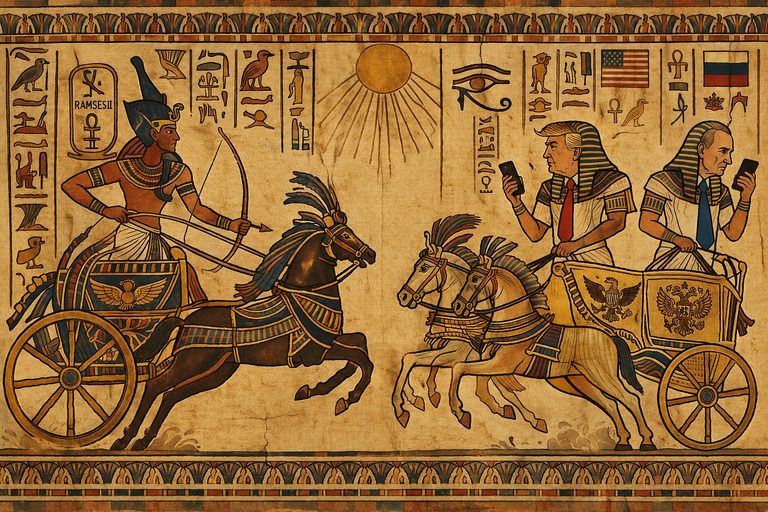
From Washington to Moscow, passing through European chancelleries and the summits of global finance, the decisive levers are in the hands of a generation that is well past seventy-five, often touching eighty and beyond. How did we come to hand over the future to those who reason with the defensive reflexes of old age? Methodically, actually. Power is accumulated and preserved in this way:
- The inertia of compound interest. Building networks of influence, occupying strategic positions, and neutralizing adversaries takes decades. By the time you finally have all the strings in hand, the registry office has already paid the bill, and those in power use those same strings to secure their own position. Retirement, for some reason, is never a possibility.
- Selection of control patients. Those who cling to the scepter at eighty belong to an extreme psychological species: they have fused their identity with the position they occupy. For certain personalities, ceasing to decide is equivalent to disappearing.
- The generational cap. An elderly and insecure leader surrounds himself with docile followers and keeps the brilliant young men at bay: the capable young man is a rival, the obedient courtier a guarantee of peace of mind. The turnover remains stalled until nature intervenes, which may take biblical time but at least it is punctual.
- Ithe demographic weight at the polls. In Western democracies, those over 65 are a compact and disciplined bloc, while young people desert the polls or disperse. The ruling class ends up resembling those who actually vote, including fears, nostalgia, and conservative reflexes.

The paradox of paranoia
There's a detail that makes the picture even more grotesque. In everyday life, seeing enemies everywhere and living on constant alert wears down relationships and condemns one to loneliness. In the corridors of power, the same paranoia becomes an evolutionary advantage: those who suspect every shadow survive palace conspiracies longer.
The result is there for all to see. The games that will decide the next thirty years, from the energy transition to artificial intelligence to geopolitical balances, are being played by leaders with a very short time horizon, driven by the fear of losing ground rather than the desire to build something. People driving at 200 miles an hour toward tomorrow with their eyes glued to the rearview mirror.
We cannot rewrite biology, nor dismantle the planet's gerontocracies alone. But we can stop calling “wisdom” what is merely fear disguised as authority. And choose, day after day, to keep our minds flexible, curious, and impervious to the sterile laments of those who have ceased to be amazed.
Because I seek beauty everywhere: also, and above all, in the rare clarity of those who recognize their own time and have the grace to step aside to make room for those who will come after. And if I don't find it, I'll move on.

Digital creative, musician, and storyteller. I explore the intersection of humanity and technology, telling stories of AI, music, and real life. Welcome to my organized mess.”