
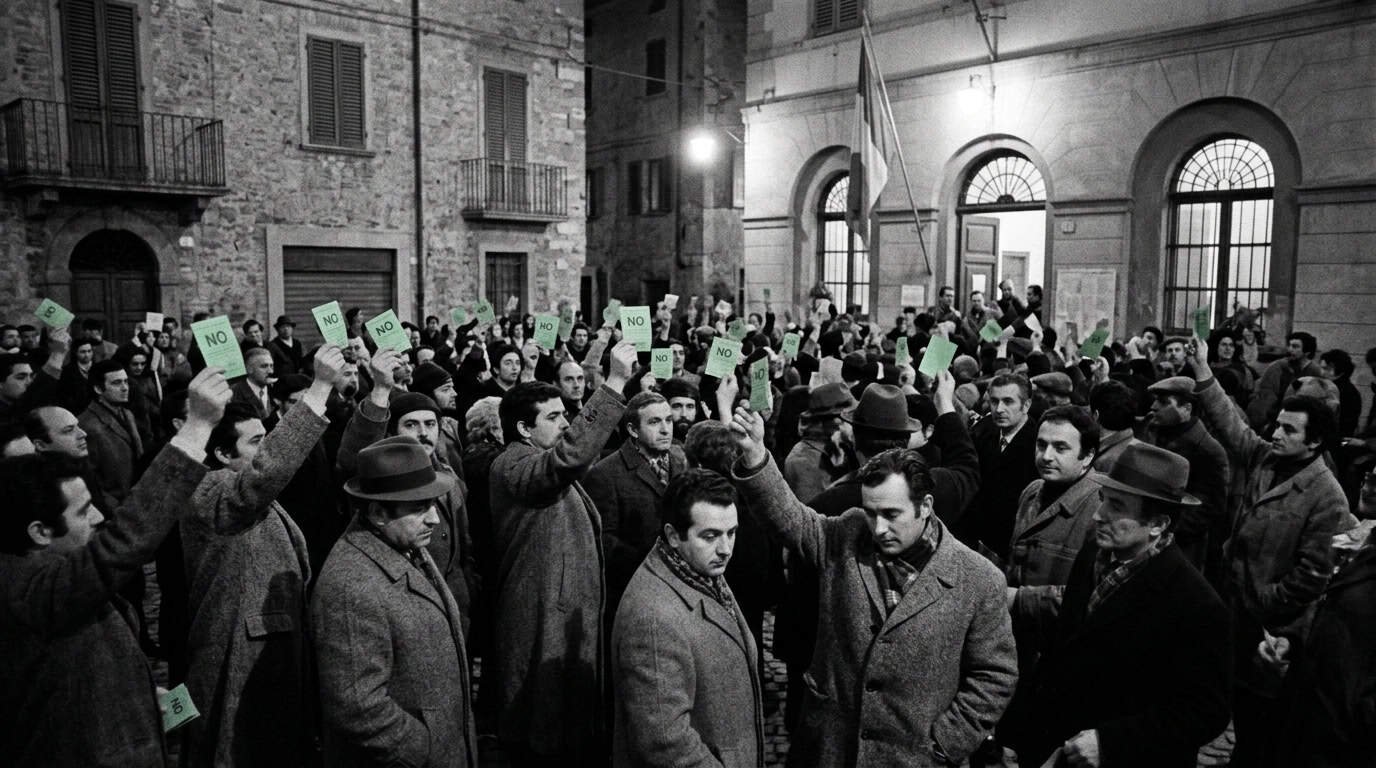
The Silent Italians have spoken. And no one expected it.
There's an Italy you never see on television. It doesn't shout on talk shows, it doesn't post angry memes about X, it doesn't comment on Salvini's posts or Schlein's. It doesn't have a uniform. It doesn't have a tribal chief. It does, however, have something much rarer: a functioning brain and a breaking point.
On March 22 and 23, 2026, that Italy got up from the couch. And went to vote NO.
The numbers that no one had really predicted
The constitutional referendum on the reform of justice – essentially, the separation of careers between judging and prosecuting magistrates, the great battle of this government – has concluded. with a clear defeat of the government front.
NO: 53,74%. YES: 46,26%.
Almost eight points of difference. But the most notable figure is another: the turnout was close to 59% —an all-time record for a constitutional referendum in Italy, in a country where voter disaffection seemed irreversible.
Only three out of twenty regions voted YES: Friuli Venezia Giulia, Lombardy, and Veneto. The rest of the peninsula—seventeen regions—said NO. Florence and Bologna reached 71% voter turnout. Stuff that would send shivers down the spines of the spin doctors at Palazzo Chigi.
How can all this be explained? Politics, almost never. Italians, always.
Silent Italian: a profile
Let me sketch a portrait of this character that pollsters struggle to intercept and politicians always forget to consider.
The silent Italian is not an abstentionist on principle. He is a selective. He votes when he feels there's something concrete to defend. He's not interested in the drama of everyday politics—in fact, he avoids it like a nagging neighbor. But he's not deaf. He listens. He observes. He elaborates. And when he realizes things are going badly, he doesn't start yelling on Facebook: takes the house keys, goes to the polling station and votes.
It's that person who perhaps didn't vote in the last general election because "everyone's the same anyway"—and in part, she was right. But who shows up for a referendum on the structure of the justice system, the independence of the judiciary, the separation of powers. Because certain issues aren't right or left. They're before or after.
These are the kind of questions that don't allow for the easy answer of "but also on the other side...".
The government underestimated the antibodies
Italy has a strange memory. It's not always explicit; you don't find it in anniversary speeches or ministerial declarations. But it's there, subterranean, visceral. It's the memory of a country that lived through the twenty-year period, that knows—deep down, even without having lived through it—what it means when a government begins to systematically attack an independent judiciary.
Not that this reform was a dictatorship, mind you. But the tone, the method, the language used in the last weeks of the campaign —the attacks on judges, the statements bordering on decency, the analyses of the reform's consequences so bizarre that anyone with a modicum of common sense could have debunked them in thirty seconds—have triggered something.
Those antibodies.
It wasn't the left that won this referendum. The left contributed, of course. But it didn't have the numbers to do it alone. More is needed. It takes that segment of moderate Italians, distant from political parties, who saw this referendum not as a vote on technical justice, but as a signal to send. A line to draw.
“This far and no further.”
A victory that should make even the winners reflect
Here comes the uncomfortable part, the one that the winners of the day don't like to hear.
Elly Schlein and the opposition parties are already thinking about the next general election. The NO committee is celebrating in Piazza della Signoria in Florence—and naturally, they deservedly won. But be careful: the silent Italians did not vote for you. They voted against a trend. The difference, in politics, is abysmal.
Anyone who interprets this result as a blank cheque is committing the same strategic error as those who lost. Those same Italians who said NO to the Nordio reform between Sunday and Monday morning were already back on the couch by Monday evening, disgusted by politics in general. They haven't found a new love. They've simply erected a wall.
And walls, as we know, don't last forever unless you build something better on the other side.
The elephant in the room (or rather: the orange-haired megalomaniac)
There is one last element that it would be dishonest to ignore. To go arm in arm with certain characters—without naming names, but the orange hair and industrial lies are enough of a clue —it doesn't benefit the credibility of a European government. Not in 2026, with what's happening in the world.
Italians aren't stupid. They see. And when the leader of your government poses smiling next to someone who's rewriting the rules of democracy with tweets and executive decrees, something cracks. Not immediately, perhaps. But it cracks.
History has a precise accounting system. Sooner or later, it will present the bill to those who chose the wrong side for momentary convenience.
Conclusion (which is not a conclusion)
No referendum will solve the structural problems of the Italian justice system—and they are many, serious, and real. The system malfunctions, trials take forever, and efficiency is a mirage. The debate on this must continue.
But that wasn't the point. The point was: Who's really in charge in this country?
And on Sunday, for a few hours, the response was crystal clear.
Not the buildings. Not the talk shows. Not the social media.
Those silent Italians who look around, nod slowly, and every now and then—when really necessary—stand up and remind everyone where the power lies.

Digital creative, musician, and storyteller. I explore the intersection of humanity and technology, telling stories of AI, music, and real life. Welcome to my organized mess.”