The courage to be wrong
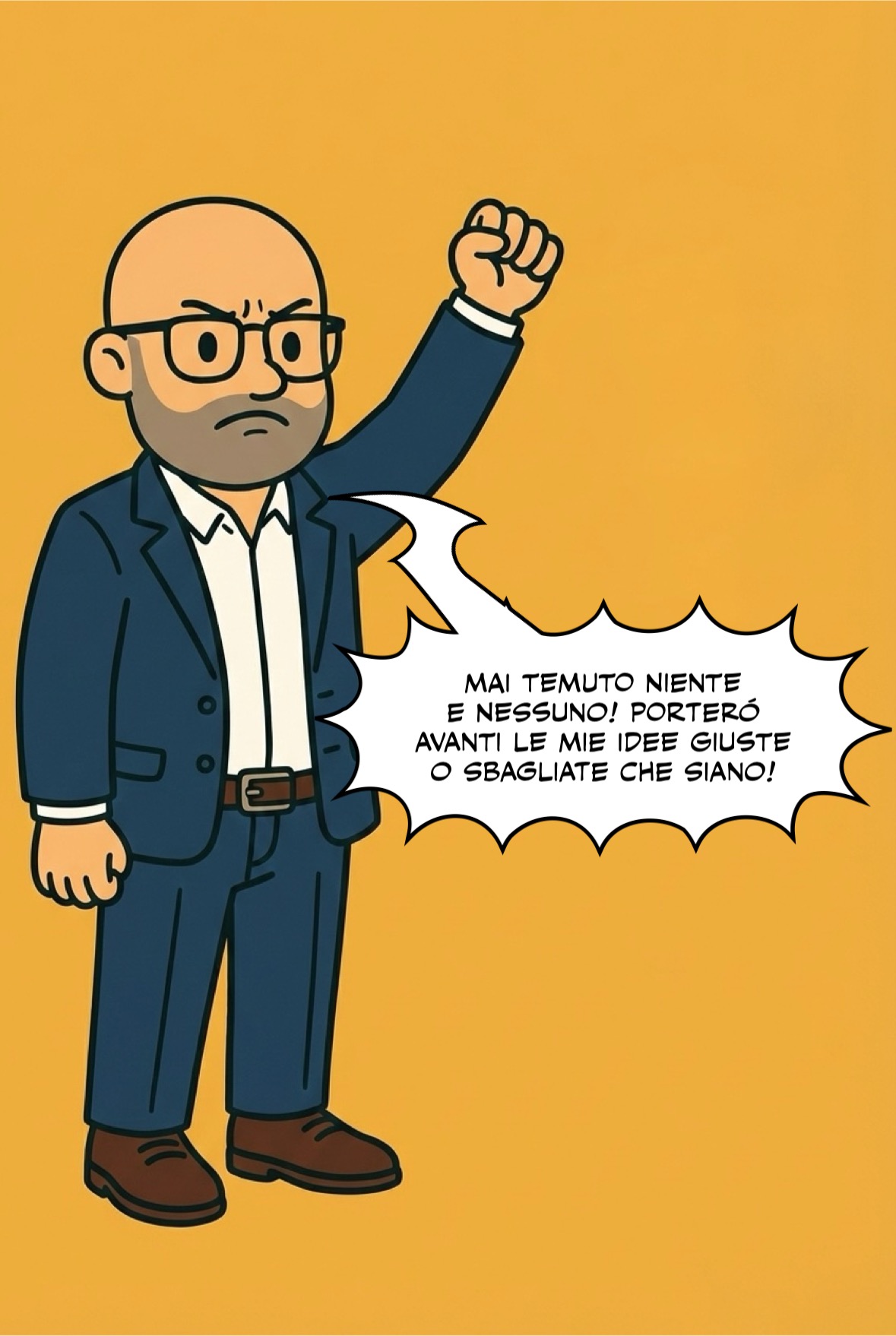
There's a quote I recently read in a couple of articles in various newspapers. It was written by a fairly well-known television personality, in response to a dig he received from a colleague. The quote goes something like this: "I've never feared anything or anyone. I will carry forward my ideas, whether they're right or wrong, never compromised, and never will I."“
That phrase stuck in my head. Not because of who wrote it. But because of what it reveals.
The most elegant own goal in recent history
Let's examine that sentence. Because it conceals a paradox that deserves a university course.
“I will carry forward my ideas, whether they are right or wrong.”
Literal translation: I don't care if I'm wrong. This isn't a statement of courage—it's a public declaration that truth isn't a relevant variable in your decision-making process. You're saying, in your own words, that the correctness of an idea is irrelevant to whether it's yours.
This isn't character. This is ego in a leather jacket.
The psychology of those who never make mistakes
There's a well-documented mental mechanism called cognitive dissonance. Theorized in the 1950s by psychologist Leon Festinger, it describes the tension we feel when two ideas—or an idea and a behavior—are contradictory.
When we are faced with evidence of having made a mistake, our brain basically has two options:
- Update the belief – accept the mistake, revise your thinking, grow.
- Protect the ego – distort reality, find justifications, attack whoever points out your mistake.
The second option is more common, especially among people who tie their self-esteem to their opinions. The more insecure you are, the more a criticism of what you think sounds like a criticism of who you are. And at that point, defending your position becomes a matter of identity survival.
Those who never make mistakes are usually not smarter than others. He simply built a defense system that was impervious to evidence.
“I know that I know nothing” — or, courage 2500 years ago
Socrates, in the 5th century BC, had already figured it all out. He wandered around Athens asking uncomfortable questions of the powerful, the wise, and the arrogant. And the conclusion he reached, every time, was the same: I know that I know nothing.
It wasn't self-pity. It was recognition. that awareness of one's own limits is the starting point of any true knowledge. The Athenians sentenced him to death, partly because he made others feel stupid. But history proved him right.
Intellectual humility—the ability to recognize that one's beliefs may be wrong, incomplete, or partial—is one of the most studied psychological constructs in the fields of well-being and relationships. People with high intellectual humility learn faster, make better decisions, and have stronger relationships. Not because they're weak, but because they don't have to waste energy defending sand fortresses.
The difference between consistency and rigidity
Here lies the crux of the matter, and it is worth being precise.
Consistency It means being true to your values. If you believe in justice, loyalty, freedom of expression—you stay true to them even when it's inconvenient, even when it costs you. That's strength.
Rigidity It means being faithful to your positions, regardless of what reality tells you. If you've argued something and the evidence proves you wrong, persisting isn't coherent—it's an inability to update.
The difference is subtle but crucial. A truly self-confident man can afford to change his mind. Indeed, he changes his mind precisely because he's self-confident. He doesn't need his ego to outlast every single position he's ever expressed.
Those who, on the other hand, protect themselves in advance—"I will carry forward my ideas, whether they are right or wrong"—are admitting, between the lines, that they cannot stand without that wall.
True courage
True courage isn't never being afraid. True courage is doing the right thing even when it hurts.
And in the intellectual realm, the most difficult thing is to say: I was wrong.
It takes three things to do this:
Inner security —don't need every idea you have to be right to feel like a person of value
Curiosity —be more interested in the truth than in winning an argument
Operational humility —not as an abstract virtue, but as a practical tool to navigate reality better
So
The next time you hear someone publicly declare that they will pursue their ideas, "right or wrong," don't be shocked. They're not a lion. They're someone who built a cage and called it a fortress.
The courage to be wrong is rare. And for that very reason, it's worth its weight in gold.

Digital creative, musician, and storyteller. I explore the intersection of humanity and technology, telling stories of AI, music, and real life. Welcome to my organized mess.”