Happy Birthday, Mr. Gilmour
Today, March 6, 2026, David Gilmour turns 80. And I can't let it pass in silence—even though, in a certain sense, silence is precisely what he's always used better than anyone else.
Because David Gilmour has never been a guitarist who overwhelms you. He's someone who waits for you. He gives you space. Then he strikes a note—just one—and the world stops.
From Cambridge with fury (and a few pennies)
Born on March 6, 1946, in Cambridge, the son of a zoology professor and a teacher, David received his first guitar at 13 and taught himself, with a record and a Pete Seeger manual. No academy. No paid teacher. Just an ear, persistence, and an urgency he didn't yet know what to call itself.
Then comes the moment that always makes me smile: young Gilmour, to pay for his instruments and stay afloat, works as a fashion model. Yes. That David Gilmour. The man who would write "Comfortably Numb" and "Shine On You Crazy Diamond" posed for advertising campaigns while Roger Waters designed his architecture of rage. Are there parallel universes less absurd than this?.
Joining Pink Floyd: The burden of picking up the pieces of a genius
In December 1967, drummer Nick Mason called Gilmour and asked him to join Pink Floyd. It wasn't exactly a triumphant entrance: the official job was to patch up the live performances of Syd Barrett, who was slipping into a devastating mental crisis precipitated by LSD.
Gilmour enters as the fifth wheel. He leaves as the beating heart of one of the greatest bands in history.
When Barrett was officially ousted in April 1968, it was David who took up the legacy—not to steal it, but to guard it as respectfully as possible. And he would do so for decades, even when his relationship with Roger Waters escalated into a Cold War worthy of a Russian novel.
The Gilmour Paradox: The "Simple" Guitarist No One Can Imitate
Here's the point that has always fascinated and pissed me off at the same time — in a good way.
David Gilmour isn't a speed virtuoso. He's not a six-string shredder. He himself has said it without embarrassment: "I've created my own personal style. I know I don't have great technique. I'm not very fast, but behind every solo of mine there's a melodic intention.".
So why can't anyone play like him?
Because technique is studied. But tone, intention, when not to play—those are not learned. Bob Ezrin, producer of The Wall, summed it up definitively:
«You can give him a ukulele, and he’ll make it sound like a Stradivarius.»His method, if we can call it that, is almost monastic: pentatonic scale, long notes, dense vibrato, bending that seems to breathe, silences used as pauses in a discourse that already knows where it wants to go. He uses delay and reverb not as effects, but as architectural space. Each solo has a narrative structure—introduction, development, climax—as if he were telling a story without words.
The solo on "Comfortably Numb" is considered by many to be the most beautiful in rock history. And it's made up of a few notes chosen with the precision of a surgeon and the passion of a lover. Aristocratic. That's exactly the right word: there's something noble in the way he chooses each note, as if wasting a single measure were a lack of style.
Eighty years old, a black Stratocaster and no regrets
Rolling Stone ranks him 14th among the greatest guitarists of all time. A well-deserved honor, even if those rankings have always bored me a bit—like lining up sunsets for beauty.
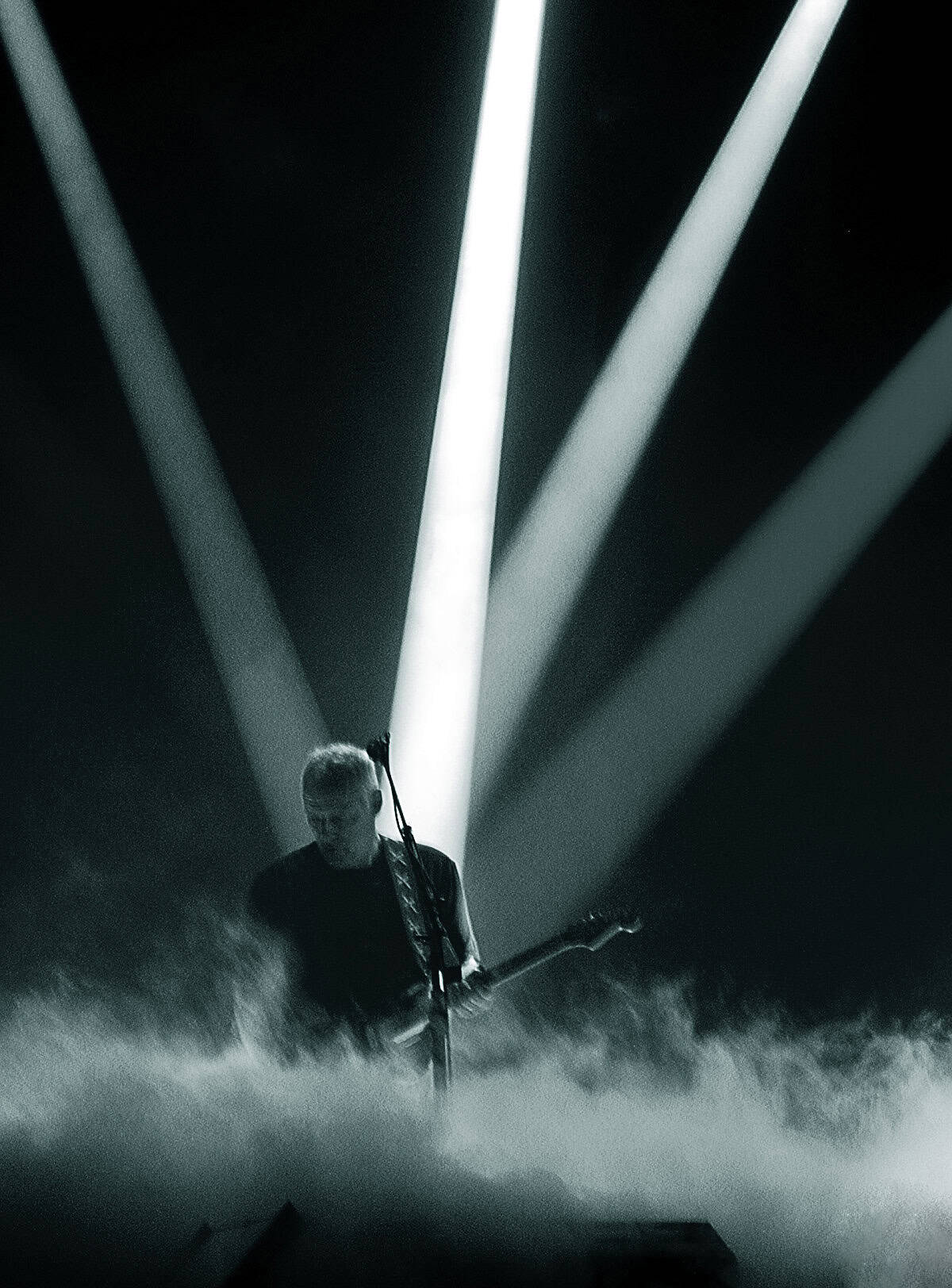
What matters is that The Dark Side of the Moon, Wish You Were Here, Animals, The Wall, The Division Bell are there—immovable, immortal—and that his Black Strat, that black-painted Fender Stratocaster he played for the first time at the Bath Festival in 1970, is perhaps the most recognizable instrument in the history of modern rock.
Eighty years old. And still that voice. Still that touch. Still that rare, extremely rare ability to make you feel—in three seconds of sustained note—that life is worth living.
Happy birthday, Mr. Gilmour. With all the respect and envy in the world.
PS — Today is my mom's birthday too. She's not a famous guitarist; you won't find her name in Rolling Stone. But in her way of being—essential, precise, able to tell you everything with little—I've always sensed something very similar to that sound. Maybe some people are born knowing that the best notes are the ones you choose not to waste.

Digital creative, musician, and storyteller. I explore the intersection of humanity and technology, telling stories of AI, music, and real life. Welcome to my organized mess.”