
Bellum Iustum: when war was at least theoretically just (and today it is no longer)
There was a time when, to wage war, you at least had to have a decent excuse.
I'm not talking about absolute morality. I'm talking about criteria. Rules. Even a certain form of intellectual dignity in horror. The Romans called it bellum iustum —just war—and as much as it may seem like an oxymoron put there on purpose to torment you, it had a precise meaning.
Not today. Today that theoretical construct is a ruin, and what's happening in the world is its systematic denial. But let's proceed in order.
What does it really mean? Bellum Iustum
The expression originated in the Roman world. Cicero coined it, then Augustine revived it, and Thomas Aquinas systematized it in the Middle Ages: the fundamental idea is that not all wars are the same. To be “just,” a war must satisfy at least four conditions:
- Legitimate authority: only those who have the political mandate of an entire community can declare war - not a whim, not a private interest.
- Just cause: one responds to a real injustice, to a suffered aggression, to a violated right — one does not conquer for the sake of gain.
- Right intention: the goal is to restore peace, not to destroy, punish, or take revenge.
- Proportionality in methods (ius in bello): even during conflict there are limits — civilians are not targets, violence is not unlimited.
It's a picture that sounds almost utopian today. But it was at least an attempt to contain human brutality within conceptual boundaries. What has happened in the last thirty years is the exact opposite.
Wars of the 21st Century: Undeclared Aggression
Since 1945, the formal declaration of war has virtually disappeared from the political vocabulary. Today, there are active declarations of war around the world. 56 armed conflicts, the highest number since the Second World War, involving 92 countries and causing over 233,000 victims and 100 million displaced people in 2024 alone.
None of these — I say Nobody —it began with a formal declaration of war in the classical sense of the term. Euphemisms are used: "special military operation" (Russia-Ukraine), "anti-terrorist operation" (dozens of conflicts in Africa and the Middle East), "self-defense operation" (Gaza). Terms that empty the concept of war of its legal and moral weight, making it impossible even to apply the categories of bellum iustum. If there isn't even a declaration, the first criterion—the legitimate authority assuming public responsibility for a choice—has already been eliminated.
The Iraq 2003 case: when the just cause was invented
The most striking case, the one that will remain in history as the most expensive geopolitical lie of the 21st century, is the invasion of Iraq in 2003.
On February 5, 2003, the U.S. Secretary of State Colin Powell He appeared before the UN Security Council and, with a dramatic gesture that has gone down in history, waved a small vial of white powder in front of cameras around the world. It was "proof" of Saddam Hussein's possession of biological weapons of mass destruction: anthrax, mobile laboratories, and clandestine production networks.
It's a shame that none of this existed. The Duelfer report, later published by the American secret services themselves, he dismantled the entire accusatory framework in almost a thousand pages. Powell himself, in 2016, called that presentation at the UN "a permanent stain" on his career. The result? Hundreds of thousands of deaths, a country destabilized for decades, the birth of ISIS as a side effect of the post-invasion chaos. By the criteria of the bellum iustum, that was not a just war. It was a crime.
Ukraine 2022: Europe's Bloodiest "Special Operation"
On February 24, 2022, Russia invaded Ukraine on a large scale. There was no declaration of war. No international authority legitimized it. Just a euphemism conceived overnight and forever etched in history: “special military operation”. As if bombs were falling on Kharkiv or Mariupol to correct a bureaucratic oversight.
Four years later, the toll is devastating and still impossible to measure precisely — neither Russia nor Ukraine have ever communicated data transparently. The most conservative estimates speak of between 500,000 and 600,000 victims between military and civilians, with civilian losses caused by bombings and explosive weapons which in 2025 are increased by 26% compared to the previous year. Criterion of the bellum iustum Violated? All four. No international authority has recognized the cause, no intention of restoring peace, no proportionality in methods—not even the honesty to call it by its name.
Gaza: When Numbers Stop Making Sense
On October 7, 2023, Hamas launched a brutal attack on Israeli soil. Israel responded. So far, even applying the most flexible categories of the bellum iustum, one could discuss a reaction to an attack. The problem is what happened. After.
According to a study published in The Lancet Global Health in February 2026, in the first 16 months of the conflict, 1,000 people died in Gaza over 75,200 people —351 TP3T more than the official figures from the Palestinian Ministry of Health. The figure that should stop us all: 56% of these victims were women, children and elderly people. More than one in two victims was someone who should have had nothing to do with the war. ius in bello — what even in the most archaic doctrine of the bellum iustum It protected noncombatants—it has been reduced to waste paper. If you're looking for the right word for this, international jurists have been searching for it for months.
Iran 2026: When "I've already destroyed you" isn't enough.
This is the most grotesque of all, and it is worth telling it well.
June 2025. Israel and the United States bomb Iranian nuclear sites at Fordow, Natanz and Isfahan in the so-called Twelve Day War. Trump announces to the world a “spectacular military success”Iran's nuclear capabilities have been destroyed. Ceasefire. Victory. Going home.
February 28, 2026 —twenty-four days ago. Same actors, same script: US and Israel launch second surprise attack on Iran. The motivation? Iran was rebuilding the nuclear program we had just "annihilated." The attack hits at least 26 of Iran's 31 provinces, eliminating Supreme Leader Khamenei and dozens of senior officials. Iran responds with missiles on Israel, the United Arab Emirates, and Kuwait. On March 18, Israel strikes the South Pars gas field in the Persian Gulf; Iran attacks Qatar's main LNG facility in retaliation.
In practice: Trump had declared victory over a problem he had not solved, and then used the reappearance of the same problem as justification for another war. It's like demolishing a building and then, when someone starts rebuilding it, bombing it again—each time claiming to have "destroyed it definitively." bellum iustum It would require at least a real, non-circular cause. Still no formal declaration. Still no international warrant. Still the same deaths.
The truth that no one wants to tell: wars are unnecessary
Here we come to the most uncomfortable point. The one no news program says with such clarity.
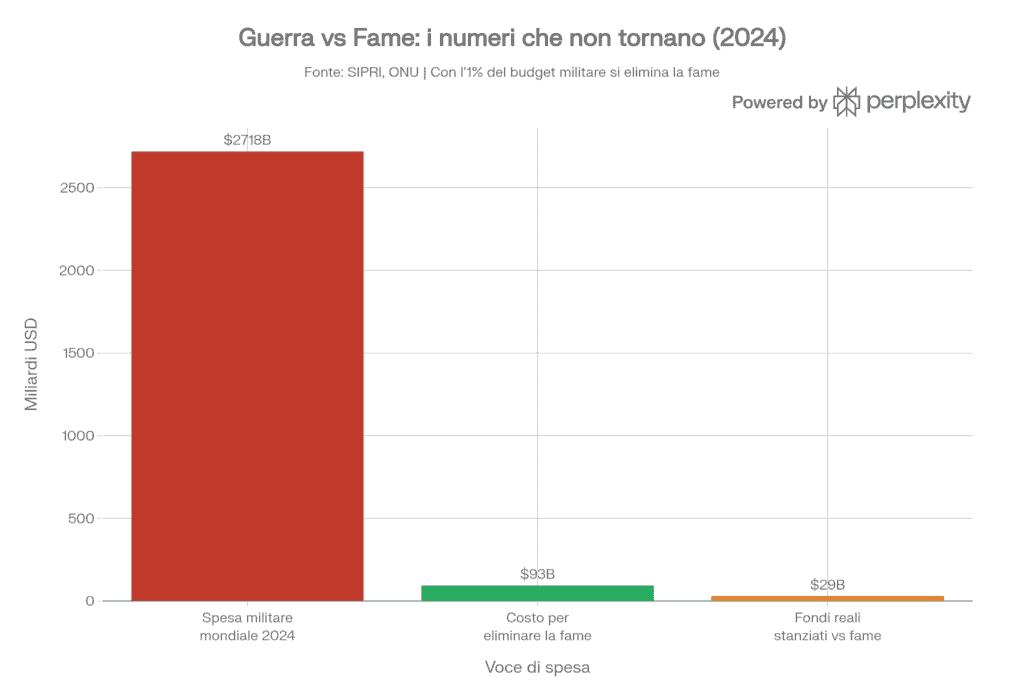
In 2026, World hunger isn't a problem of resources. It's a problem of political choices. The United Nations estimates that to eliminate acute hunger by 2030, approximately $93 billion a year. In 2024, global military spending reached 2.718 billion dollars —the highest level ever recorded in history. Translated: eliminating starvation would cost less than 1% of what the world spends on weapons.
Science, medicine, and agricultural technology have already given us the tools to feed every human being on the planet. There are cures for diseases that kill millions of people every year. Desalination, vertical farming, and food distribution technologies exist that could transform the relationship between humanity and resources. They aren't being used because it's not worth it. Not to those who decide.
Humanity isn't ready. And perhaps it never will be.
We have the data. We have the numbers. We have the documented evidence, the belated confessions, the UN reports, the studies in the world's most authoritative scientific journals.
And yet here we are. In Gaza, the dead are counted in the tens of thousands, more than half of them women and children. In Ukraine, the victims are counted at half a million, without yet having the courage to call them by name. In Iran, something we had already declared destroyed is being bombed for the second time in the same year, like Sisyphus using nuclear bunkers instead of stone.
The question is simple: if after all this humanity continues to tolerate wars, what is it waiting for?
It's not a problem of ignorance. The data is there, it's public, it's verifiable. It's not a problem of resources. Those are there, too. The problem is that we've become experts in only one thing: allow others to decide for us. Governments, lobbyists, generals, bankers—all with a vested interest in keeping the fire burning. And we, there, watching the evening news as if it were a sport.
The "justest war"—that of peoples who refuse to be the fuel for conflicts decided elsewhere—has never been fought. It doesn't make the news. It doesn't sell weapons. It doesn't consolidate power.
The bellum iustum It was medieval, imperfect, and instrumental. But it was at least the idea that violence should serve something greater than private interest. Today, those barriers are no longer there—and it's not as if they were torn down by tyrants. They were left to rot by the indifference of those who had the power to defend them.
Humanity isn't tired enough yet. Or maybe it's already too tired to do the right thing.
One of the two. And in either case, it's not good news.

Digital creative, musician, and storyteller. I explore the intersection of humanity and technology, telling stories of AI, music, and real life. Welcome to my organized mess.”