You don't have children, what do you want to know (and other phrases that only protect those who say them)
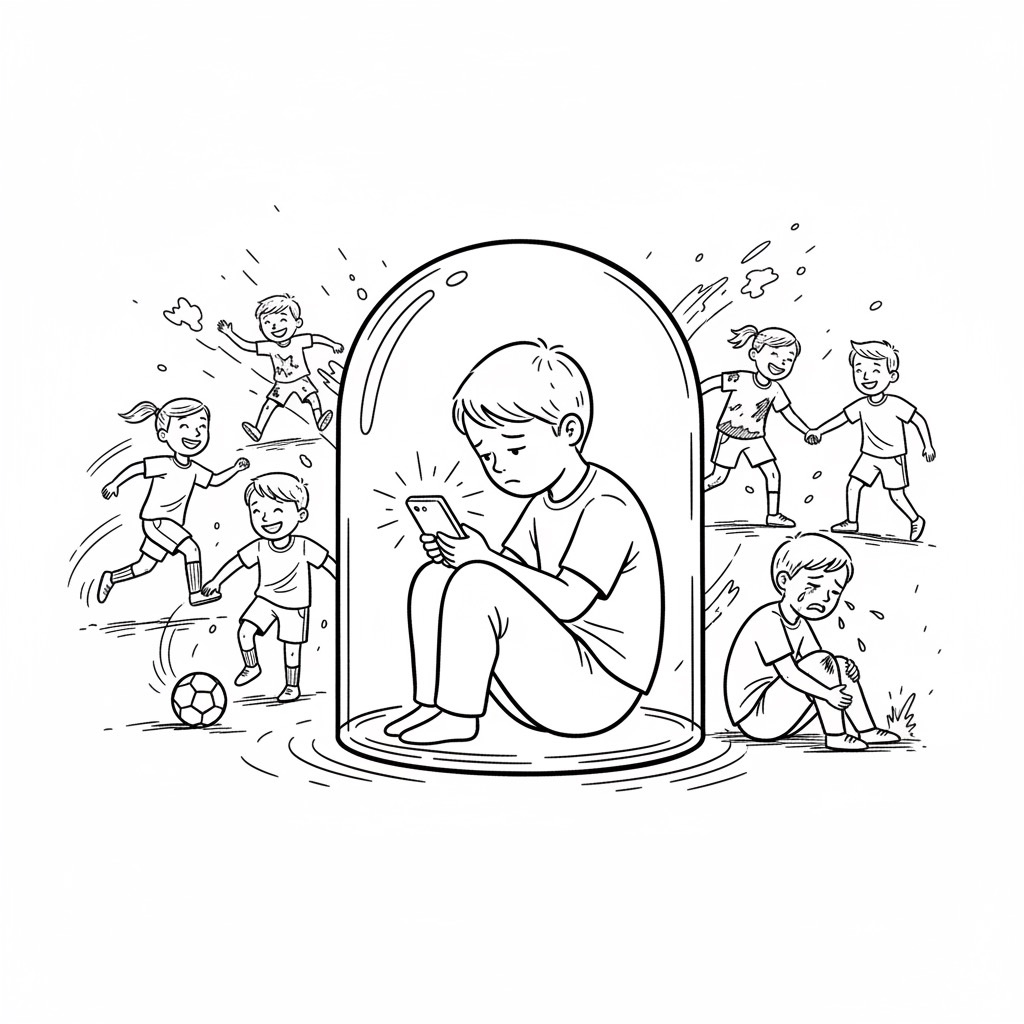
There is a phrase that works like a lock.
You hear it and you immediately understand that it is not a dialogue: it is a shutter lowered under the excuse of prudence.
“You don’t have children, what do you want to know?”
It's true: I don't have children.
Life didn't give me this gift. But it did gift me the privileged position of being an "adult friend" to many young men and women. Someone who's easier to confide in, precisely because he's neither a parent nor a teacher, but someone with whom you share a passion for something.
And I have eyes to see, ears to hear, and something that seems to be bothering me lately: a head trained to think. THINK, don't "think you know"...
And when you truly use reason, a strange thing happens: you can look at things without that emotional tangle that makes everything untouchable. You're not "against" your parents. You're not "against" fear.
You are against the fact that fear disguises itself as love and goes unnoticed.
Why yes: protect it's a noble verb.
But there is a point—thin, invisible—beyond which protecting becomes deny.
Denying a child the right to live.
To take risks.
Of making mistakes.
To learn from your mistakes.
And above all: of to be passionate to something.
Which is the great paradox.
In theory you want it safe.
You're basically leaving him without internal fuel.
If a boy can't get his hands dirty with something that ignites him (music, sports, friendships, a real challenge, a passion that slaps him in the face and then gets him back on his feet), sooner or later he'll look for a spark elsewhere.
And the day will come when he will need to feel alive: to to transgress, to get involved, to prove that you are worth something.
And there life WILL NOT ASK you for permission.
Because someone, sooner or later, will propose “the wrong thing” to him.
And if your child has never had room to make small mistakes—without being humiliated, without always being saved, without being absolved regardless—he risks learning to make big mistakes right away.
Under the glass bell jar you grow clean.
But you don't grow strong.
And then there's another thing that does damage, often along with the bell: the shield.
The “my son can’t be wrong” one.
The one about “it was provoked”.
The one about “you don’t understand what it’s like”.
I understand very well.
He is made like everyone else: confused, fragile, and incredibly powerful.
And it needs two things that today seem almost heretical:
consequences, when he's really wrong
trust, when he really tries
It's not meanness. It's a sentimental education in reality.
Because reality isn't kind.
But it can become beautiful, if one learns to stay within it without imploding at the first impact.
How many times I wish I could say this to those parents who keep their children under a glass bell jar: who defend them even when they're dead wrong, who shield them from everything, even the healthy weight of responsibility.
And no: I'm not talking about "let's leave them alone".
I'm talking about the opposite: guiding them while they take risks.
Stay close without replacing each other.
Be a network, not a cage.
Because loving is not preventing the fall.
To love is to teach how to get back up.

Digital creative, musician, and storyteller. I explore the intersection of humanity and technology, telling stories of AI, music, and real life. Welcome to my organized mess.”