Size S… Inclusive! – The paradox of vanity sizing: when gaining weight saves you money.
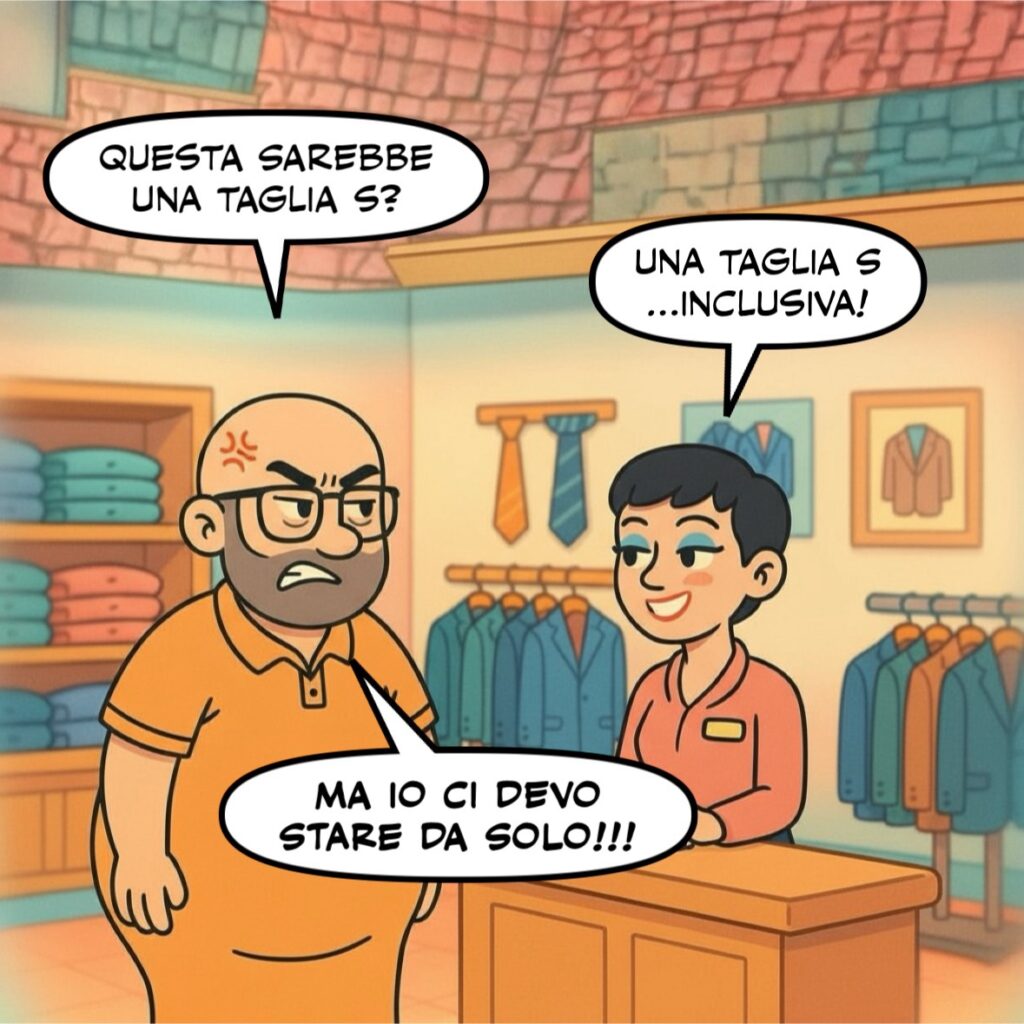
Yesterday I went into a store of a famous clothing chain. I tried on some sweaters in size S and trousers in size 46. I looked at myself in the mirror and felt like I was wearing the Michelin Man. There wasn't an XS, nor a 44. "Ours are inclusive sizes”" the sales assistant tells me...
I mean. It's all there. I don't understand why this sentence struck me at the moment, but thinking about it, it encapsulates an absurd paradox that no one really talks about. Clothing sizes are getting bigger. Period. It's not a perception, it's a fact. And behind it is a marketing strategy so cynical... you almost admire the audacity.
Reality: Sizes have become fiction
Sizes mean nothing today. A size S today is what a M was twenty years ago. A M is what a L was. It's all overused, overblown. The numbers are there to reassure us, but they're completely useless.
And do you know why? Because the average weight of the population has increased. Constantly, inexorably, year after year. And the major clothing chains have simply adapted. But they haven't extended sizes: they've inflated them.
The result? If you're a person with a slender build, like me—and no, I'm not saying it's a good thing personally, it's just an observation—you now have a terrible time finding a dress that doesn't fit you like a burlap sack. You walk into a store, pick out a size S, put it on, and it looks like it was designed for someone else.
It's a dirty game!
Of course, there's a psychological marketing strategy behind all of this that's both brilliant and disgusting.
If you're a heavier person, and you wear a size S or M from a certain brand—when you'd normally wear a L or XL—you feel… better! You look in the mirror and think, "Hey, look, I look good, I'm wearing a size S!" And if a brand has been kind enough to let you feel good about yourself… guess what? You come back to them. You come back, again.
Brands know this. They've calculated it. They sell the feeling, not the clothes. They sell the illusion that wearing that label means something good about you. And it works. Sales increase, brand loyalty increases, everyone is happy.
Except for a few…
The paradox that no one tells you
Those who are fit, who take care of themselves, who—and here we come to the really bitter point—resist the progressive weight gain, now have to spend double. Because they can't find anything in regular stores.
Think about it: where do thin people go to buy clothes that fit them? High-end brands. Boutiques. Specialty stores. Expensive stuff. The market is telling you, subtly: "If you return your body to its natural weight, you can wear whatever clothes you want, but pay double."“
It's a tax on health. Literally. The market financially rewards those who follow the weight curve and penalizes those who resist. This isn't a moral consideration; it's an observation on the absurd economic logic of what we're building.
Inclusivity that excludes
And the best part? The best part is that all this is being passed off as inclusiveness.
“Oh, great! Now we have sizes for everyone!” No, that's not true. Now you have inflated sizes that mean nothing anymore, and in this chaos—guess what—people with truly abnormal bodies continue to be excluded anyway.
Anyone who needs a true, uninflated XL won't find one. Anyone who needs a truly small XS won't find one either. Everyone's confused, everyone's frustrated, and the brand is there smiling.
The truth is, it's not inclusivity: it's a lack of precision disguised as open-mindedness. It's the market saying, "We've decided what the average body is and we've built everything around it. If you don't fit in, it's your problem."“
The body is always a commodity
Ultimately, vanity sizing is just further proof that the market doesn't sell products. It sells stories. It sells the narrative that wearing that stuff will make you feel good about yourself. And while it plays with labels, the rest of us—anyone with a real body, whatever that body may be—pays the price.
Those who are bigger still feel excluded. Those who are thinner continue to pay more. The only truly inclusive size? Frustration. And it's free for everyone.

Digital creative, musician, and storyteller. I explore the intersection of humanity and technology, telling stories of AI, music, and real life. Welcome to my organized mess.”