The point of a hobby is to do it
Or: why Zuckerberg & Co. don't know how to live
There's a subtle paradox, and a touch of comedy, in the latest wave of promotions from tech giants. They present us with intelligent "agents," autonomous software like Meta's Muse or Open AI's very recent Dots, promising to finally free us from the tyranny of small daily chores. They'll book our flights, do our online shopping for us, sign our kids up for basketball tournaments while we sip a drink at a party. Life, as we know, is what happens in the intervals between one commission and another, and must be protected from commissions at all costs.
The underlying assumption is clear: every minute of the day spent doing something practical is wasted time. An annoying friction to be smoothed away with a line of code.
These are people who have turned the lives of others into a product and their own into a case study. It's easy to dismiss spending as a design flaw in life when you're wealthy enough not to have done it long ago.
Unfortunately, the premise is a colossal lie: that human beings have industrial efficiency as their ultimate goal. As if at birth, together with the certificate, they gave us a KPI.
We are not machines designed to maximize personal productivity. We want to be intrigued, engaged, entertained. We want to touch things. When I plan a trip, hunting for a train connection, discovering an unfamiliar alley on a crumpled map, choosing the right room are already the journey. Delegating everything to a aseptic algorithm It's like swallowing a vitamin pill instead of sitting down to a plate of tagliatelle with meat sauce that's been simmering for four hours. Technically, you're feeding yourself. You're basically not eating.
Recipe for efficiency (ingredients: zero time, zero taste)
The short circuit becomes almost hilarious when optimization breaks down at home. A few months ago, Mark Zuckerberg outlined his vision: artificial intelligences that don't just buy notebooks for school, but even suggest "personalized recipes" for his daughter to try. We're talking, remember, about a man who spent billions to convince us to spend our free time in a virtual room, inside an avatar that, for a while, didn't even have legs. It's no surprise that a cake with his daughter seems like a logistical problem to be outsourced.
Personalized recipes. To make a cake with your daughter. Let's reread it slowly.
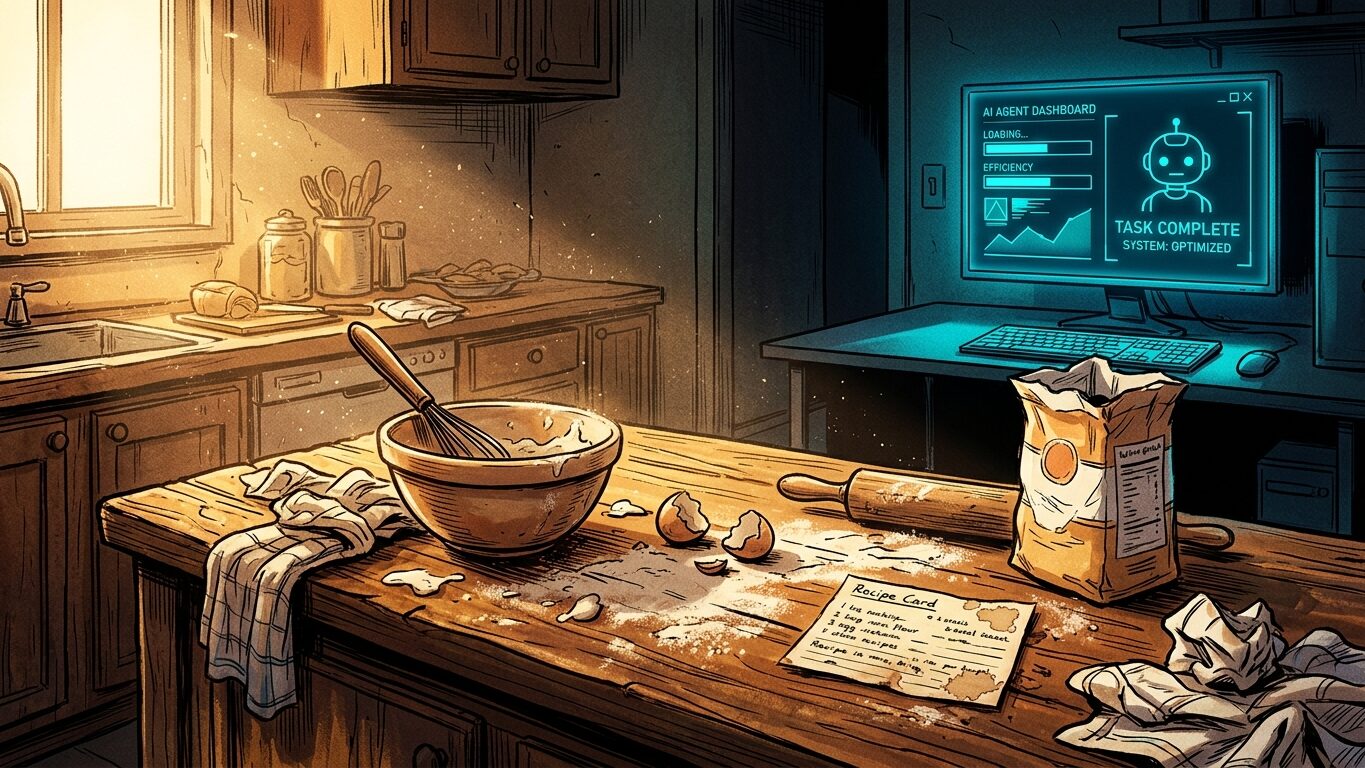
Baking a cake with a child is perhaps the messiest, most imperfect, and wonderful act in existence. The beauty lies in the badly cracked eggs, the shells accidentally falling into the bowl, the fingers covered in sugar and flour, the laughter over a dough that turned out too runny, and a kitchen that looks like it's just exploded. Why on earth would I ask an artificial assistant to calculate the perfect nutritional profile and portion sizes—that is, to eliminate the unexpected, which is precisely why we make cakes?
The editorial staff is right The Verge when he states, without too many mincing words, that Zuckerberg simply doesn't know how to live: the point of a hobby is to do it. It took an editorial team to say this, but maybe it's also a company problem: when every person you talk to is paid or listed on the stock exchange to agree with you, the question «"But what's the point?"» stops reaching you.
Remove the effort, the personal choice, the failed attempt, and the whiff of experience, and you're left with an empty shell: a hobby without a hobby. Silicon engineering continues to mistake the end result for the process that gives it value. It's like climbing to the top of a mountain in a helicopter and complaining that the view is less thrilling than expected.
The illusion of being able to fix everything
In 2018, sociologist Zeynep Tufekci wrote about New York Times A shocking truth: tech moguls are deeply convinced they can fix every aspect of human existence, and they're genuinely disconcerted when the real world doesn't welcome them with stadium-level cheers. The real world, that uncooperative environment that can't be patched or optimized, even by those with the capital to try.
The engineering mindset has a fundamental flaw: it sees everything as a problem to be solved. If a process takes twenty minutes, reducing it to three seconds is an objective victory. In real life, however, eliminating friction means eliminating enjoyment.
And what do we do with all this saved time? We already know the answer, and it suits them first and foremost: the hours freed up from practical tasks are promptly sucked into a feed, watching short, insipid videos designed to keep us glued to a screen, which is exactly the product these people sell. They take away the pleasure of choosing a shirt by touching the fabric or browsing a catalog, to give you twenty more minutes of digital lethargy. They free us from time to sell it back to us in pieces. A bargain for them.
Defending the “effort” of living
There is a silent form of resistance to be rediscovered: the right to waste time on the things we enjoy.
We reclaim the joy of comparing two routes for hours before getting on a motorbike — yes, even if the navigator has already decided for us —, the patience to tune a guitar by ear without an app that calculates the hundredth of a tone, the pleasure of walking into a store and letting yourself be guided by curiosity rather than the predictive algorithm of the agent on duty, who in the meantime has already decided that you need another charger.
Efficiency is fine for shipping a container across the ocean or keeping an accounting file in order. Let's leave it there, among warehouses and offices, to be admired. Real life requires dust, crooked attempts, disorder, and slowness.
Some say the future is in these people's hands. Maybe so. But the present, fortunately, is still in our hands, and for now we mostly need it for tuning a guitar.
I look for beauty, everywhere. And if someone tries to delegate it to an algorithm to save me five minutes, I'd rather roll up my sleeves and do it myself. With badly cracked eggs, of course.

Digital creative, musician, and storyteller. I explore the intersection of humanity and technology, telling stories of AI, music, and real life. Welcome to my organized mess.”