The famous tongue didn't say it! But it could have!
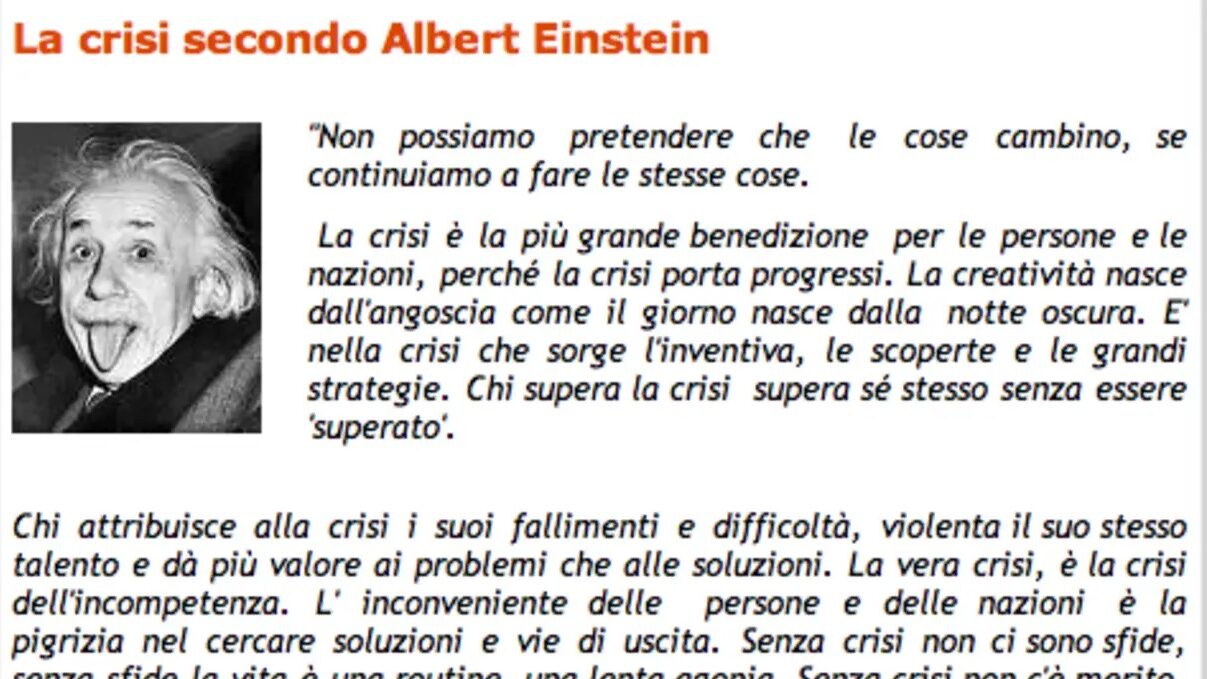
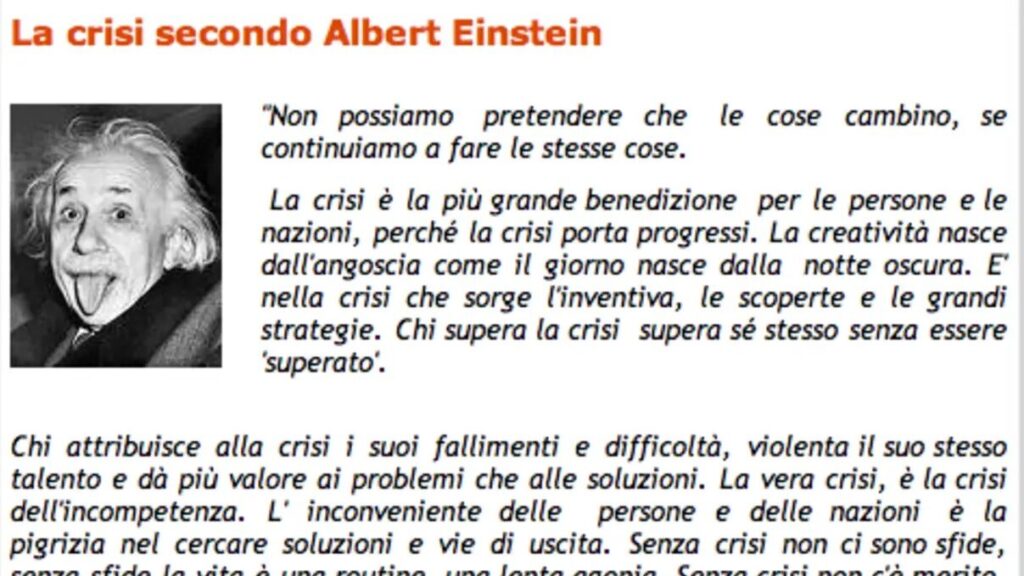
Yesterday, while I was in a customer's waiting room, my eye fell on a small painting hanging on the wall, with the unmistakable image of Albert Einstein and his tongue sticking out. I leaned closer to read the text around the photo:
«We can't expect things to change if we keep doing the same things.
Crisis is the greatest blessing for people and nations, because crisis brings progress. Creativity is born from anguish as day is born from dark night. It is in crisis that inventiveness, discoveries, and grand strategies arise. Those who overcome crisis surpass themselves without being "surpassed.".
Those who blame their failures and difficulties on the crisis abuse their own talent and value problems more than solutions. The real crisis is the crisis of incompetence. The problem of people and nations is their laziness in seeking solutions and ways out. Without crisis, there are no challenges; without challenges, life is routine, a slow agony. Without crisis, there is no merit. It is in crisis that the best in each person emerges, because without crisis, all winds are but gentle breezes. Talking about crisis only increases it, and remaining silent during the crisis is glorifying conformism. Instead, let's work hard. Let's put an end once and for all to the only dangerous crisis, which is the tragedy of not wanting to fight to overcome it.»
— Albert Einstein
It has been circulating on digital message boards for years, with the same punctuality of a relative who sends you a message every morning “Good morning ☀️🙏” on WhatsApp. Accompanied, invariably, by that iconic black and white photograph in which Einstein shows the language to the whole world, as if to say: «"Look what I have to hear attributed to me forever"’. A rhythmic, emphatic text, a secular manifesto that celebrates the crisis as a blessing, a forge of ingenuity, a spark for reinvention. All seasoned with the unmistakable agenda-setting prose of a life coach which sells courses from 497 euros plus VAT.
There's just one small detail, one of those that ruins the party: Albert Einstein never wrote or uttered these lines. Not even in a whisper, not even after one drink too many.
Anatomy of an illustrious frontman
Philological verification leaves little room for doubt, and even less room for embarrassment for those who continue to share it undauntedly. Anyone who tries to skim the 1934 essay My World Picture (The world as I see it), cited almost everywhere as a primary source—usually by those who have never opened it—encounters a completely different scenario. In those pages, the physicist analyzed the rubble of the Great Depression. of '29 talking about working hours, technological unemployment, wages and purchasing power. Pretty boring stuff, basically: no lyrical flight, no crescendo from a motivational commercial like «"Creativity is born from anguish as day is born from dark night."». Einstein, you know, he preferred equations toinspirational posts.
Even the dazzling incipit («"We can't expect things to change if we keep doing the same things."») belongs to the vast and highly honoured lineage of the apocryphal aphorisms. That kind of extended family where all the catchy phrases that have been left without a father willing to sign them end up. The official archives of the Hebrew University of Jerusalem and Alice Calaprice's research categorically exclude its authorship. They trace its first cries to self-help pamphlets from the early 1980s—the paper equivalent, so to speak, of reel motivational songs today, only with less background music. The entire song that is so popular now appeared online in Spanish between 2001 and 2008, in the context of motivational literature and coaching corporate, to then be translated, forcibly pasted onto the face of the most famous scientist in history and sent in one glorious leap towards virality. A small masterpiece of quotation recycling, with Einstein in the role, completely unaware, of involuntary guarantor.
The need for a notary stamp to think
Once the author's trick is exposed, however, something strange happens - and slightly uncomfortable for those who love clear-cut endings: the value of thought remains intact. What a drag.
We're often tempted to demand a notary's stamp to validate what we already feel, as if a thought only has the right signature at the bottom. We seek academic authority to reassure us, as if we needed the signature of a Nobel Prize winner to authorize us to face difficulties and start over. Clearly, common sense alone is never enough to convince us of anything.
The authentic strength of this text, stripped of its counterfeit label, lies entirely in its ability to give a constructive meaning to the’friction. When established habits are shattered, the urge to awaken dormant energies and invent new directions arises. There's a profound dignity in considering the obstacle as a testing ground for one's ingenuity, rejecting the comfort of excuses or passive surrender—even if, it must be said, excuses remain a much cheaper and decidedly more restful option.
Who wins the bet in the end?
The intuition that ingenuity flourishes precisely where certainties evaporate becomes even more true knowing that it arises from the sensitivity of those who experience ordinary challenges, elbow to elbow with the daily mess. Not from the pen of a physicist sitting comfortably at Princeton.
Perhaps Einstein stuck out that big mouth precisely because he foresaw all this: our perennial hunger for illustrious fathers to whom we can delegate our faith in the future, just so we don't have to believe in it ourselves. If an idea lights a fire and gets our arms moving again, he has already won his bet, regardless of the surname printed at the bottom - and above all regardless of how many like he picked up on the street.

Digital creative, musician, and storyteller. I explore the intersection of humanity and technology, telling stories of AI, music, and real life. Welcome to my organized mess.”