
Head or heart? Reason or instinct? The useless (and dangerous) dilemma.
It's all Pascal's fault
It's all everyone's fault Pascal. And a fundamentally sensible phrase of his, but probably expressed under the influence of some substance: “the heart has its reasons that reason does not know”. From then on, entire generations have brandished this maxim as a universal pass to turn off their brains whenever it was convenient.
Then Susanna Tamaro got involved and the mess was complete. “Go where your heart takes you’ it has become the official mantra of anyone who wishes to justify a wicked choice with the excuse that “he felt it inside”. It is a pity that the heart, from a purely anatomical point of view, is a hydraulic pump who has never made a decision in his life.
The brain always makes decisions, for better or worse. It just sometimes relies on the emotional circuit, sometimes on the rational one, and in most cases—when things are working properly—it activates both in unison.
For as long as I can remember, I've been entangled in this discussion. There's always someone, at a bar counter, at a dinner party, or on social media, ready to explain to you with an enlightened air that “the head deceives, the heart doesn't”. Only to then realize, after years of debate, a basic truth: anyone who staunchly defends one side or the other is making the exact same mistake. He's using his brain halfway.
The myth of the infallible heart
Let's start from an inconvenient fact for the supporters of the “pure feeling”: the heart never tells the truth, simply because it does not speak. What we call “feeling” is actually a lightning-fast processing performed by the brain through archaic circuits—the limbic system, the amygdala—programmed to make us react instantly to a threat, not to choose a life partner or a professional trajectory.
These circuits are formidable when you have to determine in a fraction of a second whether a noise in the shadows is a broken branch or a hungry predator. They become quite disastrous when used to abandon a stable job and “chase the passion” without having done some basic calculations. In that case, the emotion isn't whispering a cosmic truth: it's screaming “I want this, now”, with the same maturity of a three-year-old in front of the candy shelf.
Studies on the so-called System 1, the rapid and intuitive thinking encoded by Daniel Kahneman, highlight how this method is full of useful shortcuts but also of systematic errors, the famous cognitive biases. Instinct is not a mystical revelation: it is statistics applied quickly, calculated automatically without our knowledge.
The myth of pure (and cold) reason
That said, before the hardcore rationalists pop the champagne: even isolated reason isn't doing so well. The illusion of a cold, sterile mind, capable of weighing every crossroads of existence on an Excel spreadsheet of pros and cons, is another myth to be dispelled. And thankfully so, otherwise we'd turn into hyper-efficient sociopaths.
The most emblematic example of modern neurobiology comes from the patients analyzed by Antonio Damasio: individuals with lesions in the brain areas that connect logic and emotion. People with perfectly intact cognition, memory, and language skills, but completely incapable of making basic decisions—even choosing what to order for lunch—due to the lack of an emotional cue that would value the alternatives. Without emotion to provide weight, color, and urgency, pure reason spins in an infinite loop.
A rationality completely disconnected from feeling doesn't guarantee better decisions; it produces lucid and inhuman calculations. In the worst-case scenario, it creates individuals capable of arguing any atrocity with unassailable logic. Let's face it: hyper-pure reasoning, devoid of any empathetic restraint, would end up landing us all in jail.
Two speeds, one brain
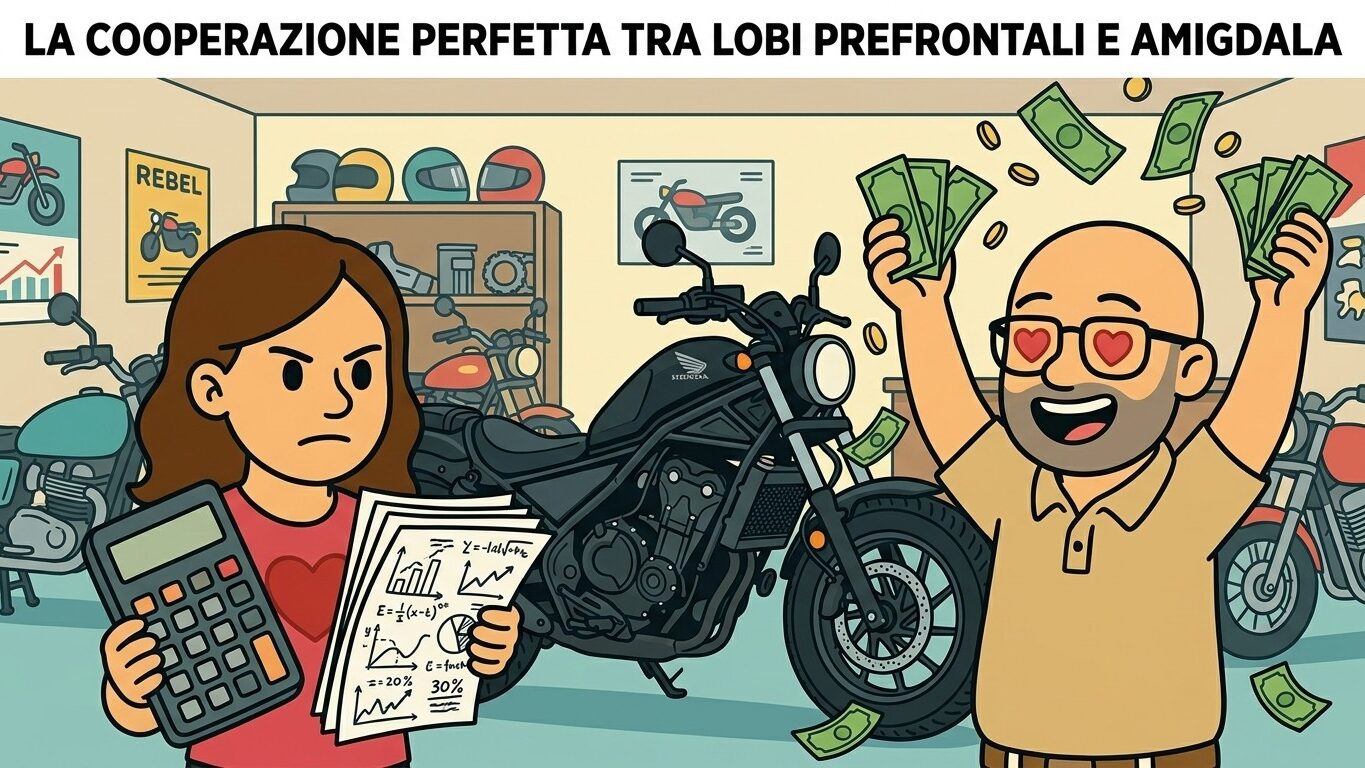
Reason and emotion are not two rival entities locked in an internal control room, arguing. They are two integrated systems, with distinct operating speeds, hardwired within the same neural architecture. The network connecting the prefrontal cortex (the seat of analysis) to the amygdala (the emotional center) is their physical connection.
When an external stimulus arrives—a provocation, a knowing look, a passive-aggressive email from the office—the brain processes it on two parallel tracks:
- The quick and visceral way: generates an instant emotional reaction.
- The slow and conscious path: evaluates the context, weighs the consequences and decides how to modulate that first reaction.
The fast path constantly sends signals to the slow path. This means that whatever thought we believe to be "rational" is already imbued with an emotional undertone. The idea of immaculate, sterile logic is pure science fiction.
He who uses his brain halfway (and boasts about it)
Here's the crux of the matter: both the fanatics of pure instinct and the priests of blind logic reject half the toolbox at their disposal, exhibiting the same calm arrogance.
- He who despises reason Often, he does so to avoid the effort: training his logic, recognizing his own fallacies, and verifying the facts requires effort and imposes the risk of admitting he's wrong. It's much quicker to hide behind a comfortable “I feel it”.
- He who despises emotions, on the contrary, often runs away from one's own vulnerability: it is more reassuring to hide behind formulas and tables than to admit fear, passion, pain, or uncertainty.
At both extremes, giving up half of one's mental potential is laziness masquerading as a philosophy of life.
The ongoing dialogue
The concrete solution lies in a constant and collaborative dialogue between the two decision-making hemispheres, where neither assumes tyrannical control.
- Emotions indicate what matters to us: Fear signals a boundary or a risk, anger highlights an injustice, enthusiasm charts a course toward an opportunity worth exploring. Ignoring them turns them into undercurrents that continue to maneuver us from the shadows.
- Reason questions those emotions: check whether the reaction is proportionate to the facts, whether it reflects the present or whether it is the conditioned reflex of an old scar from the past.
Scholars of the so-called somatic marker They have extensively demonstrated that integrating emotional memories and logical processing is the true secret to effective decisions. Knowing how to choose means listening to your instincts, critically examining them, and allowing both components to forge a solid synthesis.
Train your mind without freezing your heart
Training your mind doesn't mean stifling your emotions; educating your sensitivity doesn't mean disconnecting your critical judgment. These are two complementary muscles that require daily exercise.
- Train your head It means unmasking your own mental traps, checking information at its root, separating facts from narratives, and embracing the possibility of changing your mind.
- Educating the heart It means giving an authentic name to impulses, understanding their origins and giving them the right space without transforming them into the sole arbiters of our path.
Those who learn to make them cooperate cease to experience a fictitious rift. Head and heart have never been enemies: they are two climbing partners, separated only by an old tavern debate, perhaps sparked by a French philosopher on a rainy day.

Digital creative, musician, and storyteller. I explore the intersection of humanity and technology, telling stories of AI, music, and real life. Welcome to my organized mess.”


Solid write-up — learned a lot. Worth trying H3MaxAI — for 5–15s H3 Max clips. H3MaxAI