“Have you ever thought about writing a book?” (But I don't know you!)
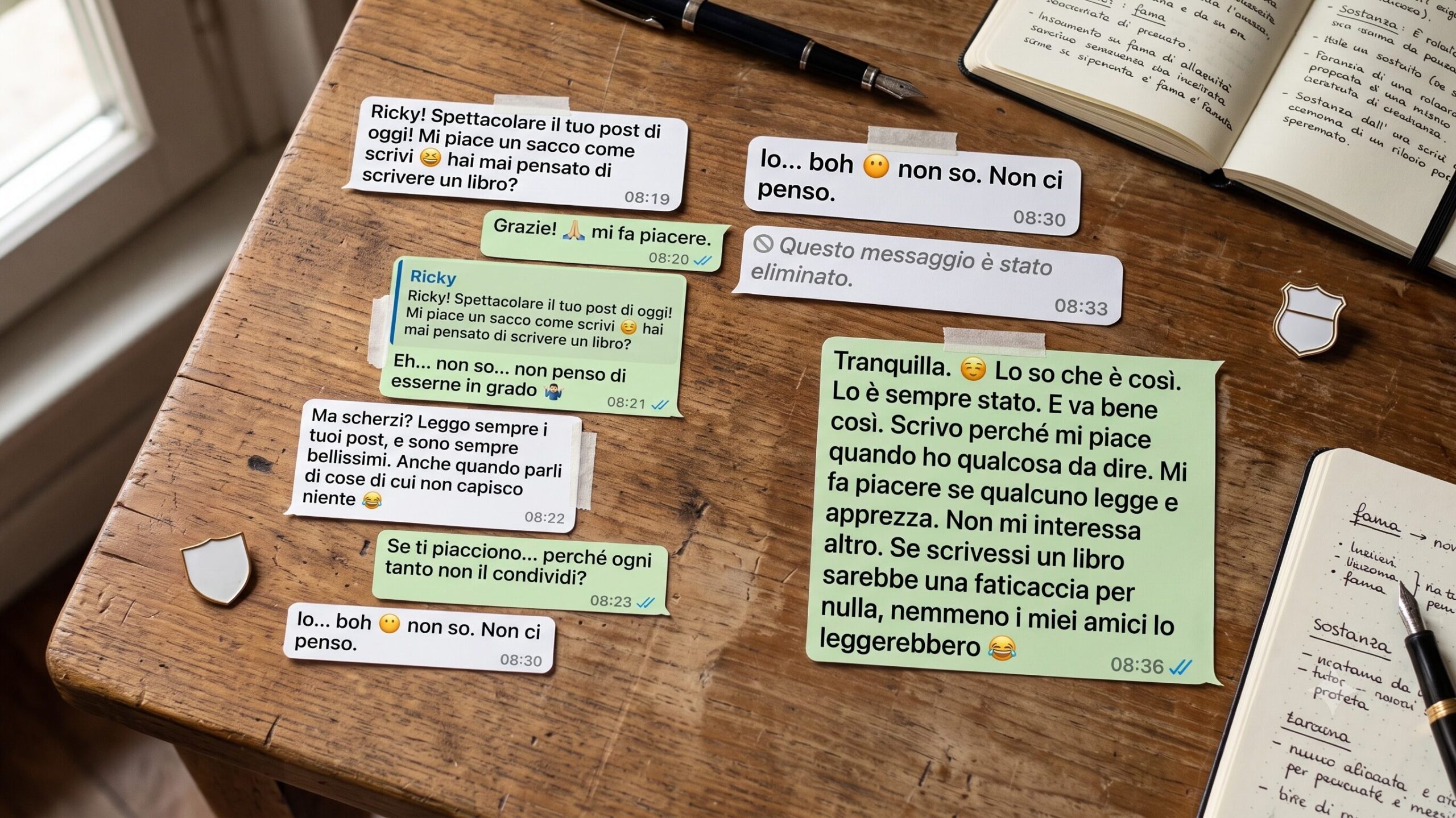
A couple of days ago, I received one of those private messages that make me smile. A blog reader wrote: «"Your post today is amazing! I really like your writing. Have you ever thought about writing a book?"».
I feel a genuine warmth, and I respond with thanks. Then a question slips out, perhaps a bit risky, and certainly undiplomatic for digital etiquette: «"If you like them… why don't you share them every now and then?"».
Pause. Three dots suspended in the chat bubble. The reply arrived promptly, disarming in its merciless authenticity: «"I... I don't know. I don't think about it."».
The conversation ended there, with a laugh and a joke about how even if I wrote a book, not even my friends would read it. No drama, mind you. It's a daily scene, almost comical in its recurrence. Yet it carries with it a fascinating psychological mechanism.
The lapel pin and the fear of free thought
This story reminded me of an episode from a few years ago. Below is a rather detailed reflection posted on Facebook, a user left a memorable comment: «"But why are you writing? You're not famous!"».
In that seemingly absurd statement there was already an entire x-ray of modern fruition.
When a person reshares a quote from a great author, a marketing guru, or a famous person, they are making a specific gesture: buy a pin to pin on your jacket. Tells your network: «"Look how cultured, intelligent or profound I am, because I reflect myself in this recognized authority."». The famous brand acts as a shield. If the quote is criticized, the responsibility falls on the giant that uttered it.
Instead, share the thoughts of an ordinary person — Ricky's post, an article by a independent blog, The reasoning of an acquaintance—requires an act of individual responsibility. It means putting your face on the line, exposing yourself, supporting that idea without the support of a million followers. Faced with this step, the vast majority are stumped. The substance is enjoyed and appreciated in private; in public, only the blue stamp is displayed.
“"Why are we more willing to share a quote from a guru than the thoughts of an ordinary person? Because a famous brand acts as a shield, while the ordinary person does not."”
The price of doing too much (and trying to do it well)
Over the past twenty-five years, I've periodically been told what I "should" have done with my life. The list is varied:
- The singer
- The musician
- The journalist
- The writer
- The screenwriter
- The photographer
- The psychologist
- The life coach
…the only thing missing is the Astronaut!
The explanation is simple: the visceral passion it leads to taking care of what you do down to the smallest details, conveying an idea of almost professional competence. The trap lies in eclecticism.
The modern content ecosystem rewards the banal, one-dimensional. It demands easy-to-label figures, quick recipes, pills that can be chewed in three seconds while waiting for the bus. Multifaceted curiosity, time-consuming writing, and the overlapping of different languages are indigestible for the rigid boxes with which the public (and the algorithm) reorganize the world.
The silent victory of the private message
All things considered, the matter is less bitter than it seems.
The illusion that quality equates to virality belongs to those who view the internet as a perpetual arena. Reality tells a different story: real impact often occurs far from the spotlight.
A private message sent at eight in the morning by someone who has read, reflected, and felt an authentic emotion has a specific weight immensely greater than a hundred distracted reshares, made simply to fill an Instagram story.
I keep writing on my blog For the unwavering passion for shaping thoughts, creating beauty, sparking a spark. Asking the masses to be a sounding board for unconventional content is an unrealistic expectation. Those seeking brand recognition will continue to share the same old gurus; those seeking substance will continue to find it, perhaps silently, in a private chat.
That's fine. Ultimately, the meaning of what we create lies in the depth of the footprint that we leave, not in the number of people who trample on it.

Digital creative, musician, and storyteller. I explore the intersection of humanity and technology, telling stories of AI, music, and real life. Welcome to my organized mess.”